As Seeker smartphones are delivered on a massive scale globally, the importance of SKR is reflected in its attribute as a vehicle for “Real Yield”—currently, over 40% of the circulating supply is locked in staking contracts, yielding an initial annual percentage yield (APY) of up to 24%. Driven by the Season 2 incentive program, staking SKR is not only the core indicator for obtaining future airdrop weight but also a key metric for measuring the activity and capital efficiency of the Solana mobile ecosystem.
SKR has successfully disrupted the centralized profit-sharing model of the traditional smartphone market. This token value model, supported by physical terminals, not only provides a zero-fee competitive advantage for the decentralized app store but also offers a paradigm for how large-scale mobile nodes will participate in global collaboration and reshape digital production relations in the future.
Seeker Tokenomics
SKR is the native token of the Seeker ecosystem, with a total supply of 10 billion. It serves as the core vehicle for economic incentives, payment mediation, and governance tools within the ecosystem. SKR utilizes a linear inflation model, starting with a 10% inflation rate in the first year and gradually decaying to 2% by the sixth year, designed to incentivize early participation and long-term holding.
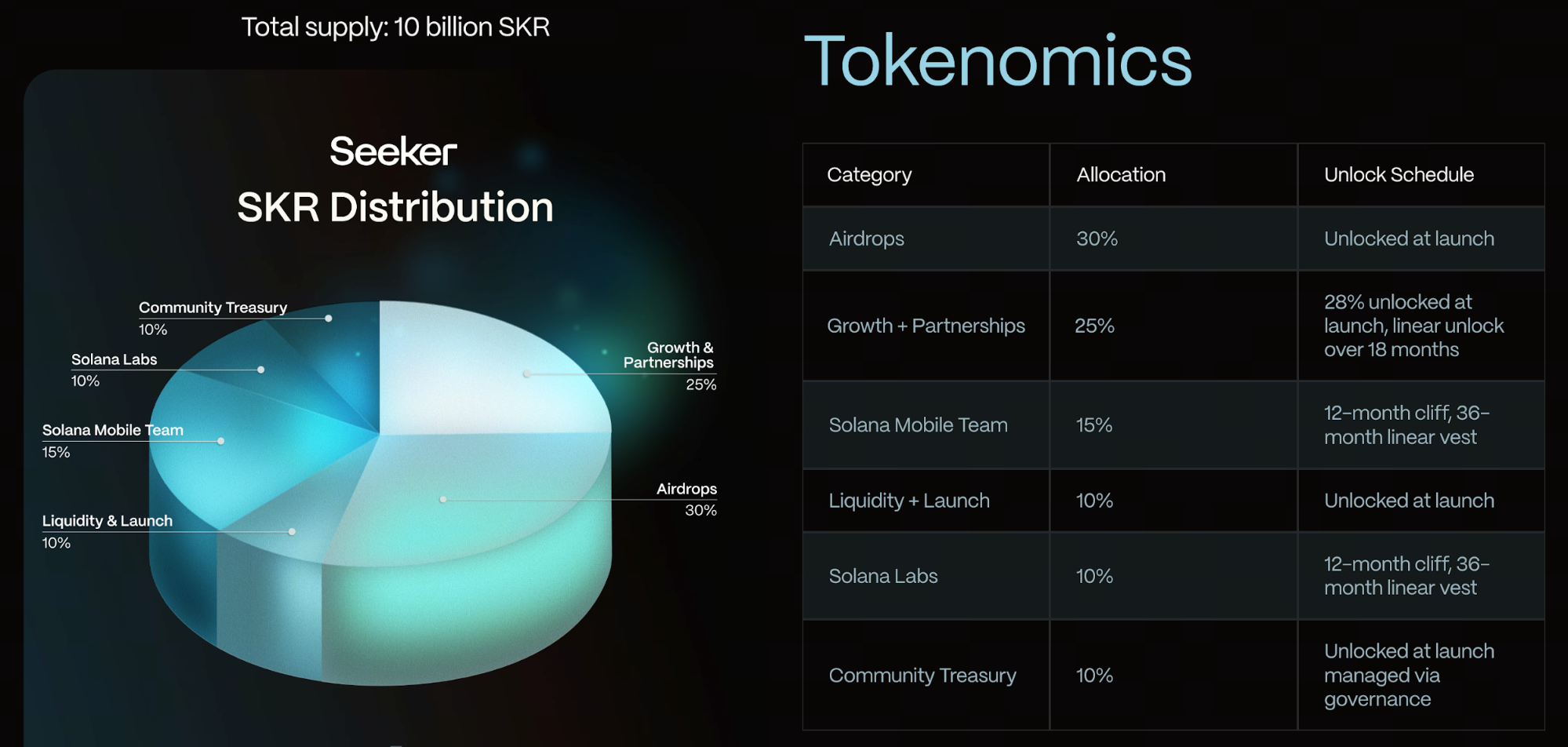
SKR’s distribution strategy is strongly community and user oriented, with relatively high transparency compared to many other projects. The allocation structure is as follows:
- Airdrop allocation: 30% (unlocked at launch)
- Growth and partners: 25% (28% unlocked at launch, the remainder unlocked linearly over 18 months)
- Team allocation: 15% (locked for the first year, then unlocked linearly over the following 36 months)
- Liquidity and launch: 10% (unlocked at launch)
- Solana Labs: 10% (locked for the first year, then unlocked linearly over the following 36 months)
- Community treasury: 10% (unlocked at launch and managed through governance)
Token Use Cases and Scenarios
SKR has multiple practical use cases within the Seeker ecosystem, including payment and spending with SKR, staking and ecosystem rewards, and access to exclusive benefits provided by partners. Its utility goes far beyond that of a purely investment focused token.
Core Payment and Spending Scenarios
- Hardware device purchases: Paying with SKR provides a 50% discount on the Seeker phone (original price around $500, approximately $250 equivalent when paying with SKR).
- dApp store spending: Purchasing applications, services, or content within the Solana dApp store.
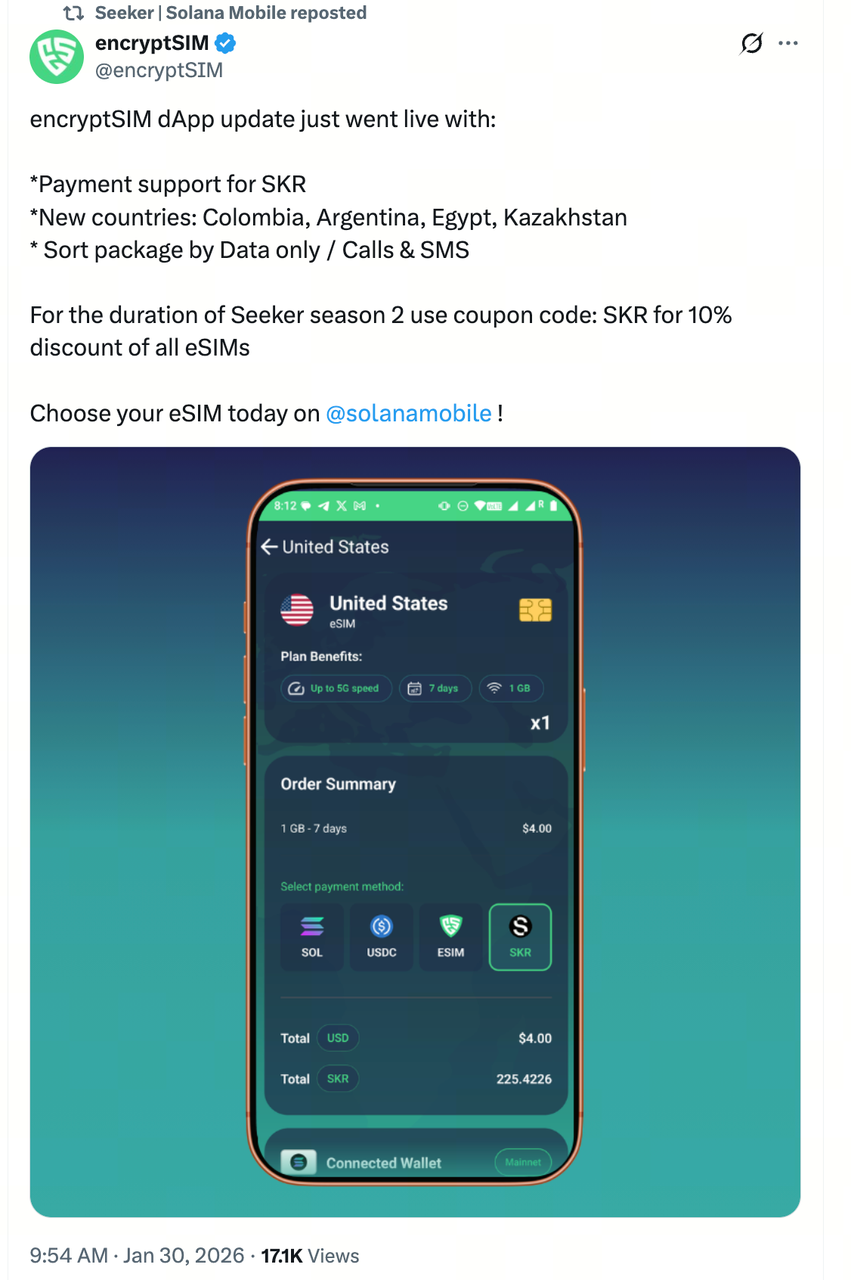
- Ecosystem service payments: For example, using encryptSIM to pay eSIM data fees with SKR provides a 10% discount.
Benefits and Yield Scenarios
- Staking rewards: SKR staking is currently live, with the latest APY at 20.6%.
- Ecosystem rewards: Users can earn SKR airdrops by participating in Seeker Season activities. During Season 1, a total of 1.819 billion SKR was distributed, with 100,908 users receiving varying amounts of SKR.
- Governance voting: In the future, SKR may be used to vote on proposals related to ecosystem development.
Integrated Partner Incentive Campaigns
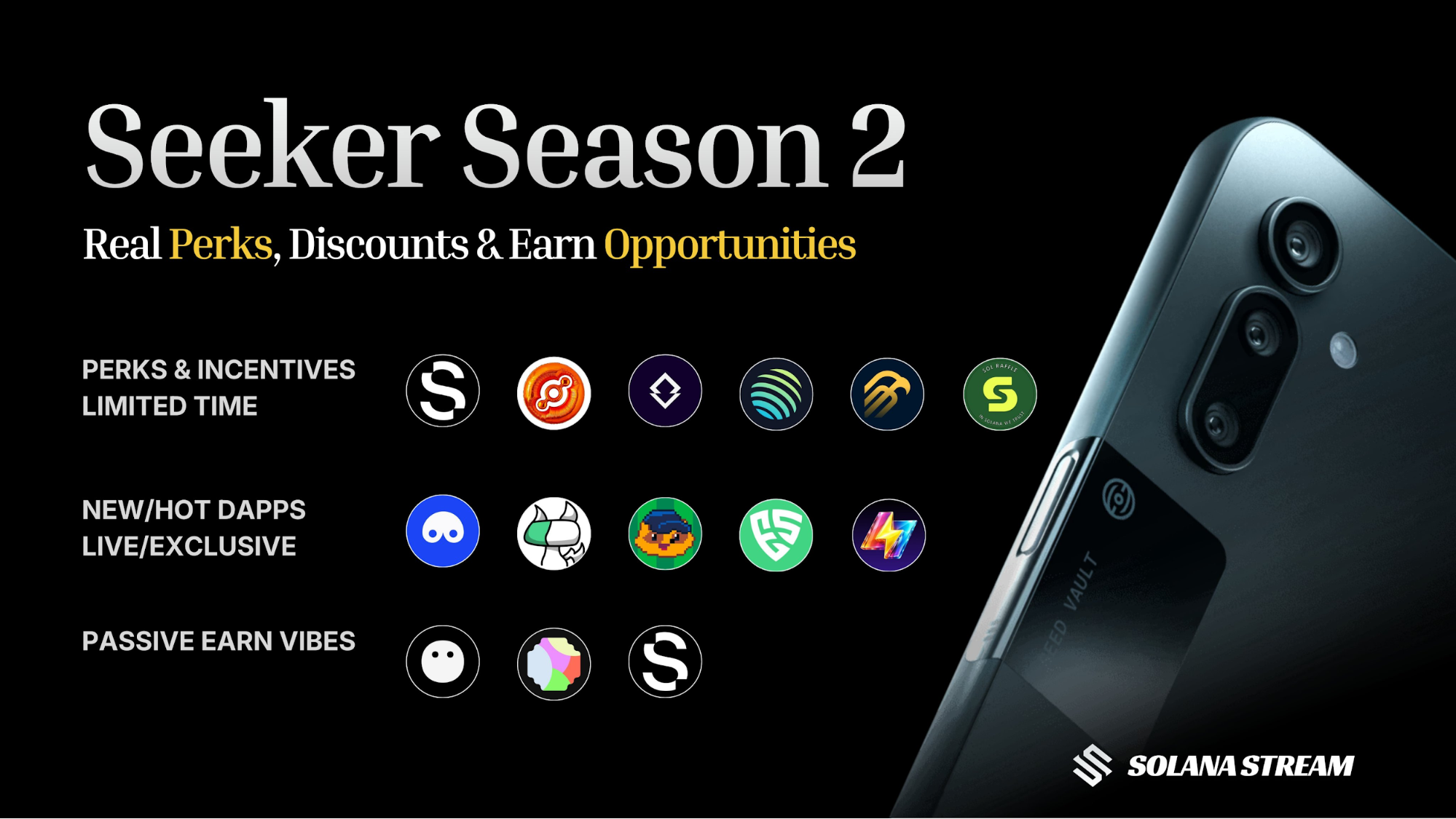
During Seeker Season 2, users can participate in multiple SKR related incentive activities:
- Jupiter Exchange: Trading with the Seeker wallet provides chances to enter a lottery to win a Seeker phone.
- Hubra App: Ten Seeker users who download and use raSOL will be selected to share a total of 50,000 SKR tokens equally.
- Sol Raffle: The “Wager Pack” lottery event features a prize pool of 100,000 SKR.
SKR Staking
In January 2026, SKR officially launched staking functionality. The workflow is as follows:
- Select a guardian and delegate SKR to that guardian.
- Earn rewards by securing the network. According to the latest information as of February 11, the current staking APY is 20.7%.
- If you wish to unlock tokens, the unbonding period is 48 hours.
On January 30, Solana Mobile stated that since the token generation event, more than 1.8 billion SKR has been distributed to nearly 72,000 wallets, with over 40% of claimed SKR already staked.
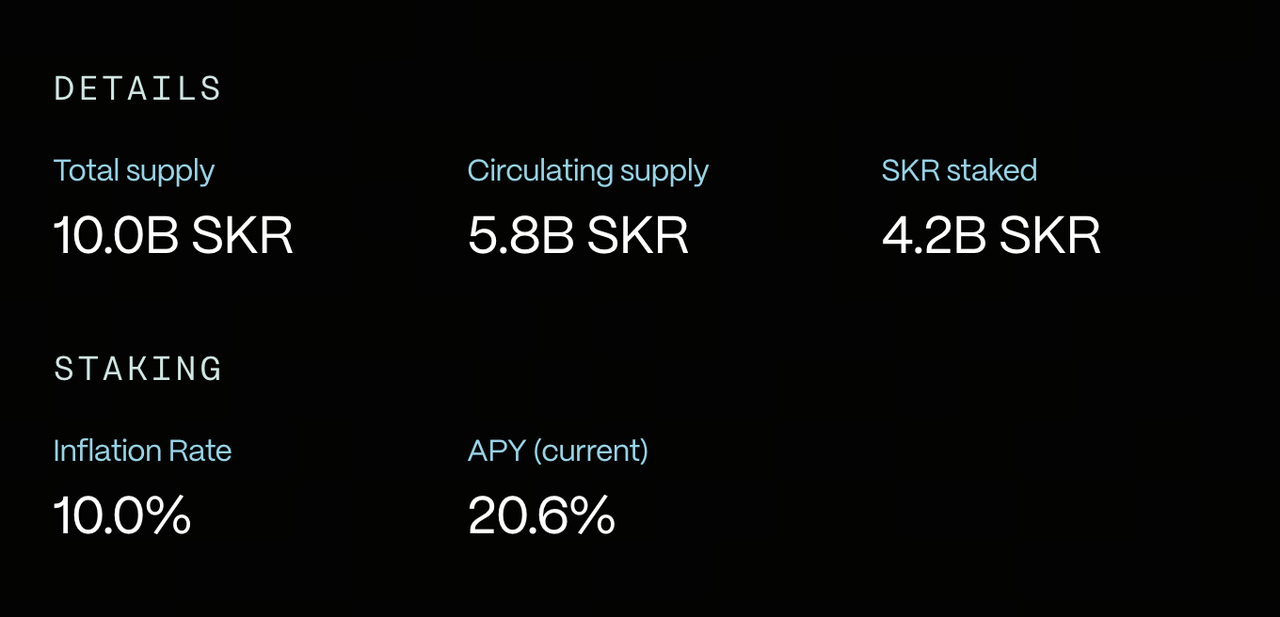
According to official data, the current circulating supply of SKR is approximately 5.8 billion tokens, with 4.2 billion SKR staked, resulting in a staking ratio of 42%.
These figures convey two key signals. First, broad initial distribution provides a solid decentralization foundation and helps avoid highly concentrated selling pressure. Second, the high staking ratio indicates strong community consensus around SKR’s long term value, with users willing to lock tokens in exchange for future returns.
How to Buy and Trade SKR Tokens on Gate
Currently, Seeker (SKR) is listed for spot or perpetual trading on multiple centralized exchanges such as Coinbase and Gate, as well as decentralized exchanges such as Meteora and Orca.
Using Gate as an example, as of February 12, 2026, the latest SKR price is $0.028, with a 24 hour trading volume of $81 million on the platform.
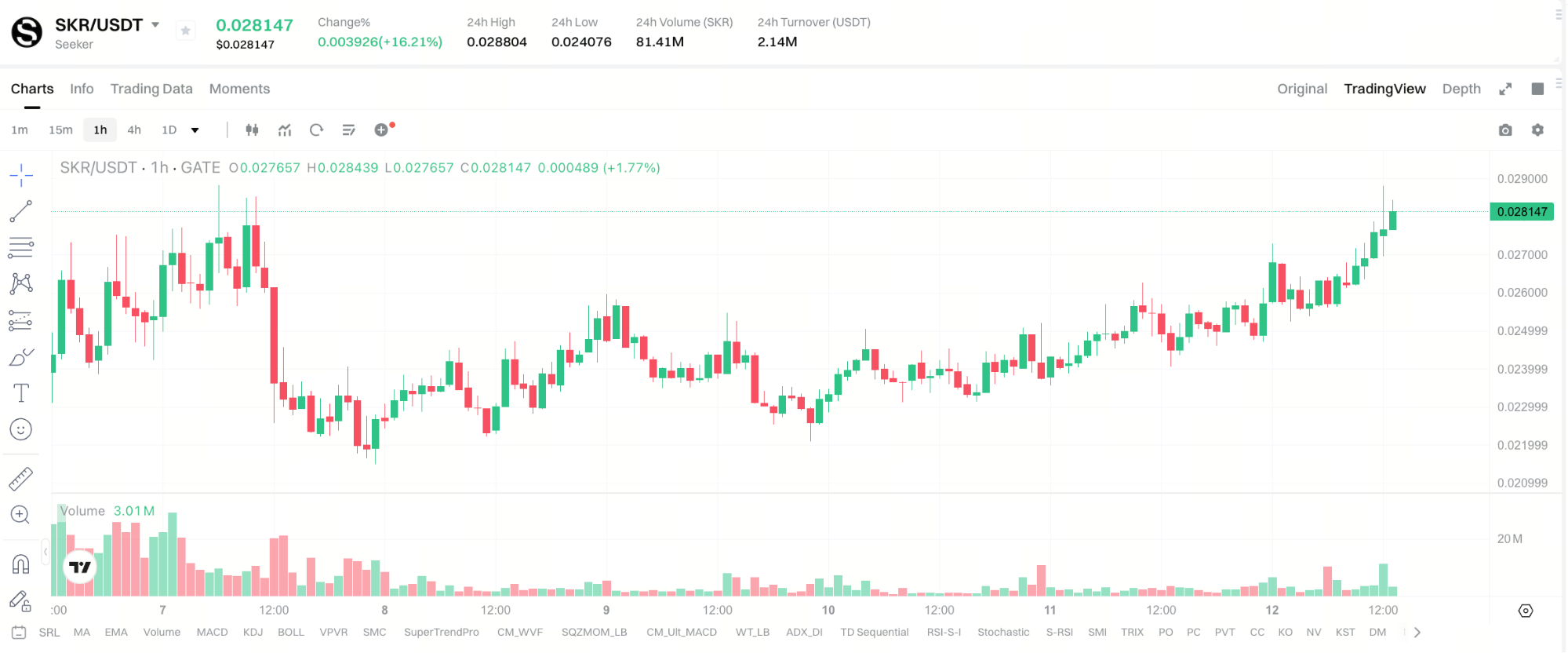
To buy or trade SKR on Gate, users can follow these steps:
- Open Gate and log in to your account. If you do not have an account, complete registration and basic security setup first.
- Enter SKR in the search bar on the Gate trading page and select the corresponding project page.
- Review Seeker’s project overview, official information, platform announcements, and relevant risk disclosures.
- Scroll down to view SKR market data, including price trends, trading volume, and historical performance.
- Gate supports SKR spot and perpetual contract trading. Users can review supported trading pairs, trading methods, and rules on the page.
- Users can withdraw SKR to self custodial wallets, such as the built-in Seeker wallet.
Recent Seeker Developments and the Outlook for Web3 Phones
Since 2026, Seeker’s progress has focused on the token launch, enabling SKR staking, hosting Solana Mobile hackathons, and expanding the dApp ecosystem.
- From January to February 2026, SKR was successively listed on Coinbase spot markets, Hyperliquid perpetual contracts, Binance USDT margined perpetual contracts, and platforms such as Robinhood.
- SKR staking is now live. According to the latest data on February 12, the current staking APY is 20.6%.
- The second Solana Mobile hackathon, hosted by RadiantsDAO, is currently underway. It runs for five weeks, with a deadline of March 9, 2026, and a prize pool of $125,000.
- On January 9, Seeker Season 2 officially launched, allowing users to explore the Web3 app store and earn potential airdrops.
The series of actions around the Seeker phone and the SKR token demonstrates a typical example of deep integration between hardware and token economics. Rather than simply selling devices, Solana Mobile is using token incentives to build a closed loop ecosystem.
In essence, Solana Mobile is replicating the successful path of its first generation product Saga, but at a larger scale and with a more mature design. By using hardware as the entry point, Seeker leverages strong airdrop expectations to drive device adoption, then binds the interests of users, developers, and projects through token economics to form a mutually reinforcing growth flywheel. The ultimate goal is not to become a phone manufacturer, but to serve as the foundation and traffic gateway of the Solana mobile ecosystem.
Risks and Challenges for the Seeker Token
So far, Seeker has performed better than the first generation Web3 phone Saga and shows a clearer long term roadmap. However, after SKR became tradable and staking was introduced, the project faces greater challenges related to user retention and ecosystem application development.
If users purchase Seeker primarily to receive SKR airdrops or future token rewards, similar to the BONK driven logic of the first generation Saga, devices may face the risk of being set aside once rewards are fully distributed.
In addition, although the Solana dApp store currently hosts more than 100 applications, it still lacks a true killer app. Most existing dapps are concentrated in DeFi and NFT trading, with a shortage of social, payment, or lifestyle applications that support high frequency daily use.
As the value carrier of the Seeker ecosystem, the value and market performance of the SKR token will depend directly on whether it develops irreplaceable utility within the ecosystem, such as broader payment usage, consumption scenarios, benefit redemptions, and partner discounts.
At the same time, investors should closely monitor changes in SKR staking rates and the growth of daily active users across dapps. A sustained decline in these metrics may signal weakening investor confidence.
Summary
Solana Seeker is not merely a hardware iteration following Saga, but an ambitious attempt by Solana Labs to build a mobile native ecosystem.
Unlike traditional smartphones where application distribution is controlled by centralized corporations, Seeker aims to redistribute value through the SKR token. By using hardware as the entry point and tokens as the connective layer, it tightly aligns the interests of users, developers, and the platform, positioning itself as a foundation and traffic gateway for the Solana mobile ecosystem.
However, even after launching token and staking features, Seeker still faces long term challenges related to the lack of killer applications and sustained user retention.
FAQs
What is the SKR token and what is its supply?
SKR is the native token of the Solana Seeker ecosystem, used for payments, staking, governance, and ecosystem rewards. Its initial supply is 10 billion tokens and it uses a linear inflation model, with a first year inflation rate of 10% that gradually declines to 2% by the sixth year, balancing early incentives with long term value.
What are the current staking rewards for SKR and is there a lockup period?
As of February 2026, SKR staking offers an APY of around 20.6%. Users can delegate tokens to guardians to secure the network and earn rewards. There is no long term hard lockup, but unstaking requires a 48 hour cooldown period.
How can I participate in Seeker Season 2 to earn rewards?
Users can explore the Web3 app store and participate in partner campaigns, such as those from Jupiter, Hubra, and Sol Raffle, to earn points or lottery entries. Season 2 emphasizes activity and sustainability, and staking SKR is also considered an important loyalty signal that increases the weighting for potential airdrops.