Solana Explores Enterprise-Grade Blockchain Privacy Needs
 (Source: SOLANA)
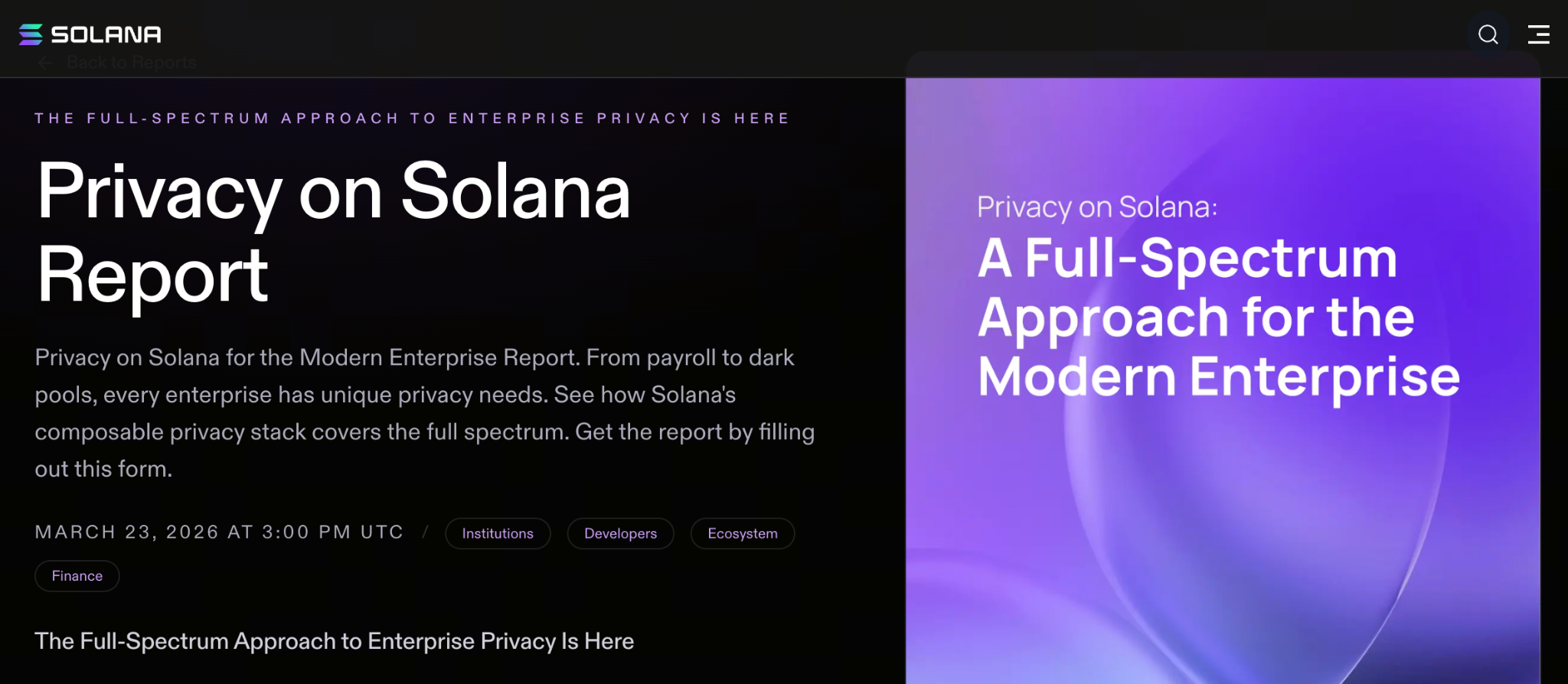
The Solana Foundation recently published a report titled "Privacy on Solana: A Full-Spectrum Approach for the Modern Enterprise," offering new insights on blockchain privacy.
According to the report, the next critical phase of crypto industry adoption is no longer about absolute transparency. Instead, enterprises need the ability to control both the extent and the recipients of information disclosure. In short, the future of blockchain requires a more flexible balance between transparency and privacy.
From Full Transparency to Controllable Privacy
Early public blockchain models emphasized openness. Traditionally, most blockchain transactions are viewable by anyone, with users identified by wallet addresses rather than their real-world identities.
This model is known as pseudonymity. Solana’s report notes that this approach still presents challenges in many real-world business scenarios, such as:
-
Financial institutions needing to verify transaction completion without exposing their counterparties.
-
Companies wanting to keep employee salaries private on-chain during payroll distribution.
-
Institutional traders wishing to protect order sizes and trading strategies from public view.
As a result, enterprise applications require more sophisticated privacy mechanisms.
The Solana team believes its blockchain’s high performance provides a strong foundation for supporting privacy technologies.
The network offers:
-
High throughput
-
Low latency
Some advanced privacy solutions can operate at speeds comparable to web applications.
This enables a range of new use cases, including:
-
Encrypted order book trading
-
Private credit risk assessment
-
Secure sharing of sensitive institutional data
Four Modes on the Privacy Spectrum
The report introduces a key concept: privacy is not a single model but a spectrum.
Solana identifies four distinct levels:
- Pseudonymity
This is the prevailing approach among most public blockchains.
- Confidentiality
Participants’ identities can be confirmed, but sensitive data (such as balances or transaction amounts) are encrypted—ideal for financial institutions requiring data protection.
- Anonymity
Transaction participants’ identities are concealed, while transaction data itself remains public. This model is common in privacy-centric crypto applications.
- Full Privacy
Both identities and transaction data are hidden.
Technologies enabling this include:
These offer the highest level of privacy protection.
Solana’s goal is not to offer a single privacy solution, but to empower enterprises to select different tools based on their requirements.
For example: hiding transaction amounts, validating transactions without revealing details, and controlling access to specific data. By combining these tools, enterprises can tailor privacy levels to suit various use cases.
Potential Enterprise Use Cases
If this privacy architecture is implemented, blockchain technology could support a broader range of business applications.
For example: trading platforms could conceal order sizes; banks could share risk data without revealing asset structures; and users could prove regulatory compliance without disclosing personal information. These capabilities would help blockchain technology gain deeper traction in the enterprise market.
Balancing Privacy and Regulation
The report also underscores that privacy does not mean evading regulation. Solana proposes several mechanisms to ensure compliance, including:
These features are designed to address global concerns around anti-money laundering and financial regulation.
Conclusion
As blockchain technology continues to expand into enterprise and financial sectors, a purely transparent model no longer meets every need. Solana’s privacy spectrum concept aims to establish a new balance among transparency, privacy, and regulatory compliance. If this multi-tier privacy model succeeds, blockchain could play an even more significant and mature role in financial, enterprise, and institutional applications.