As Web3 applications expand from early DeFi use cases to more complex environments such as blockchain gaming, high frequency interactions, and even on-chain AI agents, the true nature of performance bottlenecks has become increasingly clear. The real challenge is no longer simply increasing throughput, but managing state conflicts, reducing latency, and ensuring asset security within complex systems. Ethereum adopts an account based model with global transaction ordering, relying on Rollups and Layer 2 solutions to distribute execution load. Solana achieves parallel processing primarily through high speed transaction ordering and hardware optimization. Sui, in contrast, introduces an object centric model, defining assets as independent objects so that unrelated transactions can be executed in parallel at the architectural level. Behind these different execution models lie different assumptions about scalability, system risk structures, and the long term evolution of blockchain ecosystems. These choices directly influence the ability of networks to support large scale applications while maintaining stability.
The architectural divergence among Layer 1 blockchains can be understood through several dimensions, including execution models, transaction processing strategies, smart contract languages, and scaling approaches. From account based systems with global ordering to object oriented architectures with native parallel execution, and from Solidity and Rust to the security focused design of Move, these foundational choices shape developer ecosystems and influence how well a network can support high frequency applications, on-chain finance, and large scale value flows. As Web3 gradually moves toward increasingly complex application scenarios, the design philosophy embedded in underlying blockchain architecture is becoming a decisive factor shaping the future competitive landscape of public blockchains.
Sui vs Ethereum vs Solana: Introduction
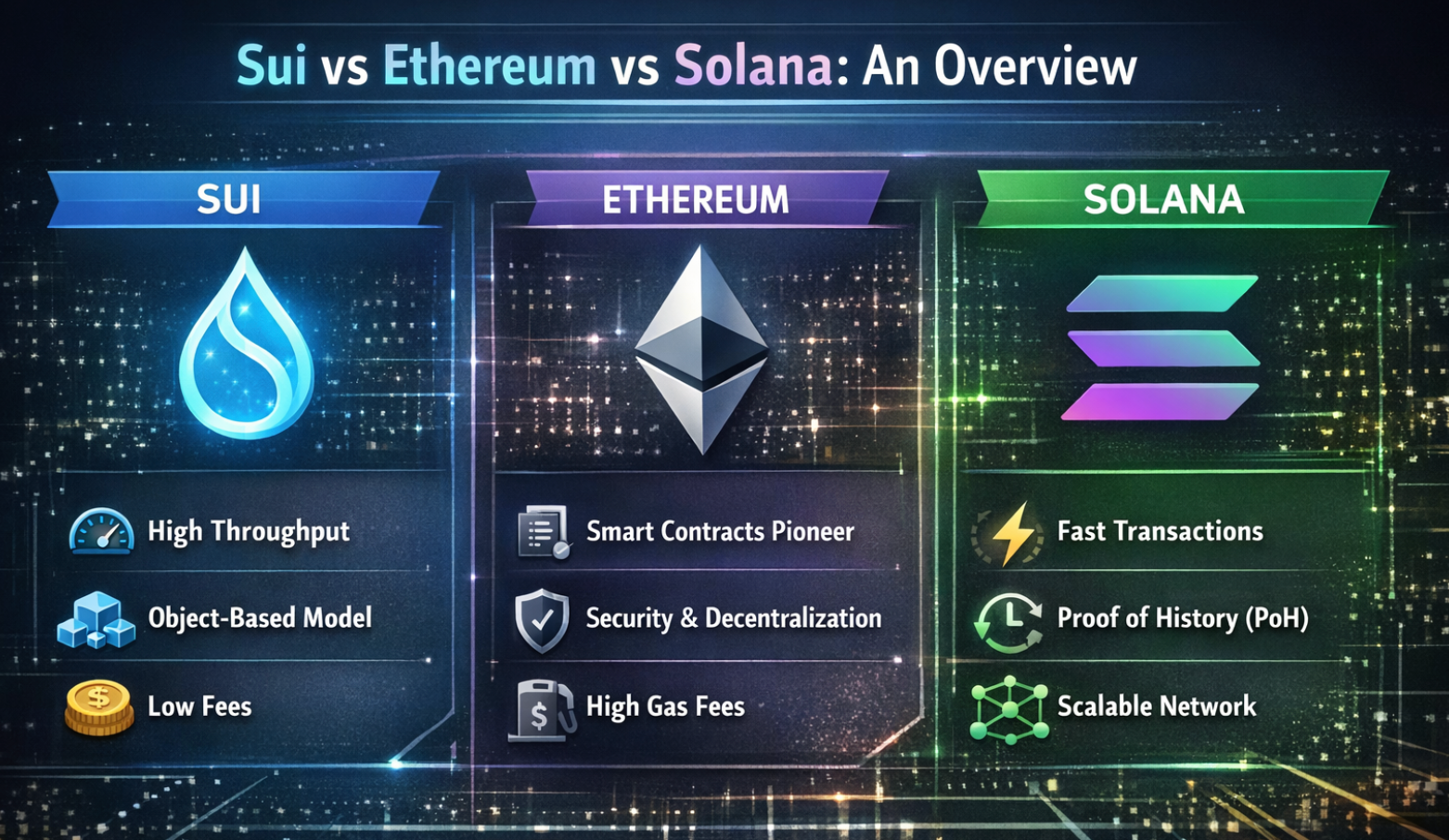
Within the competitive landscape of Layer 1 public blockchains, Ethereum, Solana, and Sui represent three distinct development paths. Ethereum centers its strategy on a mature ecosystem and modular scalability, improving overall network capacity through its Layer 2 infrastructure. Solana focuses on high performance within a single chain architecture, establishing advantages in scenarios that require high throughput and low latency. Sui, by contrast, approaches scalability from the underlying transaction model, redesigning execution logic through an object centric architecture and native parallel processing mechanisms. The differences among these networks are not limited to technical implementation. They also reflect fundamentally different perspectives on how future Web3 applications will evolve and what kind of infrastructure will be required to support them.
Layer 1 Blockchain Competition Has Entered an Era of Architectural Divergence

In the early stages of public blockchain development, competition largely focused on value priorities, such as which network was more decentralized and which was more secure. As the industry evolved, the focus gradually shifted toward performance metrics, where higher TPS became a central benchmark for technological progress.
Today, however, the core question has changed. What will ultimately determine the future competitive landscape is no longer simply parameter optimization. Instead, it is which underlying architecture is better suited to support large scale Web3 applications. Ethereum has chosen a modular architecture supported by Layer 2 expansion, moving execution pressure away from the base layer. Solana focuses on pushing the limits of single chain performance, maintaining overall efficiency through high throughput. Sui approaches the problem from the transaction model and asset structure, redesigning the execution logic itself.
This competition is therefore no longer only about technological implementation. It represents a deeper divergence in the design philosophy of blockchain infrastructure.
Sui vs Ethereum vs Solana: Differences in Execution Models
Both Ethereum and Solana use an account based model. In this design, blockchain state exists within a globally shared environment, meaning that transactions must be ordered before they can update the state. This model is mature and widely used, but it also has an inherent limitation: any state change may potentially conflict with other transactions.
Sui introduces an object centric model. In this architecture, each asset is treated as an independent object with clearly defined ownership and verification logic. When two transactions do not involve the same object, they theoretically do not need to compete for the same state resources. This approach is not merely a performance optimization. Instead, it represents a fundamental redesign of state management.
The object centric model reduces the scope of transaction conflicts from the global level to the asset level. From an architectural perspective, it can be understood as a conflict isolation design, allowing the system to process unrelated transactions in parallel while maintaining clear ownership boundaries.
Sui vs Ethereum vs Solana: Transaction Processing Strategies
On Ethereum, transactions must be globally ordered before execution, and then processed sequentially. This design ensures consistency across the network but also introduces potential risks of latency and congestion, especially during periods of high demand. As a result, Ethereum's scaling strategy has increasingly relied on Rollups and Layer 2 networks to move execution workloads away from the base layer.
Solana, while capable of achieving a high degree of parallel execution, still depends on high frequency transaction ordering to determine the sequence in which transactions are processed. Its performance advantage primarily comes from efficient pipeline architecture and hardware optimization, which enable rapid processing while maintaining network throughput.
Sui follows a different logic for parallel execution. When transactions do not involve the same objects, they can be confirmed simultaneously without competing for shared state, and in some cases may not require full consensus ordering. This form of parallelism is embedded directly into the architectural design, rather than being an optimization applied during execution. In other words, Sui treats parallel processing as the default state of the system rather than an optional acceleration mechanism.
Smart Contract Languages And Security Design Strategies
Ethereum's Solidity ecosystem is highly mature and supported by a large developer community. However, the network has also accumulated numerous historical cases of smart contract vulnerabilities. In practice, security often relies on extensive auditing, established development practices, and developer experience.
Solana adopts Rust as its primary smart contract language. Rust emphasizes performance and low level control over system resources, allowing developers to build highly efficient applications. At the same time, its complexity creates a higher barrier to entry for developers.
Sui uses the Move programming language, which was originally designed specifically for secure digital asset management. The core concept of Move is the enforcement of strict asset ownership rules, preventing assets from being copied or accidentally destroyed. This design provides natural advantages in scenarios such as financial applications and blockchain gaming where asset integrity is critical.
The choice of programming language reflects broader strategic priorities. Ethereum prioritizes ecosystem maturity and developer accessibility, Solana focuses on performance efficiency, while Sui emphasizes asset security and architectural consistency.
Ethereum's long term vision centers on a modular architecture stack, where the base layer focuses on security while execution is increasingly handled by Layer 2 networks. Data availability is separated into additional layers, forming a multi layer system. This approach reduces pressure on the main chain but also introduces greater ecosystem complexity.
Solana continues to strengthen main chain performance, attempting to overcome scalability limitations through ongoing technical upgrades and infrastructure improvements. Its strategy focuses on maintaining high throughput and low latency within a single chain environment.
Sui embeds scalability directly within its core architecture. Through its object centric model and native parallel transaction execution, the network can theoretically scale alongside application growth without relying on additional layers to absorb execution demand.
These three approaches do not represent absolute advantages or disadvantages. Instead, they reflect different tradeoffs between risk and long term benefits, shaped by distinct architectural philosophies and scaling strategies.
Key Competitive Factors In The Coming Years
The next phase of competition will no longer be limited to DeFi. The real pressure test will come from blockchain gaming, high frequency interactive applications, and even on-chain AI agents, all of which introduce more complex and real time demands. These applications require significantly higher standards in throughput, latency, state management, and asset security compared with early financial protocols.
Within this context, Ethereum's advantage lies in its mature ecosystem and highly standardized infrastructure. Solana's strength comes from its market proven high performance execution capability. Sui's differentiation lies in the scalability potential embedded within its underlying architecture.
Ultimately, the decisive factor may not be current performance metrics. Instead, it will depend on which architectural approach aligns most effectively with the evolving demands of future Web3 applications.
Conclusion
Competition among Layer 1 blockchains is fundamentally a competition of architectural philosophies, rather than simply a comparison of performance metrics or market capitalization. The technological paths chosen by different networks reflect distinct assumptions about how the future of Web3 will evolve.
Ethereum stands as the leading example of the modular architecture approach, building an open ecosystem through layered infrastructure and Layer 2 scalability solutions. Solana represents the pursuit of single chain performance limits, positioning high throughput and low latency as its core strengths. Sui, in contrast, attempts to reconstruct blockchain execution logic from the transaction model and asset structure, introducing an object centric architecture with native parallel execution.
Understanding these structural differences is more meaningful than focusing on short term market fluctuations. In the long term development of Web3, the true boundaries and capabilities of blockchain networks are ultimately determined by their underlying architectural design.
FAQ
-
What are the core differences between Sui, Ethereum, and Solana?
Ethereum, Solana, and Sui represent three different development paths for Layer 1 blockchains. Ethereum follows a modular scaling strategy through Layer 2 expansion and emphasizes a mature ecosystem and layered architecture. Solana focuses on single chain high performance, with high throughput and low latency as its primary strengths. Sui takes a different approach by redesigning the underlying transaction model through an object centric architecture and native parallel execution. These differences ultimately reflect distinct architectural design philosophies.
-
Why is Sui's parallel processing model considered different?
Ethereum and Solana both rely on an account based model, where transactions typically need to be ordered before updating the global state. Even though Solana significantly optimizes parallel execution, it still depends on transaction ordering. Sui introduces an object centric model where transactions involving different objects can be confirmed simultaneously and may not require full ordering in certain scenarios. This parallelism comes from structural differences in state management rather than simple performance optimization.
-
What are the key competitive advantages of these three blockchains in the future?
Ethereum's advantage lies in its mature developer ecosystem and highly standardized infrastructure. Solana's strength comes from its market proven high performance single chain execution capability. Sui's potential is rooted in its architecture native scalability and security oriented asset model. As applications such as blockchain gaming, high frequency interactive systems, and AI agents emerge, the decisive factor will be whether the underlying architecture can support increasingly complex and real time workloads.







