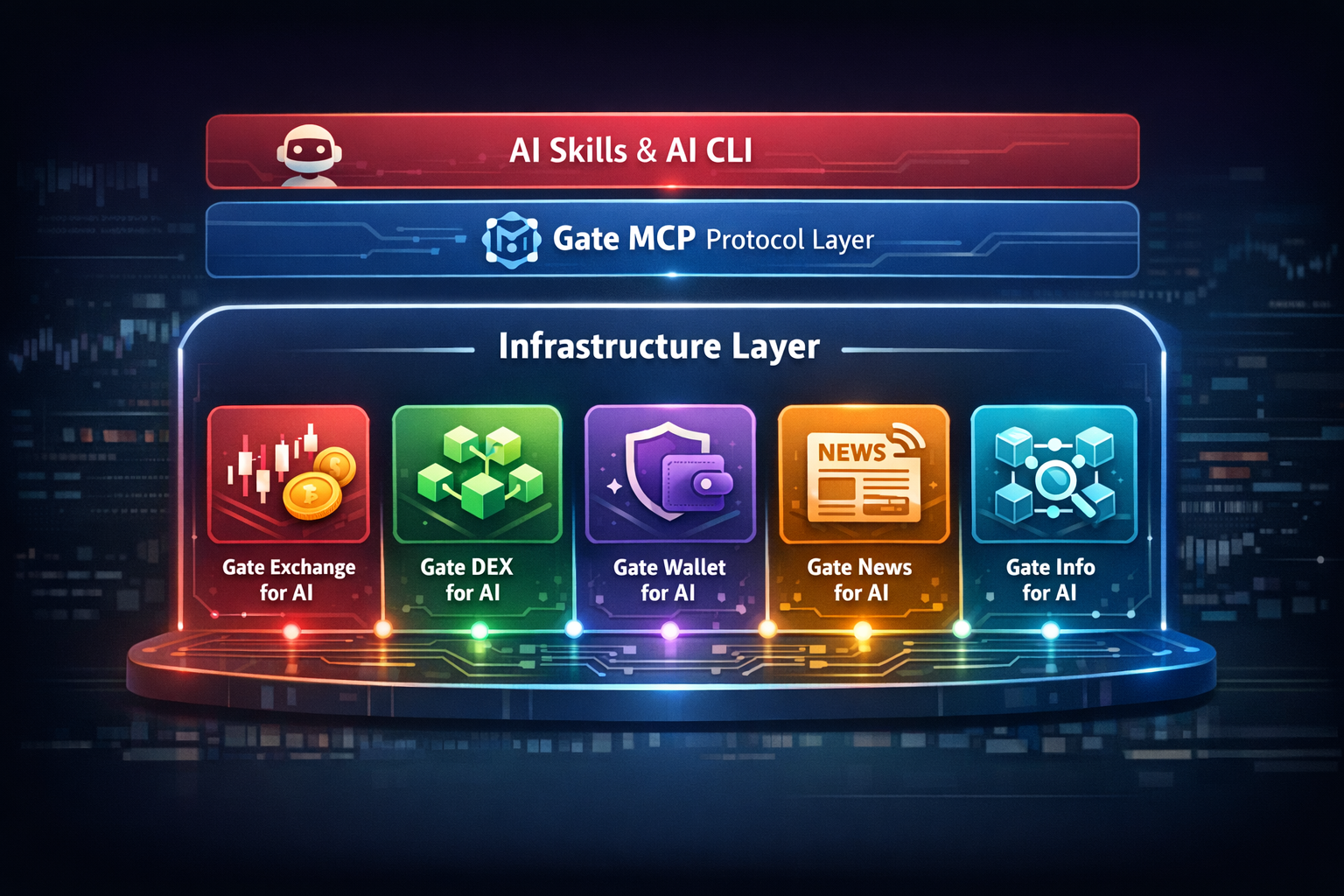
AI agents begin performing real tasks beyond conversations. They face challenges like retrieving market data, executing trades, managing digital assets, and analyzing on-chain activity reliably and securely. Gate for AI approaches these challenges with layered architecture built around Gate MCP, AI Skills, AI CLI, and five infrastructure modules: Exchange, DEX, Wallet, News, and Info. Each module represents a distinct service domain designed to expose specific capabilities to AI agents.
This modular architecture ensures service boundaries remain clear while allowing agents to navigate the functional complexity of the crypto ecosystem through a standardized interface.
What are Modules in Gate for AI
In Gate for AI, modules are functional infrastructure domains that allow AI agents to access different parts of the crypto ecosystem. These domains include centralized trading services, decentralized on-chain execution, wallet management, news feeds, and blockchain data.
Within the platform architecture, the infrastructure layer consists of five modules: Exchange, DEX, Wallet, News, and Info. Above this layer sit the protocol and capability layers, where Gate MCP and AI Skills translate an agent’s intent into structured tool usage.
A module is therefore more than just a feature or product category. It acts as a service boundary. Each module groups related capabilities together, so AI agents can request a specific type of action or data source without mixing unrelated functions.
This structure improves clarity and coordination. In a single workflow, an AI agent might rely on one module for execution, another for contextual information, and a third for asset management.
Overview of the Five Core Modules
Gate for AI defines five core modules that support the operational needs of crypto-focused AI agents:
-
Gate Exchange for AI – centralized trading and financial services
-
Gate DEX for AI – decentralized and on-chain trading operations
-
Gate Wallet for AI – wallet infrastructure and asset management
-
Gate News for AI – real-time crypto news and market updates
-
Gate Info for AI – structured blockchain data and analytics
Each module represents a different layer of crypto interaction. Exchange focuses on centralized markets, DEX handles decentralized trading, Wallet manages asset control and permissions, News provides market context, and Info delivers structured blockchain data.
Together, these modules form the operational base of the Gate for AI infrastructure layer. AI agents access them through Gate MCP, while AI Skills coordinate how they are used in multi-step workflows.
Gate Exchange for AI
Gate Exchange for AI is the module that provides AI agents with access to centralized exchange services through structured APIs.
The module includes functions such as spot trading, futures markets, wealth management tools, Launchpad participation, and asset management features. Its goal is to allow AI agents to interact with exchange services directly without relying on fragile interface automation.
In practice, the Exchange module supports agents that need to operate in centralized environments. Tasks may include retrieving market prices, checking account balances or positions, and initiating trading operations when proper authorization is available.
Within the overall architecture, this module acts as the bridge to off-chain or exchange-managed markets. For many trading and portfolio workflows, centralized exchanges remain an important source of liquidity and financial services.
Gate DEX for AI
Gate DEX for AI provides AI agents with access to decentralized trading environments across blockchain networks.
The module supports functions such as token swaps, decentralized market data, perpetual trading, meme token activity, and multi-chain interactions. These capabilities allow agents to participate directly in on-chain trading workflows.
While the Exchange module focuses on centralized infrastructure, the DEX module emphasizes blockchain-native execution. It enables agents to interact with decentralized liquidity pools and smart-contract-based trading mechanisms.
Architecturally, this expands the system beyond exchange-only workflows. AI agents can include decentralized execution paths in their decision processes, which is particularly important in an ecosystem where liquidity is distributed across many chains and protocols.
Gate Wallet for AI
Gate Wallet for AI is the custody and wallet infrastructure module that enables AI agents to interact with blockchain assets and decentralized applications.
According to the platform design, the module includes Native Wallet, PluginWallet, and Keygenix, along with multi-chain support, agent wallet functions, plugin-based DApp connectivity, and security mechanisms such as TEE hardware isolation.
The role of this module is fundamental. AI agents cannot perform on-chain operations without a mechanism for wallet access, transaction signing, and asset management. The Wallet module provides that bridge between an agent’s decision logic and the blockchain environment.
At the same time, this capability introduces an important design challenge. As AI agents gain greater authority over wallet actions, issues such as permission control, key management, and security isolation become critical.
Gate News for AI
Gate News for AI delivers real-time crypto news and market information to AI agents.
The module allows agents to subscribe to, search, and analyze market updates, including breaking news alerts, sentiment indicators, and other informational signals.
Unlike execution modules, News primarily functions as a context layer. Its role is to help AI agents understand what is happening in the broader market environment before making decisions or after monitoring ongoing positions.
For example, a trading or monitoring agent may use news updates to detect sudden market developments, interpret price movements, or prioritize further analysis.
Gate Info for AI
Gate Info for AI is the data and analytics module that provides structured blockchain information to AI agents.
The module includes coin profiles, project data, block information, wallet address activity, analytics tools, and portfolio tracking features. These datasets allow agents to query blockchain activity and analyze projects in a structured way.
Unlike the News module, which focuses on narrative updates, Info focuses on organized reference data. It helps answer questions such as what a project does, how a wallet address has behaved, or what events have occurred at the blockchain level.
For AI agents, structured data is especially valuable because it reduces ambiguity. Instead of inferring meaning from unstructured text, the agent can retrieve clear datasets for analysis.
How the Five Modules Work Together
The five modules interact through Gate’s layered architecture.
At the base level, the infrastructure layer provides the underlying services. Above it, Gate MCP acts as the protocol layer that standardizes how tools are accessed. Finally, AI Skills coordinate multi-step workflows across the modules.
A typical process may look like this:
Step 1 — Goal Identification An AI agent detects a user request or system trigger that requires analysis or action.
Step 2 — Tool Access via Gate MCP Gate MCP provides standardized access to the relevant modules within the infrastructure layer.
Step 3 — Workflow Orchestration with AI Skills AI Skills coordinate calls across one or more modules, combining them into a structured workflow.
Step 4 — Result Generation The system returns the final output, which may include analysis results, monitoring insights, or executed actions such as trades or on-chain operations.
For example, an agent might use News to detect a market event, query Info to verify project data, check balances through Wallet, and then execute a transaction through Exchange or DEX.
In this system, modules remain specialized, but workflows remain flexible.
Example AI Agent Workflows
Understanding modular systems becomes easier when looking at real workflows.
| Workflow |
Process |
Modules |
| Market Monitoring & Execution |
Monitor news, verify project data, check balances, and execute trades if conditions are met. |
News, Info, Wallet, Exchange / DEX |
| On-Chain Research |
Analyze unusual blockchain activity and cross-check with market news. |
Info, News |
| Portfolio Monitoring |
Review wallet balances, exchange positions, and summarize overall exposure. |
Wallet, Exchange, Info |
These workflows show why specialized modules are often more effective than a single all-purpose interface.
Advantages of Modular Architecture
Modular architecture offers several advantages for AI-driven crypto systems.
-
Clear separation of functions Trading, wallet management, data analysis, and market intelligence operate as independent services, making workflows easier to organize and audit.
-
Flexible composability Because modules are distinct, AI Skills can combine them in different ways depending on the task.
-
Easier system maintenance Defined service boundaries allow modules to evolve independently without requiring major changes across the entire platform.
-
Structured tool access Standardized APIs and MCP protocols reduce fragile integrations and make AI tool usage more predictable.
Risks and Considerations
Modular architecture improves structure but does not eliminate operational risks.
-
Execution risk If an AI agent misinterprets data or market signals, access to multiple modules will not prevent incorrect decisions.
-
Security concerns The Wallet module introduces challenges related to key management, signing permissions, and secure isolation.
-
Data quality The usefulness of the News and Info modules depends on the reliability and timeliness of the data they provide.
-
System complexity While modular design increases flexibility, it also creates more coordination points across workflows.
-
Different execution environments Centralized exchange operations and decentralized on-chain transactions operate under different rules for custody, settlement, and risk.
Gate for AI reflects a broader shift toward crypto infrastructure designed for machine interaction as well as human interaction.
In this emerging model, platforms are not just trading interfaces or wallet apps. They become service environments where AI agents can gather information, analyze events, manage permissions, and execute actions through structured protocols.
The five-module design therefore represents more than product organization. It illustrates a move toward AI-operable infrastructure, where services are exposed in a way that automated systems can reliably call and combine.
The long-term development of such systems will depend on factors such as security design, interoperability, data reliability, and the real-world adoption of autonomous or semi-autonomous AI agents.
Conclusion
The five core modules of Gate for AI, Exchange, DEX, Wallet, News, and Info form the infrastructure layer that enables AI agents to interact with crypto systems.
Each module serves a distinct function: Exchange supports centralized trading, DEX enables on-chain execution, Wallet manages asset access and security, News provides market context, and Info supplies structured blockchain data.
By separating these services into specialized modules and connecting them through Gate MCP and AI Skills, the platform allows AI agents to assemble flexible workflows while maintaining a clear system structure.
Even so, modular design does not remove the fundamental challenges of crypto markets. Execution risk, wallet security, and data interpretation remain important considerations.
FAQs
What are the five core modules of Gate for AI?
The five modules are Gate Exchange for AI, Gate DEX for AI, Gate Wallet for AI, Gate News for AI, and Gate Info for AI.
Why does Gate for AI use a modular design?
Modular architecture separates major crypto functions into specialized services, so AI agents can combine them into structured workflows.
How is Gate Exchange for AI different from Gate DEX for AI?
Exchange focuses on centralized trading environments such as spot and futures markets, while DEX focuses on decentralized on-chain trading and token swaps.
Why do AI agents need both News and Info modules?
News provides real-time market updates and event context, while Info provides structured blockchain and project data used for analysis.
How do AI agents access modules?
AI agents connect to the modules through Gate MCP, while AI Skills coordinate tool usage across modules.
Does modular architecture eliminate crypto risks?
No. While it improves system organization and flexibility, market risk, security concerns, and data interpretation challenges still remain.