Trump Responds to Pardon Possibility
(Source: Koorah)
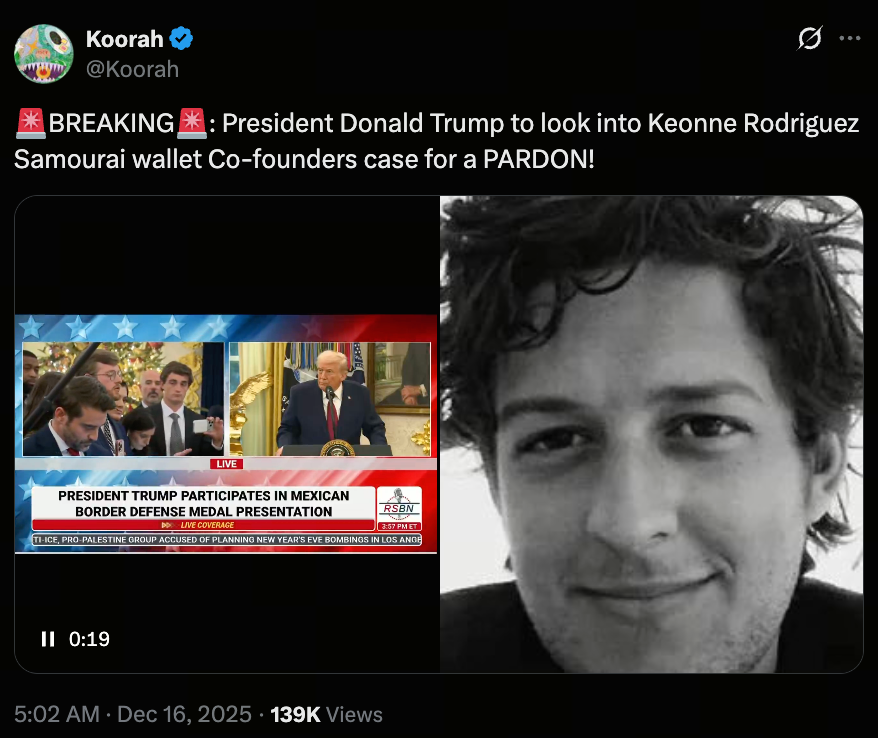
During an event in the Oval Office, Trump addressed questions from the media regarding the potential pardon of Samourai Wallet developer Keonne Rodriguez. He stated that he is aware of the case and is open to further evaluating the circumstances. Trump also raised the matter with Attorney General Pam Bondi, signaling that the case is now within his scope of attention.
Samourai Wallet Case Background
Rodriguez is a co-developer of Samourai Wallet, a Bitcoin privacy tool designed to allow users to maintain transaction privacy without relying on third-party custodians. Under the previous administration, the U.S. Department of Justice charged Rodriguez and co-developer William Longeran Hill with operating an unlicensed money transmission business and facilitating criminal activity. Last month, Rodriguez received a five-year federal prison sentence and is expected to begin serving his term this week.
Plea Agreement and Sentencing Outcome
Facing a potential maximum sentence of 25 years, both developers entered guilty pleas this summer, admitting to one count of operating an unlicensed money transmission business.
- Keonne Rodriguez: Five years (statutory maximum)
- William Longeran Hill: Four years
Although the Department of Justice dropped several crypto-related cases from the prior administration after Trump returned to the White House, the prosecutions of Rodriguez and Hill continued, leading to severe sentences.
Chilling Effect on Crypto Privacy Rights
This case has triggered significant backlash among the crypto community and privacy rights advocates. Many argue that such verdicts are having a direct impact on the development of blockchain privacy technologies. Supporters highlight that one of Bitcoin’s founding principles is to safeguard users’ privacy during online transactions. Prosecuting tool developers could destabilize the technological foundation of the entire crypto sector. Similar cases—such as the conviction of Ethereum privacy tool developer Roman Storm—are also viewed as major precedents contributing to a chilling effect.
Conflicting Stance Within the Department of Justice
The Trump administration’s position on crypto privacy tools is not entirely unified. Earlier this year, senior Department of Justice officials instructed prosecutors to reduce enforcement efforts against crypto privacy software and publicly stated an intent to avoid prosecuting decentralized software developers in the future. Nevertheless, after these policy signals, the Department of Justice continued to seek the maximum penalties for Rodriguez and Hill, raising questions about the policy’s actual implementation.
Rodriguez’s Practical Concerns
Rodriguez does not have high hopes for a pardon. He openly acknowledged lacking the resources and influence enjoyed by major crypto company founders. He also noted that Binance founder CZ, who received a pardon this year, benefited from significant capital and political clout—a stark contrast to his own situation.
If you want to learn more about Web3, click here to register: https://www.gate.com/
Conclusion
The Samourai Wallet case is more than a legal dispute involving a single developer; it is widely seen as a key indicator of the U.S. government’s stance on privacy technology and software liability. Whether Trump ultimately pardons Rodriguez will not only decide one engineer’s fate but could also prove pivotal for the future of crypto privacy innovation.