As DeFi evolves from simple trading use cases into more complex financial structures, data reliability, composability, and real time accessibility have become critical constraints. The architectural shift represented by Walrus focuses on redesigning the on-chain data layer so that it can directly participate in financial logic, rather than serving only as a passive record of state.
From a broader Web3 perspective, Walrus explores an infrastructure path centered on the idea of data as an asset. By combining storage proofs, data availability, and smart contract execution, this architecture enables data to be priced, traded, and composed in a manner similar to tokens. This approach provides foundational support for the convergence of DeFi, AI, and data driven markets.
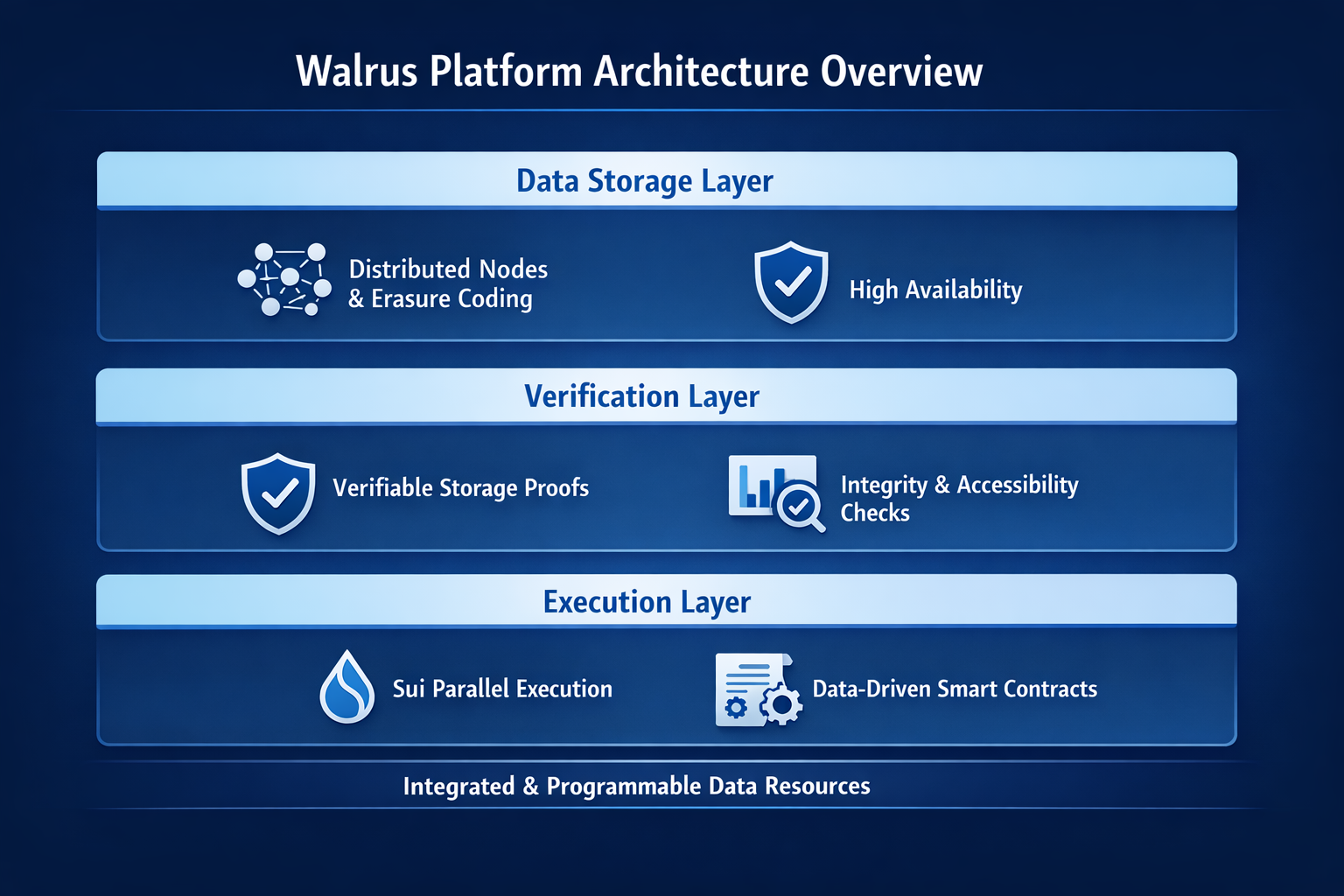
Walrus can be understood as a three layer coordinated system consisting of a data storage layer, a verification layer, and an execution layer.
-
Data storage layer, Walrus uses a distributed node network to fragment and store data across multiple nodes. By integrating erasure coding, the system improves fault tolerance and ensures higher data availability. This design reduces the risk of single point failures while maintaining consistent access to stored data.
-
Verification layer, Walrus introduces verifiable storage proof mechanisms that allow on-chain applications to confirm data integrity and accessibility. This capability is particularly important for DeFi use cases, where data such as collateral records, oracle feeds, and transaction histories must be reliable and verifiable.
-
Execution layer, Walrus integrates with Sui’s parallel execution architecture, enabling data to directly participate in smart contract logic. Instead of acting as passive input, data becomes part of how financial operations are executed on-chain.
This architecture effectively shifts the data layer from a supporting role into a core component of blockchain infrastructure.
Decentralized Trading and Liquidity Mechanism Innovation
Within DeFi systems, trading and liquidity are fundamental components. While Walrus is not a traditional decentralized exchange, its architecture provides foundational support that can enhance DEX functionality.
In terms of liquidity design, Walrus enables data driven liquidity management. By incorporating real time data inputs, parameters such as fees or asset weights can be adjusted dynamically. This allows protocols to improve capital efficiency and respond more effectively to changing market conditions.
On the trading side, Walrus allows deeper integration between on-chain data and order execution logic. Instead of relying solely on price based matching, transactions can be triggered by external data conditions. For example, trading logic can incorporate:
-
Oracle based conditional execution
-
Automated rebalancing based on on-chain activity
-
Time based or event driven strategy execution
These capabilities shift DeFi from static automated market maker models toward more adaptive, strategy driven systems.
In addition, the verifiability of data within Walrus can help reduce risks associated with maximal extractable value. By improving transparency and data integrity, the system contributes to fairer transaction execution within decentralized markets.
Smart Contracts and Automated Execution in Walrus
At the smart contract layer, Walrus introduces a key capability centered on data driven execution. Traditional smart contracts primarily rely on on-chain state, while Walrus enables contracts to directly access verified data resources. This allows more advanced forms of automation and expands the scope of what on-chain logic can achieve.
For example, this design can support:
-
Automatic liquidation based on real time collateral data
-
Automated yield optimization in response to market data changes
-
AI driven strategy execution that incorporates off chain model outputs
In terms of technical implementation, this capability relies on several core components:
-
Verifiable data input (Verifiable Data Input)
-
Modular contract architecture
-
Deep integration with the Move language
The resource oriented nature of Move improves how assets and data are handled, strengthening overall security.
This design enables Walrus to support more advanced DeFi primitives, including structured products and on-chain hedging strategies.
Technical Approaches to Improving User Experience and Security
From a user experience perspective, Walrus focuses on reducing complexity and improving responsiveness.
-
High performance interaction by integrating with Sui’s high throughput architecture, Walrus enables low latency data access and transaction execution. This improves both trading efficiency and overall user interaction.
-
Flexible account and permission management, Walrus supports more adaptable identity and permission structures, allowing users to manage assets and data more efficiently within the system.
From a security perspective, Walrus adopts a multi layer protection approach:
-
Data redundancy and erasure coding ensure availability and resilience
-
Storage proof mechanisms maintain data integrity
-
Smart contract auditing and formal verification reduce code level risks
-
A distributed network design enhances resistance to censorship and attacks
In addition, the architecture reduces reliance on centralized oracle systems. By strengthening data verification at the protocol level, Walrus helps mitigate systemic risks associated with external data dependencies.
How Walrus Supports Multi-chain and Cross-chain Functionality
Multi-chain and cross-chain capabilities are essential for Walrus to scale its applications and expand its role within the broader Web3 ecosystem.
- At the data layer, Walrus can function as a cross chain data availability layer, providing unified data storage and verification services for different blockchains. This means that:
-
Applications on different chains can access shared datasets
-
Data can be verified and utilized across chains
-
DeFi protocols can build cross-chain composability
- At the asset layer, Walrus can integrate with cross chain bridges and messaging protocols to enable synchronized movement of both assets and data.
For example:
-
Cross-chain liquidity pools
-
Multi-chain collateral management
-
Cross-chain derivatives trading
Through this architecture, Walrus extends beyond a storage protocol and acts as a data coordination layer that connects multiple blockchain ecosystems.
Future Development and Optimization of Walrus Architecture
From a forward-looking perspective, Walrus is expected to evolve across several key directions.
-
Integration of data and AI systems: Walrus may serve as infrastructure for AI models, enabling training and inference data to be verifiable and tradable within decentralized systems.
-
Data marketplace and pricing mechanisms: By incorporating token incentives, Walrus can support decentralized data markets where datasets become economically valuable and can be priced and exchanged.
-
Convergence of storage and computation: As DePIN and edge computing develop, Walrus may further integrate storage with computation, enabling processing to occur closer to where data is stored.
-
Standardization of cross-chain protocols: Through unified interfaces and protocol standards, Walrus has the potential to become a standardized data layer across multiple blockchain ecosystems.
Conclusion
The core architecture of Walrus represents a shift in how blockchain systems treat data. Instead of acting only as a recording tool, the data layer becomes a value carrying component within the network.
By integrating storage, verification, and execution capabilities, Walrus enhances efficiency and security in DeFi while also supporting emerging use cases in AI and data driven economies. In a multi-chain environment, this type of architecture has the potential to become a foundational layer for the next phase of Web3 infrastructure.







