Based.one Project Overview: A New Entry Point for On-Chain Super Apps
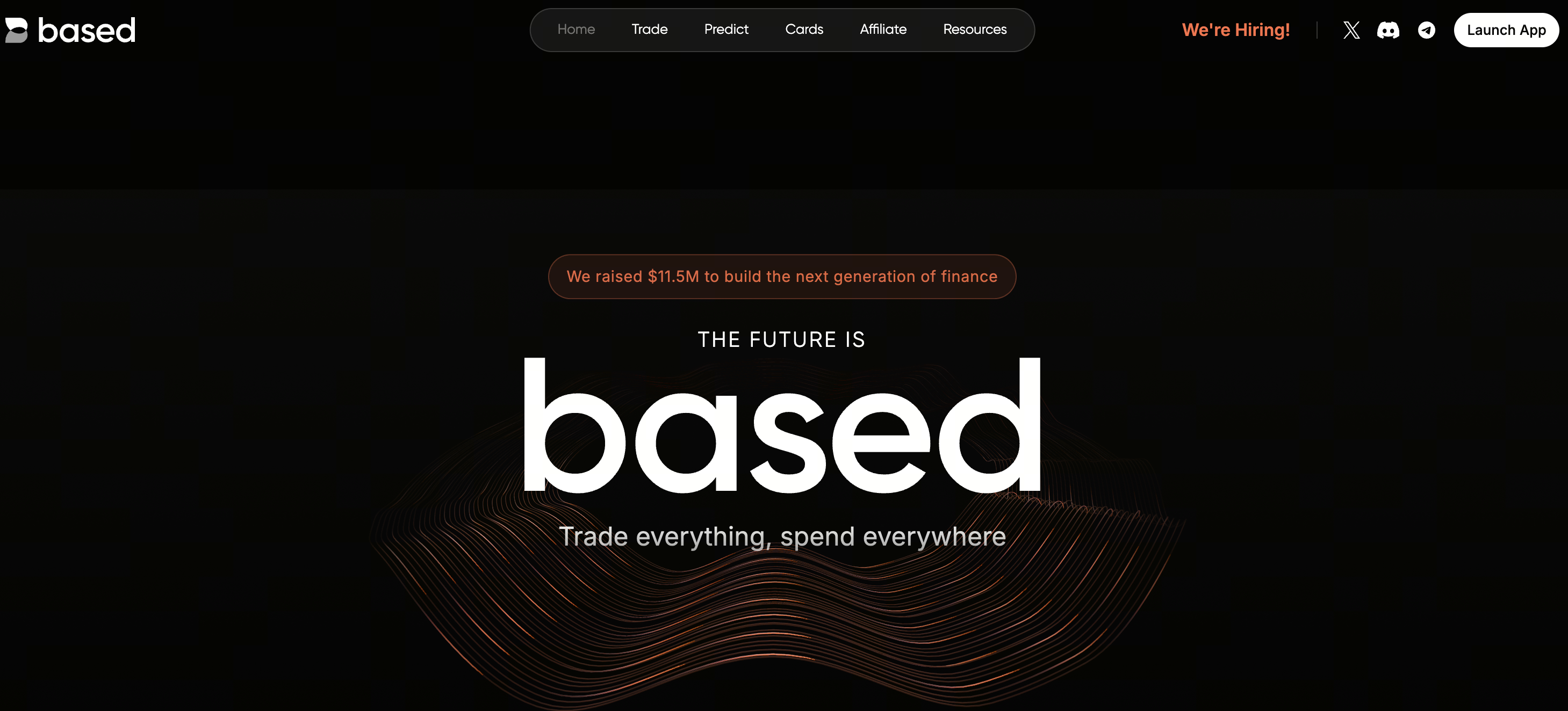 Image source: Based Official Website
In today’s crypto landscape, most projects still revolve around a “single-function” approach—DEXs focus on trading, lending protocols optimize capital efficiency, and prediction markets target event betting. Based.one, however, takes a distinctly different route. The project aims to build a “super gateway” for on-chain finance, integrating multiple core functions into one unified product. Based is positioned more like a Web2-era financial Super App than a single-feature protocol; its goal is to become the primary entry point for users entering the on-chain world, not just to dominate a specific niche.
This mindset reflects a broader industry trend: as infrastructure matures, competition shifts from “protocol capabilities” to “user entry points.” In the future, long-term value will come not just from underlying technology, but from application-layer products that control user traffic and behavioral data. Based is a product of this evolution, with a core logic of lowering user barriers through integrated functions and converting user activity into a sustainable economic cycle via its token mechanism.
Product Architecture: Unified Trading, Prediction Markets, and Payments
Based’s product design centers on “high-frequency usage scenarios” with three core modules that form a mutually reinforcing closed loop.
- Trading System. Based delivers a trading experience similar to centralized exchanges, including perpetual contracts and spot trading, aiming to address the fragmented nature of current on-chain trading. Unlike traditional DeFi, Based prioritizes execution efficiency and user experience, with features like order book trading and lower latency, making it functionally closer to professional trading platforms.
- Prediction Market Module. Users can trade assets and place bets on event outcomes—ranging from macroeconomic trends to crypto market moves and current events. This merges “information judgment” with “capital trading,” elevating the platform from a simple trading tool to a “decision market.” From a user behavior perspective, this significantly boosts engagement and retention.
- Payment and Consumption Features. Based introduces crypto payments and debit card options, allowing users to spend on-chain assets in real-world scenarios. This step is critical, expanding the platform from an “investment tool” to a “lifestyle tool” and increasing user stickiness.
Together, these three modules create a straightforward, effective structure:
- Trading drives capital flows
- Prediction markets enhance user engagement and information competition
- Payments support real-world consumption
The main advantage: users don’t have to switch between multiple protocols—they can handle all on-chain activities within a single app.
Technical Architecture: Application-Layer Design Leveraging Hyperliquid
Unlike many new projects, Based did not build its own blockchain. Instead, it develops application-layer products on top of high-performance infrastructure, with a key reliance on Hyperliquid’s trading execution. This is a “light-asset development model”—the underlying complexity is handled by the infrastructure, letting the project focus on product experience and user growth.
This architecture delivers two main benefits: faster development for rapid iteration, and stable performance by inheriting the strengths of mature infrastructure. However, this approach also means a certain degree of dependence—if the base layer has issues, the application layer is inevitably affected.
Across the industry, this “application-layer-first” strategy is becoming more common, especially as competition shifts toward user experience. Based’s core advantage is not in underlying innovation, but in integrating resources through product design to streamline the user journey.
BASED Token TGE on March 30: Key Details
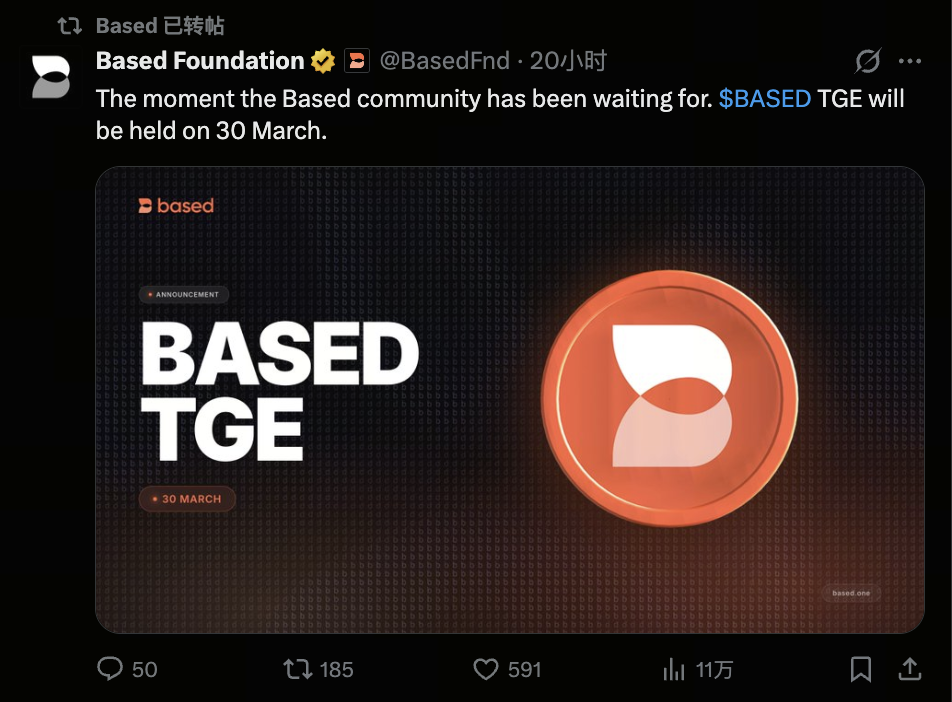 Image source: Based Foundation Tweet
The market’s main focus is the upcoming BASED token TGE (Token Generation Event) scheduled for March 30. This marks the project’s official transition into the “token-driven phase,” moving from product testing to live economic operation.
According to current disclosures, the BASED token serves three main roles:
- Platform incentive tool, rewarding trading and usage activity
- Ecosystem rights credential, unlocking features and levels
- Value settlement medium, used for fee payments and system participation
Unlike traditional DeFi projects, BASED’s token is tightly linked to user behavior, not just liquidity mining or high yields. The core objective is long-term user engagement, not short-term TVL spikes.
The TGE is crucial: it sets the initial market price and shapes user expectations. A well-designed distribution and incentive mechanism can drive user growth; a poor one may fuel short-term speculation.
BASED Token Economics: User Behavior-Driven Value
Structurally, the BASED token model resembles a blend of “platform points system” and “assetization.” Its value is not derived from a single source, but from the sum of multiple user actions. It breaks down into three core layers:
- Trading Incentives. Users receive fee discounts or rewards for trading on the platform—a system similar to traditional exchange fee discounts, but implemented on-chain via tokens.
- Consumption Incentives. Payment and card spending features offer cashback or rewards, creating a positive cycle: the more you use, the more you earn. This approach is proven in Web2 (e.g., credit card points systems).
- Platform Rights. Token holders or users unlock higher levels or more features, such as increased trading limits or expanded prediction market access. Tokens thus serve as “usage rights,” not just speculative assets.
In summary, the model’s core logic is:
- Use tokens to incentivize behavior
- Use user activity to drive growth
- Use growth to support value
Sustainability, however, hinges on one key question: can the platform generate real revenue, rather than relying solely on new user inflows?
Market Positioning: From Protocol Competition to Entry Point Competition
Based’s competitive arena is no longer traditional DeFi, but the “on-chain entry point” race. Its potential competitors include:
- Wallet apps (control asset entry)
- Centralized exchanges (control traffic entry)
- Aggregators and Super Apps (integrate multiple functions)
Based’s differentiator is its unified design—multiple high-frequency scenarios on one platform. The goal is not to replace any single product, but to become the “default entry point.” If successful, this approach yields clear advantages: higher user retention, more centralized data, and more direct value capture. However, it also raises the bar for execution, requiring solid performance across multiple domains.
Risks and Challenges: The Super App Model’s Real-World Test
Despite a compelling narrative, Based faces several challenges. First, external dependency: its trading relies on infrastructure, so any base-layer instability directly impacts the user experience. Second, product complexity: more features mean higher user learning costs, which could hinder early growth.
Competitive pressure is also significant. Exchanges, wallets, and new apps are all building their own gateways, so Based lacks a natural monopoly.
Finally, the token model carries uncertainty. If platform revenue can’t support token value, incentives may become short-term subsidies, undermining long-term sustainability.
Outlook: Can BASED Become the On-Chain Traffic Gateway?
The March 30 BASED token TGE is essentially a market test of the “on-chain Super App” thesis. Long-term success hinges on three core factors: the ability to attract users consistently, the creation of real trading and spending scenarios, and the establishment of a stable token economy.
If these conditions are met, Based could become a major entry point to the on-chain world, with value shifting from a single token to a “traffic asset.” If not, it may remain at the function integration stage, unable to build a lasting moat.
Conclusion
In summary, the BASED token TGE on March 30 is more than a token launch—it’s a critical milestone in the battle for on-chain application dominance. Based.one’s core innovation is integrating trading, prediction markets, and payments into a unified entry point, using its token mechanism to drive user behavior. From an industry perspective, this model is forward-looking, but its success depends on execution and market feedback. At this stage, Based is best viewed as an “entry-point experiment” worth watching; its future performance will significantly shape the narrative around on-chain Super Apps.







