Gate MCP functions as a connectivity layer within the Gate for AI ecosystem, allowing AI models to interact with crypto systems using the Model Context Protocol. Understanding how Gate MCP operates helps explain the development of AI-native infrastructure within the digital asset ecosystem.
As AI agents evolve from conversational assistants into autonomous systems capable of executing workflows, they increasingly require structured connections to external infrastructure. In cryptocurrency systems, these interactions may involve retrieving market data, analyzing blockchain activity, or executing transactions.
To support this type of interaction, new infrastructure layers are emerging that bridge AI systems with financial services. Gate MCP is designed as part of this architecture, enabling AI models to interact with crypto infrastructure through a standardized protocol environment.
What Is Gate MCP
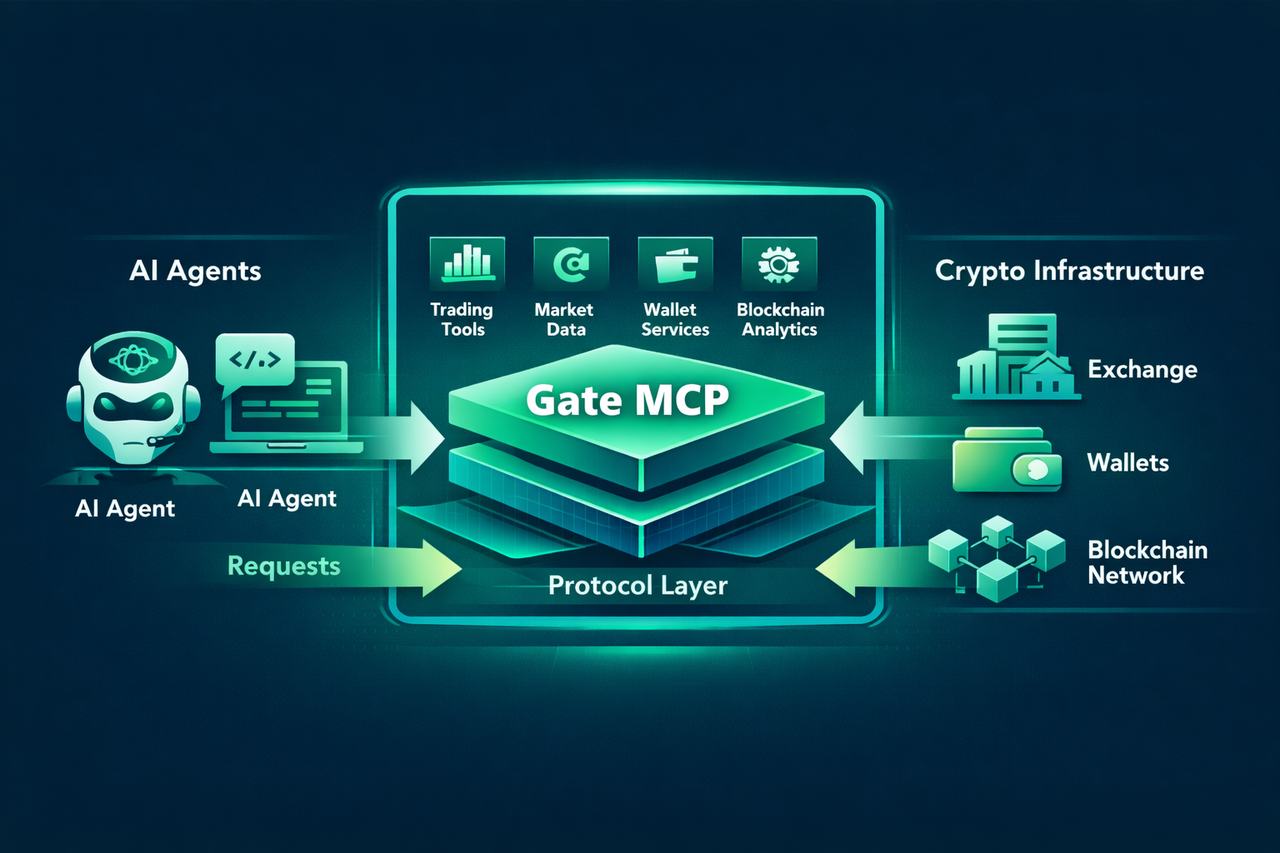
Within the Gate for AI ecosystem, Gate MCP serves as the protocol layer that links AI agents with Gate’s crypto infrastructure, allowing models to access tools for trading, market data, wallets, news, and on-chain analytics through a standardized interface.
Within the Gate for AI architecture, MCP functions as the connectivity layer between AI agents and underlying crypto services. Rather than directly integrating with multiple APIs, AI agents interact with MCP tools that expose standardized functions.
These tools may include capabilities such as:
-
retrieving real-time market data
-
executing trading operations
-
accessing wallet information
-
querying blockchain and project data
-
retrieving structured news and analytics
Through this structure, Gate MCP provides a unified interface that allows AI agents to interact with cryptocurrency systems in a consistent and controlled way.
Understanding the Model Context Protocol (MCP)
The Model Context Protocol (MCP) is a standard that allows AI models to securely access external tools, APIs, and services through a structured interface.
Instead of building separate integrations for every AI model and external system, MCP introduces a consistent communication layer where AI agents can discover and use available tools.
The protocol typically involves three main components:
• AI agents or applications (clients) that generate requests • MCP servers that expose tools and services • protocol interfaces that standardize how requests and responses are exchanged
In Web3 environments, MCP allows AI agents to connect to systems such as crypto exchanges, wallets, and on-chain data providers. Through MCP endpoints, agents can retrieve market data, analyze blockchain information, and execute operations using standardized APIs.
How Gate MCP Connects AI Agents to Crypto Systems
Gate MCP enables AI agents to interact with different components of the crypto ecosystem through a unified protocol layer.
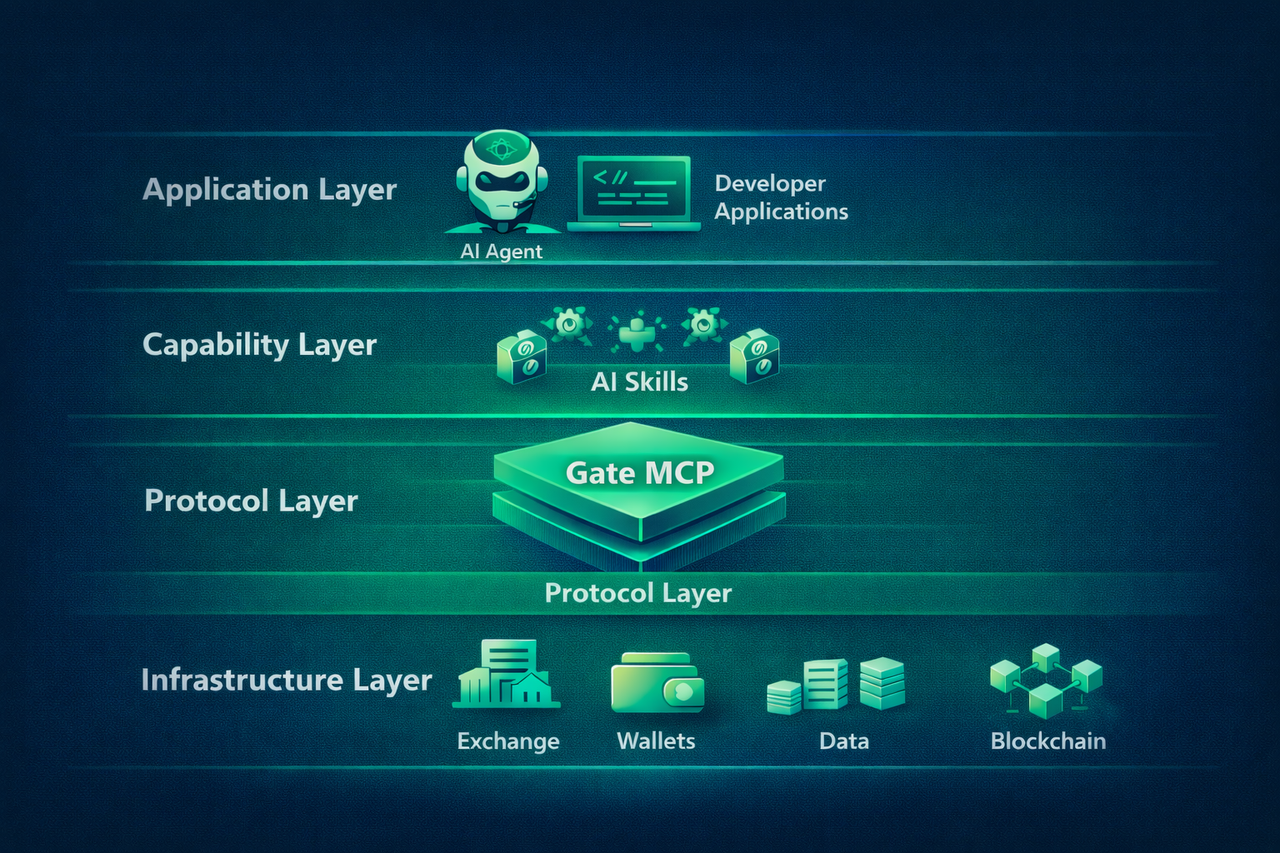
Within the Gate for AI architecture, four layers define the system structure:
-
Application Layer — AI agents and developer applications
-
Capability Layer — AI Skills and workflow orchestration
-
Protocol Layer — Gate MCP
-
Infrastructure Layer — exchange services, decentralized trading systems, wallet infrastructure, and data APIs.
Gate MCP operates in the protocol layer, acting as the communication bridge between AI agents and the underlying crypto infrastructure.
The typical interaction process includes:
-
An AI agent generates a request such as retrieving token data or executing a trade.
-
The request is formatted according to MCP standards.
-
Gate MCP routes the request to relevant crypto services.
-
Structured data or execution results are returned to the AI agent.
This architecture enables AI systems to interact with multiple services within a single standardized environment.
Developer Implementation of Gate MCP
Developers can integrate Gate MCP into AI agent systems to enable interaction with crypto infrastructure.
The process generally involves several steps:
-
Agent integration: Developers connect an AI agent framework to the MCP interface.
-
Module selection: The system allows access to modules such as:
-
trading services
-
decentralized exchange functions
-
wallet infrastructure
-
market information and analytics
-
Tool invocation: AI agents call MCP tools to retrieve data or execute actions.
-
Workflow orchestration: Higher-level operations can be built by combining multiple MCP tool calls.
Within the Gate for AI ecosystem, these workflows may also be managed through AI Skills, which orchestrate multiple MCP tools to perform complex tasks such as trading or portfolio monitoring.
Advantages of MCP-Based Crypto Infrastructure
Infrastructure built around MCP provides several architectural advantages for AI-driven crypto systems.
| Feature |
Description |
| Standardized Interfaces |
AI agents can access multiple services through a consistent protocol, enabling unified interaction across different tools and APIs. |
| Modular Architecture |
Individual services can be added, updated, or replaced without redesigning the entire system architecture. |
| Cross-Model Compatibility |
The infrastructure can integrate with different AI frameworks and models, allowing multiple agents to interact with the same protocol environment. |
| Workflow Automation |
Complex tasks can be executed by combining multiple MCP tools through orchestration layers, enabling automated multi-step operations. |
These characteristics help support environments where autonomous agents interact with financial infrastructure.
Risks and Considerations
Although MCP-based architectures improve interoperability, they also introduce several challenges.
Security management: External tool access must be carefully controlled to prevent unauthorized actions.
Operational complexity: Managing large numbers of AI agents and tool interactions requires monitoring and policy management.
Reliability of external data: AI decisions may depend on the accuracy and availability of external data sources.
Autonomous execution risks: If AI agents are permitted to execute financial operations, appropriate safeguards and oversight mechanisms are necessary.
The Future of AI-Native Crypto Infrastructure
The development of Gate MCP reflects a broader transition toward AI-native financial infrastructure.
In this model, AI agents become active participants in digital systems rather than passive analysis tools. Instead of simply generating insights, agents may retrieve data, analyze conditions, and interact with financial services.
Within the crypto ecosystem, this approach could support applications such as:
-
automated trading agents
-
AI-driven market research systems
-
autonomous portfolio monitoring
-
intelligent blockchain data analysis
Gate MCP represents an early example of infrastructure designed to support these types of AI-driven interactions.
Conclusion
Gate MCP is a protocol layer within the Gate for AI ecosystem that connects AI agents with cryptocurrency infrastructure through standardized tools and interfaces.
By enabling structured access to trading systems, wallets, market data, and blockchain analytics, it provides a framework through which AI systems can interact with digital asset markets.
As AI agents become more capable of executing complex workflows, infrastructure such as Gate MCP may play an increasingly important role in enabling secure and scalable AI-driven financial systems.
FAQs
What is Gate MCP?
Gate MCP is a protocol layer that connects AI agents to crypto infrastructure and provides standardized access to tools such as trading, market data, wallet services, and blockchain analytics.
What is Gate for AI?
Gate for AI is an AI-native crypto infrastructure platform that enables AI agents to interact with crypto markets through MCP and modular AI Skills.
What are AI Skills?
AI Skills are task-level capabilities that orchestrate multiple MCP tools to allow AI agents to complete workflows such as trading, market analysis, or portfolio monitoring.
Can AI agents execute crypto operations through MCP?
Through MCP tools, AI agents can access services such as market data, blockchain information, and trading interfaces, depending on the capabilities exposed by the infrastructure.