As decentralized applications and on-chain protocols continue to expand, traditional data indexing tools are increasingly unable to meet the demands for low latency, rich visualization, and automated alerts. Sentio offers a solution better suited for real-time monitoring needs.
Within the Web3 infrastructure stack, data indexing platforms act as a critical bridge between on-chain data and application layers. Whether for DeFi monitoring, risk detection, or user behavior analysis, efficient data infrastructure is essential. Sentio enhances data accessibility and responsiveness through real-time indexing, customizable dashboards, and automated alerts, making it an important component of the Web3 data layer.
What Is Sentio (ST)?
Sentio is a Web3 data infrastructure platform focused on real-time on-chain data processing. It provides developers with tools for data indexing, visual analytics, and automated alerting. Its goal is to transform complex blockchain data into real-time, usable insights that support protocol monitoring, risk management, and business analytics.
Unlike traditional indexing protocols, Sentio’s defining feature is its real-time capability. Conventional platforms typically rely on offline synchronization or periodic updates, whereas Sentio captures and processes blockchain events as they happen, allowing developers to receive immediate feedback.
What Problems Does Sentio Solve in On-Chain Data Infrastructure?
Web3 applications generate vast amounts of on-chain data, but this data is often complex, difficult to process, and slow to access. Developers who pull data directly from blockchain nodes must invest significant resources into parsing, storing, and processing it, which increases both development and maintenance costs.
Sentio primarily addresses three key challenges:
First, data latency. Traditional indexing tools often struggle to deliver real-time updates, yet timely data is critical for DeFi risk management and protocol operations.
Second, limited data visualization. On-chain data typically exists as raw event logs, making it hard to analyze quickly. Sentio converts this data into intuitive visual metrics through dashboards.
Third, lack of automated alerting. Manual monitoring is inefficient when anomalies occur. Real-time alert systems significantly improve response speed and operational awareness.
How Does Sentio’s Real-Time Data Indexing Work?
Sentio’s real-time indexing mechanism consists of three main stages: on-chain event monitoring, data parsing and processing, and real-time output.
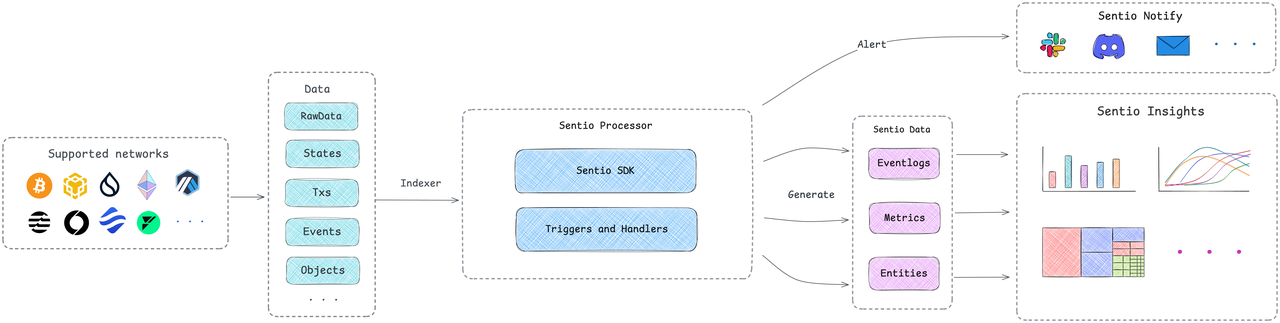
First, the system continuously listens to smart contract events on the blockchain, including transactions, state changes, and fund flows. When an event occurs, Sentio captures the relevant data immediately.
Next, the platform parses and structures the captured data, converting raw logs into readable formats. This allows developers to use the data directly without building complex parsing logic themselves.
Finally, the processed data is delivered to visualization dashboards or alert systems for real-time display and notifications. This end-to-end process significantly lowers the barrier to working with on-chain data.
What Are the Roles of Sentio’s Visualization and Alert Features?
Sentio offers customizable dashboards that allow developers to monitor protocol performance in real time, including key metrics such as transaction volume, active addresses, and fund flows.
The value of visualization lies in turning raw data into intuitive charts, enabling teams to quickly identify trends and anomalies. For example, sudden changes in a metric can be immediately spotted through the dashboard.
In addition, Sentio’s alert system lets users define monitoring conditions. When on-chain data reaches specified thresholds, the system automatically triggers notifications. This is especially useful for detecting abnormal transactions, tracking large fund movements, and issuing protocol risk warnings.
What Is the Role of the ST Token in the Sentio Ecosystem?
ST is the core utility token within the Sentio ecosystem, connecting platform services with participants.
On one hand, ST can be used to pay for platform resources and services, such as advanced analytics features or specialized data processing capabilities. On the other hand, it serves as an incentive mechanism to encourage developers and users to contribute to the ecosystem.
As the ecosystem evolves, ST may also take on governance functions, allowing token holders to participate in certain protocol decisions and enhancing overall network coordination.
What Are Sentio’s Main Use Cases?
Sentio’s real-time data capabilities make it suitable for a wide range of Web3 scenarios.
In DeFi protocol monitoring, Sentio can track liquidity changes, transaction volumes, and risk indicators, helping teams stay informed about protocol performance in real time.
In security alerting, the platform monitors abnormal fund movements or large transactions, reducing potential risks.
In on-chain operational analytics, Sentio helps projects analyze user behavior, transaction patterns, and growth trends, providing data-driven insights for product optimization.
These use cases position Sentio as a key tool bridging on-chain data and business operations.
Sentio vs The Graph: A Comparison of Web3 Data Protocols
Sentio and The Graph both focus on on-chain data processing, but they differ in their priorities.
| Comparison Dimension |
Sentio |
The Graph |
| Data Update Method |
Real-time indexing |
Subgraph indexing |
| Data Response Speed |
High |
Relatively slower |
| Visualization |
Built-in dashboards |
Requires external integration |
| Automated Alerts |
Supported |
Not supported |
| Use Cases |
Real-time monitoring and alerts |
Data querying and aggregation |
Overall, The Graph is better suited for building data query interfaces, while Sentio excels in scenarios that require real-time monitoring and automated responses.
Limitations and Risks of Sentio
Although Sentio offers real-time data capabilities, its effectiveness depends on the quality of underlying on-chain data. If the source data is delayed or inaccurate, the analysis results may also be affected.
Additionally, real-time data processing requires substantial infrastructure resources, which can lead to higher operational costs. For smaller applications, this may create a barrier to adoption.
From an ecosystem perspective, Sentio’s long-term value depends on developer adoption and ecosystem growth. Without sufficient scale, its network effects may remain limited.
Conclusion
Sentio is a Web3-focused real-time on-chain data infrastructure platform that provides efficient data support through real-time indexing, visual analytics, and automated alerts. It addresses the limitations of traditional platforms in terms of latency, visualization, and alerting capabilities, demonstrating strong value in areas such as DeFi monitoring, security alerts, and on-chain analytics.
As demand for real-time data continues to grow in Web3 applications, infrastructure solutions like Sentio are likely to play an increasingly important role in the on-chain ecosystem.
FAQs
What is the difference between Sentio and The Graph?
The Graph is primarily used for querying on-chain data, while Sentio focuses on real-time monitoring and automated alerting.
What is the purpose of the ST token?
ST is used for ecosystem incentives, payment for platform services, and potential governance functions.
What scenarios is Sentio suitable for?
Sentio can be used for DeFi monitoring, security alerts, on-chain data analysis, and user behavior analytics.
What is Sentio’s core advantage?
Its main strength lies in real-time data indexing, combined with built-in visualization and automated alert features.







