As modular blockchains continue to evolve, users evaluating infrastructure are no longer focused only on security. Execution efficiency and cross chain capability have also become central concerns, making execution layer design a new competitive frontier.
This question usually involves three core dimensions: execution layer architecture, cross chain communication mechanisms, and scaling pathways. Together, these factors define SOON’s technical position within the modular ecosystem.
What Is SOON? The Core Definition of an SVM Rollup Execution Layer
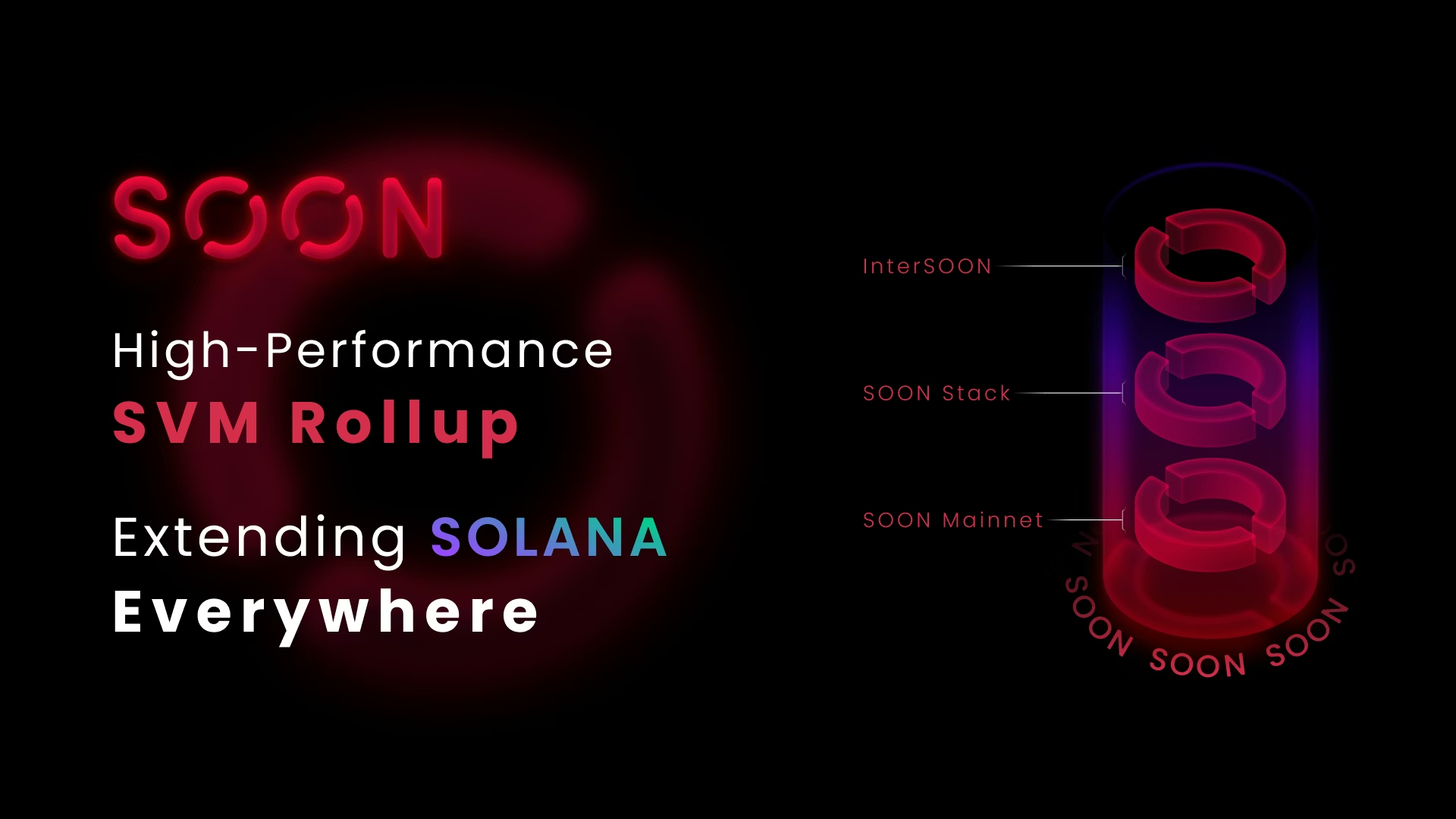
SOON is a Rollup based execution layer built around the SVM, or Solana Virtual Machine. Its goal is to bring high performance execution capabilities into different blockchain ecosystems.
At the mechanism level, SOON separates the execution layer from the traditional blockchain stack. Through a Rollup architecture, it splits transaction execution from final settlement, allowing execution to take place in a high performance environment while security is anchored by the underlying chain.
Structurally, SOON is not an independent public chain. It is an execution layer network that relies on different base chains for settlement while using its own execution environment to process transaction logic.
The significance of this design is that it shifts blockchain systems away from a single monolithic architecture and toward a modular framework, where execution becomes composable infrastructure.
How SOON’s Overall Architecture Is Designed
SOON’s architecture follows a modular design that separates execution, settlement, and data availability into independent layers.
Mechanically, the execution layer is powered by the SVM and handles transactions and smart contract logic. The settlement layer is typically provided by base chains such as Ethereum and is responsible for final state confirmation. The data availability layer stores transaction data.
From a structural perspective, this creates a three layer model that separates execution, settlement, and data. Each module can be optimized or replaced independently.
The importance of this design lies in its ability to improve performance while preserving security, and to support coordination across multiple chains.
How SOON Stack and Rollup Deployment Logic Work
SOON Stack is a deployment framework for SVM Rollups that allows developers to build execution layer networks more efficiently.
At the mechanism level, developers use SOON Stack to create Rollup instances and configure the execution environment, settlement layer, and data availability solution, allowing different chains to share execution logic.
Structurally, SOON Stack functions like modular infrastructure. It abstracts the complexity of chain deployment into standardized components, allowing developers to focus more on application layer development.
The value of this design is that it lowers the barrier to deploying Rollups, making execution layer capabilities easier to replicate and scale across ecosystems.
What Role SOON Mainnet Plays in the Execution Layer
SOON Mainnet is the core live instance of the execution layer network, where real transactions and applications run.
Mechanically, the Mainnet processes user transaction requests, executes smart contract logic through the SVM, and then submits the results to the settlement layer for confirmation.
Structurally, the Mainnet functions as a high performance execution environment that connects users with the underlying blockchain, allowing complex computation to be handled efficiently outside the base chain.
The significance of this design is that it removes execution load from the underlying chain, improving the overall throughput of the system.
How InterSOON Enables Cross Chain Communication and Interoperability
InterSOON is the cross chain communication protocol within the SOON ecosystem, designed to connect data and assets across different chains.
At the mechanism level, InterSOON uses a message passing system to transfer state information between different Rollups and main chains, allowing transaction results to be synchronized across multiple networks.
Structurally, InterSOON acts as an intermediate layer linking different execution environments, creating a unified communication network across chains.
The significance of this design is that it allows SOON to function as cross ecosystem execution infrastructure rather than remaining limited to a single chain.
The Core Mechanism and Design Value of Decoupled SVM
Decoupled SVM is one of SOON’s key technologies. By separating the execution layer from the consensus layer, it is designed to improve performance.
Mechanically, execution logic is handled by the SVM, while consensus and security are provided by the underlying chain. The two are connected through interfaces, but remain independent.
Structurally, this decoupled design allows the execution layer to scale independently rather than being constrained by the performance limits of the base chain.
The significance of this approach is that execution capabilities can be reused across multiple chains, helping form a shared execution infrastructure.
How Horizontal Scaling Supports Expansion
Horizontal Scaling is SOON’s scaling strategy. It improves performance by adding execution nodes.
Mechanically, the system increases throughput by scaling the number of nodes rather than relying on stronger individual node performance, allowing the network to expand as demand grows.
Structurally, this horizontal approach enables the execution layer to support larger transaction volumes while maintaining stability.
The significance of this design is that, at least in theory, it gives SOON stronger scaling potential for large scale application scenarios.
What Role the SOON Token Plays in the Economic Model
The SOON token is the core value carrier linking the execution layer with ecosystem incentives. Its main functions are to pay for computation and support network operations.
Mechanically, when users submit transactions or interact with applications on a SOON Rollup, they consume SOON as gas, which provides incentives for execution nodes. This design directly ties computing resources to token consumption, allowing fees to change dynamically with network usage.
Structurally, SOON serves as a unified settlement asset across multiple appchains, maintaining a consistent value standard between different Rollups. At the same time, during InterSOON cross chain communication, message passing and state synchronization also rely on SOON as the fee medium.
The significance of this model is that it creates a unified loop across execution, cross chain communication, and incentives, positioning SOON as a foundational asset for the broader SVM Rollup ecosystem.
How SOON Differs From Traditional L2s or Public Chains
SOON differs from traditional L2s and public chains in both design goals and technical approach.
Mechanically, traditional L2s are usually based on the EVM, while SOON uses the SVM as its execution environment. Public chains, by contrast, typically combine execution and consensus within a single system.
Structurally, SOON adopts a modular architecture in which the execution layer is separated out, whereas traditional public chains generally follow a monolithic design.
The importance of this difference is that SOON places greater emphasis on execution layer capability rather than optimizing the performance of a single chain.
How to Understand SOON’s Strengths and Limitations
SOON’s strengths lie in its execution performance and modular design, though it also comes with certain limitations.
Mechanically, its high performance execution capability comes from the SVM and modular architecture, while its constraints stem from cross chain complexity and the maturity of the ecosystem.
Structurally, SOON depends on coordination between underlying chains and cross chain protocols, which increases system complexity.
The significance of this structure is that SOON seeks a balance between performance and flexibility, though broader ecosystem support is still needed.
Conclusion
Through its SVM Rollup architecture, SOON separates the execution layer from the consensus layer, providing high performance execution within a modular blockchain framework while using cross chain communication and scaling mechanisms to build a new form of infrastructure.
FAQ
Is SOON a public chain or a Layer 2?
SOON is an execution layer Rollup network, not a traditional public chain.
What is the difference between an SVM Rollup and an EVM Rollup?
The main difference is the execution environment. The SVM is designed to provide higher performance computation.
Does SOON depend on Ethereum?
Its settlement layer can rely on underlying chains such as Ethereum for security.
What is the purpose of InterSOON?
It is used to enable data and asset communication across different chains.
What is SOON’s core advantage?
Its main advantage lies in its execution performance and the scaling potential enabled by its modular architecture.