As blockchain applications expand from simple transaction records to AI datasets, on-chain media content, and complex Web3 applications, traditional centralized storage architectures have begun to reveal limitations in reliability, censorship resistance, and cost efficiency. Decentralized storage protocols have therefore become an important component of Web3 infrastructure, and Walrus represents one of the projects emerging within this trend.
From a technological perspective, the value of Walrus extends beyond reducing storage costs. Its architecture integrates distributed data storage with blockchain smart contract systems, allowing stored data to function as a programmable on-chain resource. This design opens new infrastructure possibilities for scenarios such as AI training datasets, on-chain media content, and data availability layers for rollup-based scaling systems.
What Is Walrus (WAL)?
 Source: Walrus official website
Walrus is built on the Sui blockchain and is designed to store and manage large data files such as videos, images, and AI datasets. Through a distributed network of storage nodes, the protocol aims to ensure data availability, reliability, and security.
Unlike traditional cloud storage systems that rely on centralized servers, Walrus distributes data across globally distributed nodes and verifies data integrity through blockchain-based mechanisms. This structure allows data to remain accessible even if some nodes fail or experience disruptions.
The protocol focuses on managing blob data (Binary Large Objects), which refers to large and complex data content. Examples include:
Through this architecture, Walrus transforms data storage from a traditional infrastructure service into a composable Web3 infrastructure component.
Core Technical Architecture and Operational Mechanisms of Walrus
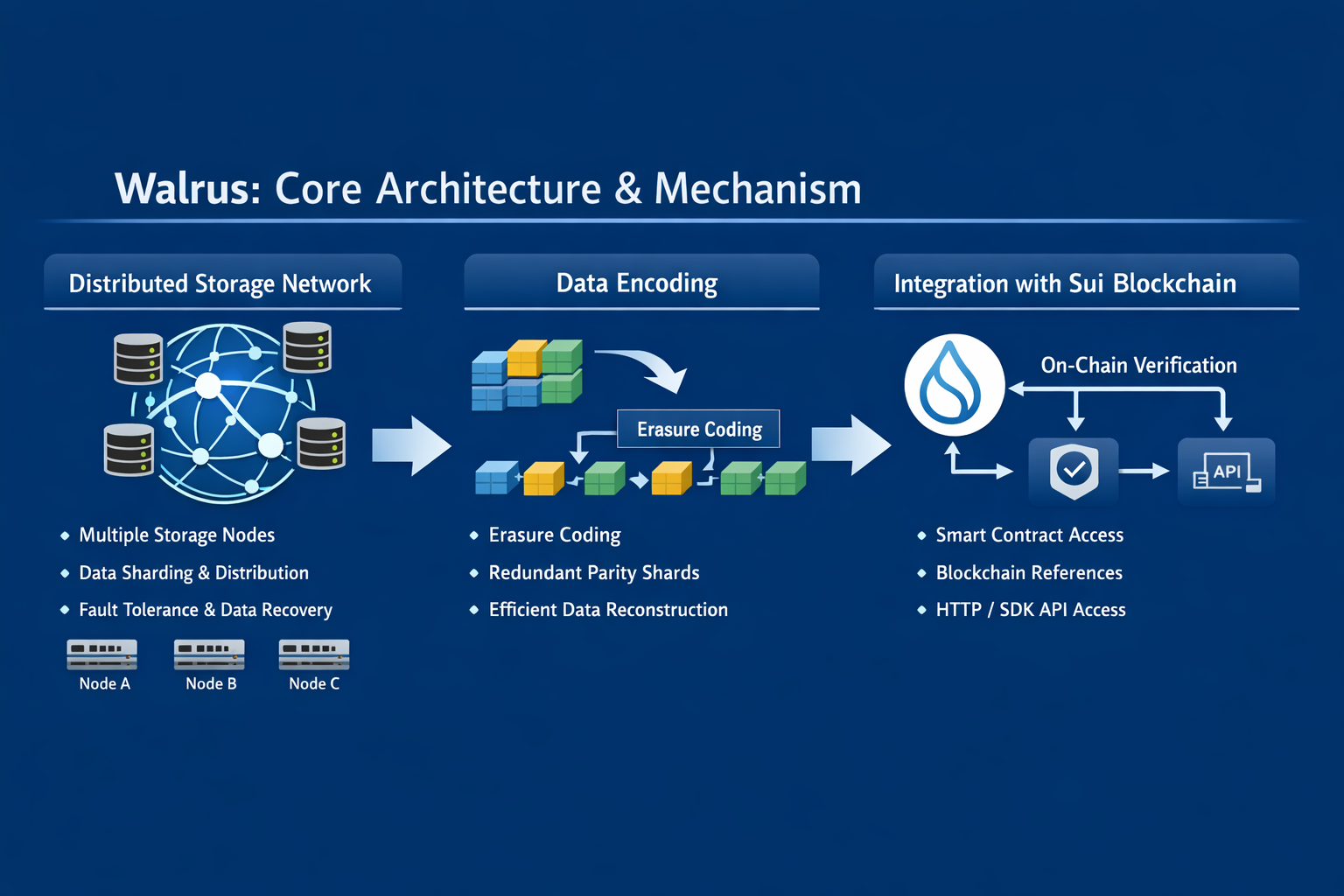
Walrus builds its technical architecture1. ### Payment for Storage Services around three core components: distributed storage, on-chain verification, and efficient data encoding.
Distributed Storage Node Network
Walrus operates through a network of distributed storage nodes responsible for storing data and providing access services.
When users upload data, the system divides the file into multiple fragments and distributes them across different nodes for storage. This structure provides two main advantages:
Even if some nodes go offline, the system can still recover the complete data set.
Erasure Coding for Data Encoding
Walrus uses advanced data encoding techniques such as erasure coding. This method relies on redundant data fragments to ensure data recoverability while reducing overall storage costs.
Compared with traditional replication-based storage, erasure coding can:
-
Reduce the amount of redundant data
-
Improve storage efficiency
-
Increase network fault tolerance
Deep Integration With the Sui Blockchain
Walrus is deeply integrated with the Sui blockchain, allowing stored data to be referenced by on-chain objects.
Developers can access stored content directly through:
-
Smart contracts
-
SDK tools
-
HTTP APIs
This integration enables storage data to become part of Web3 application logic, supporting decentralized applications that require large-scale data resources.
Walrus Decentralized Governance Mechanism
Walrus adopts an on-chain governance model, allowing community members to participate in protocol decision-making by holding WAL tokens.
Governance processes typically include several areas.
Parameter Adjustments
Community proposals may adjust network parameters such as:
-
Storage fees
-
Node reward mechanisms
-
Staking ratios
Protocol Upgrades
Community voting can determine protocol upgrades, including:
Node Penalty Mechanisms
Governance also includes oversight of node behavior. For example, nodes may face penalties if they fail to meet required standards, such as:
-
Data unavailability
-
Poor service performance
If nodes do not meet operational requirements, they may receive penalties or reductions in their staked assets.
WAL Tokenomics and Distribution Mechanism
WAL functions as the native token of the Walrus protocol and plays several important roles in the operation of the network.
-
Payment for Storage Services
Users pay WAL tokens when uploading data to the network as storage fees.
These fees are distributed to:
This mechanism incentivizes participants who maintain and secure the network infrastructure.
-
Network Security and Staking
Storage nodes must stake WAL in order to participate in the network.
If a node fails to provide reliable service or violates protocol rules, a portion of its staked tokens may be reduced through a slashing mechanism.
-
Governance Participation
WAL holders can participate in protocol governance, including decisions such as:
-
Token Supply
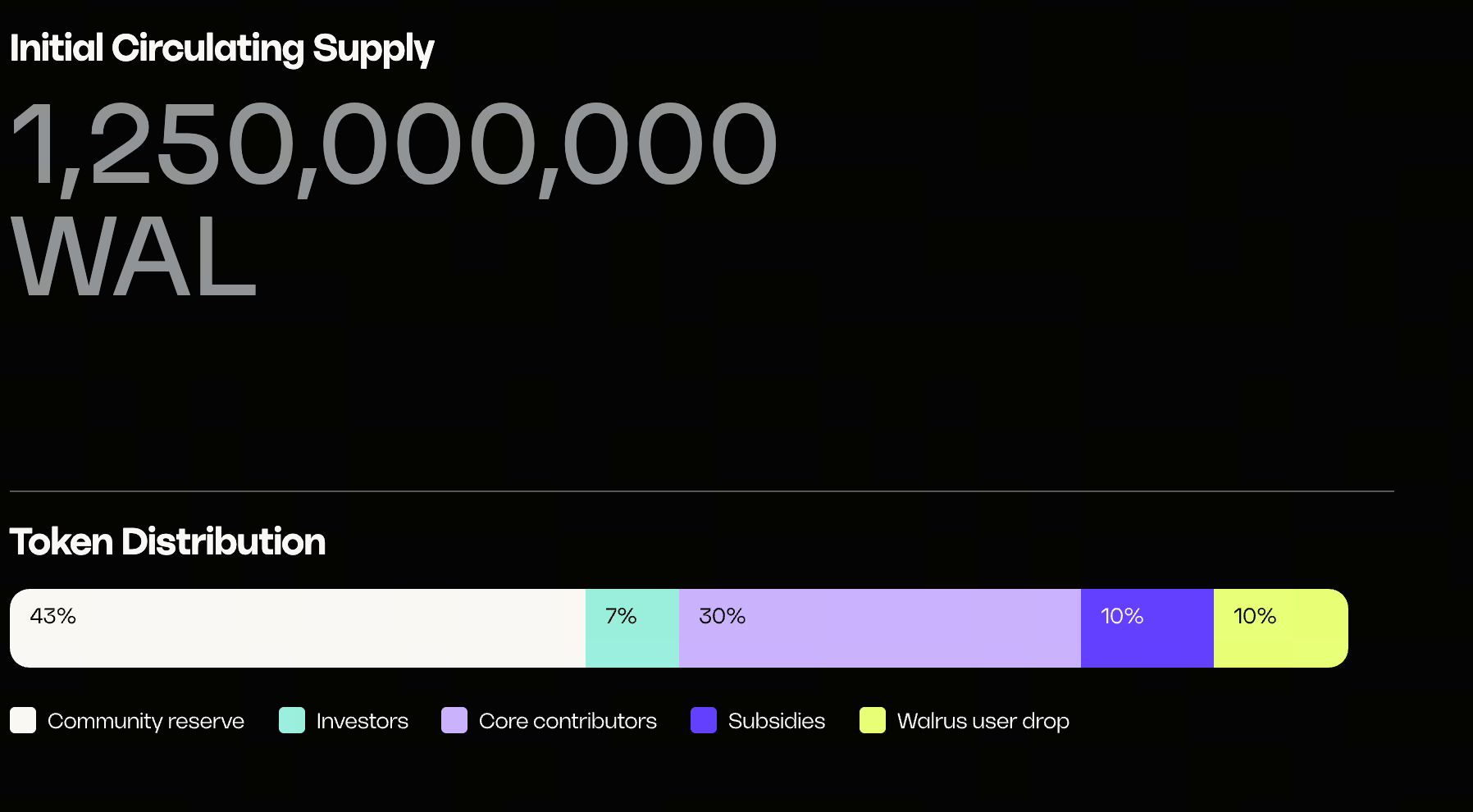
The maximum supply of WAL is approximately 5 billion tokens, with about 1.25 billion currently in circulation. Tokens are gradually released into the market through a structured distribution schedule.
Some mechanisms also include token burning designs, which may help maintain long-term value stability within the ecosystem.
Main Use Cases and Application Directions of Walrus
Walrus provides decentralized storage capabilities that support a variety of Web3 and data intensive applications.
AI Data and Model Storage: Training AI models often requires large volumes of high quality datasets. Walrus can provide decentralized storage for datasets, model version management, and verifiable data sources. This infrastructure helps improve the credibility and traceability of AI training data.
Web3 Media Content Storage: Walrus can store video files, NFT media resources, and Web3 website assets. By hosting these resources in a decentralized storage network, applications can reduce reliance on centralized servers and achieve a more fully decentralized architecture.
Layer2 Rollup Data Availability: Rollup networks generate large amounts of transaction data that must be stored to ensure verifiability. Walrus can serve as a data availability layer, providing storage services that reduce the burden on the main chain while improving overall scalability.
In addition, Walrus can support blockchain historical data archiving, such as storing blockchain state data and past transaction records. This allows nodes and developers to access reliable data storage solutions at lower cost.
Differences Between Walrus and Other Decentralized Storage Protocols
Several decentralized storage projects already exist in the market, including:
Walrus takes a somewhat different technical positioning compared with these systems.
| Protocol |
Underlying Architecture |
Storage Model |
Data Type Positioning |
Performance Characteristics |
Economic Model |
Typical Use Cases |
| Walrus |
Decentralized storage network built on the Sui blockchain |
Sharding plus erasure coding |
Primarily designed for large blob data such as videos, AI datasets, and application resource files |
High throughput and high availability, suitable for data intensive applications |
WAL token used for storage fees, node staking, and governance |
AI dataset storage, Web3 application data, rollup data availability, on-chain media |
| Filecoin |
Decentralized storage marketplace based on the IPFS protocol |
Storage proofs (PoRep / PoSt) |
General file storage |
Suitable for long term storage but with relatively slower retrieval speeds |
FIL token used for storage transactions and miner incentives |
Decentralized cloud storage, data backup, Web3 file storage |
| Arweave |
Blockweave permanent storage network |
One time payment for permanent storage |
Long term archival data |
Data stored permanently, suitable for static content |
AR token used to pay for permanent storage |
NFT metadata, web page archiving, historical data preservation |
| Storj |
Distributed object storage network |
Encrypted data sharding with redundancy |
General file storage |
Fast retrieval speeds, similar to traditional cloud storage |
STORJ token used for storage and bandwidth rewards |
Enterprise cloud storage, file sharing |
| Sia / Skynet |
Decentralized storage rental marketplace |
Contract driven data storage |
General files |
Lower storage costs but smaller ecosystem |
SC token used for storage payments |
File backup, decentralized content distribution |
| Celestia (Data Availability Layer) |
Modular blockchain architecture |
Data availability sampling |
Blockchain transaction data |
Focused on rollup data availability |
TIA token used for network security and governance |
Rollup data storage, modular blockchain infrastructure |
Walrus places stronger emphasis on high performance data processing and developer programmability, making it particularly suitable for AI and Web3 applications.
Risks to Consider When Evaluating Walrus (WAL)
Although Walrus shows technical innovation potential in the decentralized data storage sector, evaluating its investment prospects involves multiple uncertainties and risks.
-
The decentralized storage sector is still in a relatively early stage. The long term stability of protocols, the scale of storage networks, and real world demand for decentralized storage infrastructure still require time to be validated.
-
The competitive landscape is relatively intense. Several projects with strong market recognition already exist in this field, including Filecoin, Arweave, and Celestia. These projects have developed different competitive advantages in areas such as network scale, ecosystem partnerships, and technical architecture.
-
Token economics may affect market dynamics. If a large number of WAL tokens enter circulation during the early stages of the project, the increase in supply may place short term pressure on the market’s supply and demand balance.
-
Ecosystem adoption speed is another important factor. The long term value of the protocol will largely depend on whether developers continue building applications on the network and whether overall demand for decentralized storage grows across the broader Web3 ecosystem.
For these reasons, evaluating the investment value of Walrus (WAL) requires considering multiple aspects, including technical maturity, market competition, token economic design, and ecosystem development progress.
Future Development Direction and Market Potential of Walrus (WAL)
As Web3, AI, and data intensive applications continue to expand, decentralized storage is becoming an increasingly important component of blockchain infrastructure. Built within the Sui ecosystem, Walrus aims to provide more than decentralized file storage. The protocol also seeks to transform data into programmable and verifiable on-chain resources, expanding the capabilities of Web3 data infrastructure.
From a development perspective, Walrus may have potential growth opportunities in several areas:
-
AI data infrastructure: Training AI models requires large scale data storage and verification capabilities. Decentralized storage networks can support dataset management and model version tracking.
-
Web3 application data layer: Large files such as videos, images, game assets, and NFT metadata require reliable storage solutions. Walrus’s blob data storage architecture can provide a foundational data layer for Web3 applications.
-
Cross chain data services: Although Walrus is deeply integrated with the Sui ecosystem, its storage services may potentially be accessed by other blockchain ecosystems.
-
Data assetization trends: As the value of on-chain data increases, data itself may gradually become a tradable asset. Decentralized storage networks can provide infrastructure for data sharing and emerging data marketplaces.
From a market perspective, Walrus has attracted investment from several crypto focused institutions and has raised approximately 140 million USD to support ecosystem development. If the protocol succeeds in expanding its developer ecosystem and increasing network usage, Walrus may establish a role within Web3 data infrastructure. However, its long term development will depend on ecosystem adoption, network scale, and the overall growth of the decentralized storage sector.
Conclusion
Walrus is a decentralized data storage protocol built on the Sui blockchain, designed to support Web3 and AI applications with efficient and verifiable data infrastructure. Through its distributed storage network, advanced data encoding methods, and WAL token incentive structure, the protocol aims to create a secure, scalable, and developer friendly storage platform.
Although the decentralized storage sector remains highly competitive, continued growth in Web3 applications and increasing demand for AI related data infrastructure suggest that Walrus may still hold meaningful development potential in the years ahead.
FAQs
Q1: What is Walrus (WAL)?
Walrus is a decentralized data storage protocol built on the Sui blockchain. It focuses on efficiently storing large data files and providing storage infrastructure for Web3 applications.
Q2: What is the role of the WAL token?
WAL is used to pay for storage services, stake nodes that maintain the network, and participate in protocol governance.
Q3: How does Walrus differ from Filecoin?
Filecoin mainly focuses on long term decentralized storage markets, while Walrus places greater emphasis on high performance data processing and programmable storage for application development.
Q4: What types of applications can Walrus support?
Walrus can support several data intensive use cases, including AI dataset storage, Web3 media content hosting, rollup data availability services, and blockchain historical data archiving.







