As demand for computing power continues to surge with the growth of AI applications, GPU resources are increasingly becoming critical infrastructure. In traditional cloud computing models, resource allocation and pricing are controlled by centralized platforms, where fee structures and execution processes often lack transparency.
Against this backdrop, WorldLand aims to build a new kind of compute economy using blockchain. By introducing the WL token, the network not only incentivizes the supply of computing power but also integrates computation execution, verification, and value distribution into a unified on-chain economic system.
WL Tokenomics Overview: The Structure of the WorldLand Economy
The WorldLand economic model revolves around compute tasks, bringing together compute supply, execution, and value distribution within a single system. Users pay WL for computation, GPU providers execute tasks and earn rewards, validator nodes ensure the integrity of results, and the network operates through token-driven coordination.
This structure forms a closed loop where computing resources can be priced, utilized, and verified, creating an economy centered on verifiable computation.
What Is WL? The Medium of Value in the WorldLand Network
As the native token of WorldLand, with a total supply of 1 billion, WL plays a central role in value transfer and incentives. It functions both as a payment method for users accessing compute services and as a reward for nodes participating in network operations.
Unlike traditional blockchain tokens primarily used for trading, WL is directly tied to computational activity, meaning its value is closely linked to real demand for computing within the network.
WL Issuance and Distribution Mechanism
WL is issued based on a PoW mechanism, with new tokens gradually released through block production. This approach not only helps secure the network but also provides incentives for early participants.
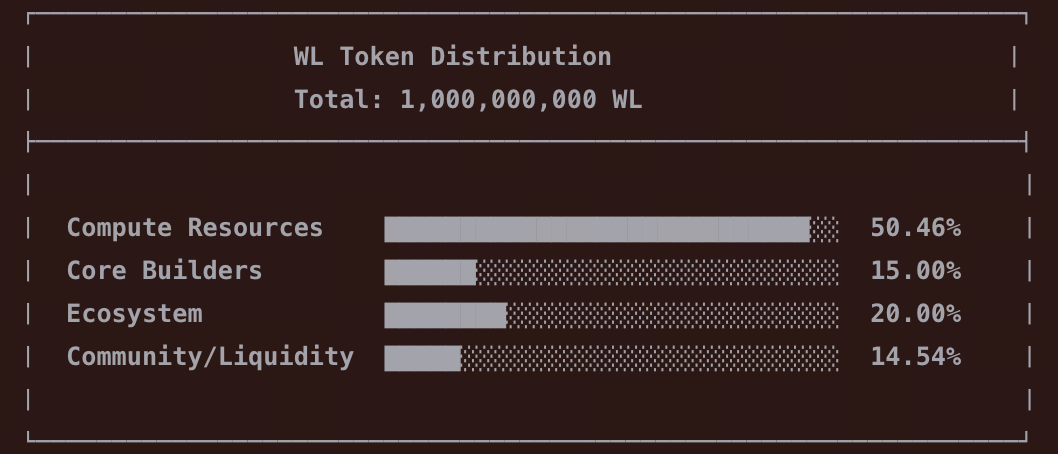 Image source: WorldLand
In terms of allocation, WL is distributed across multiple stakeholders, including mining rewards, ecosystem development funds, and long-term infrastructure support.
Incentive Mechanism: Driving GPU Providers and Validator Participation
WorldLand’s incentive model is built around compute tasks. GPU providers earn WL by executing AI computation jobs, while validator nodes receive rewards by participating in the Proof of Compute verification process.
This design aligns compute supply with network security. On one hand, nodes earn rewards by performing genuine computation. On the other, the network ensures result integrity through incentives. Together, these elements support the system’s long-term stability.
Gas Mechanism: How WL Powers Fees and Compute Pricing
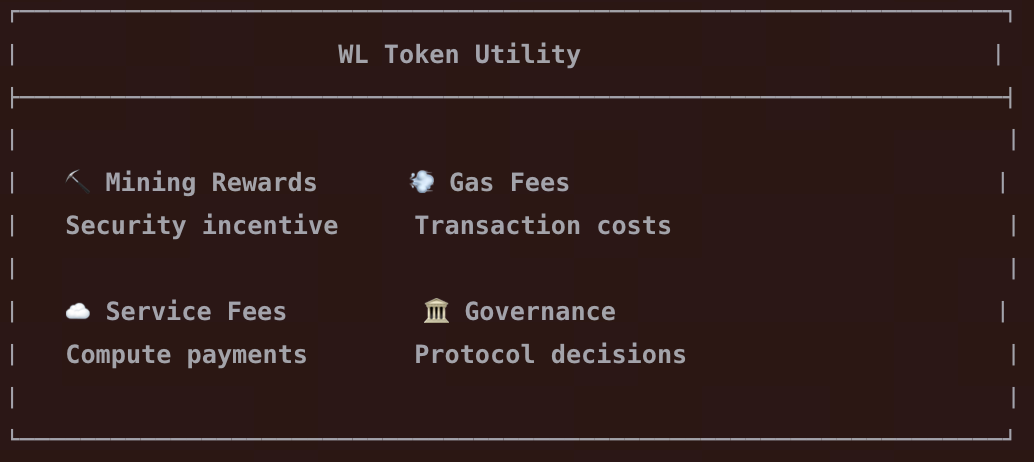
Within the WorldLand network, WL also functions as Gas, covering both on-chain transaction fees and the cost of executing compute tasks. Unlike traditional blockchains where Gas is limited to transaction fees, WL extends its role to pricing computational resources.
When users submit tasks, they pay fees based on task complexity and resource consumption. As a result, Gas becomes not just an operational cost, but also a pricing signal in the compute market.
AI Compute Economy: Connecting Supply, Demand, and Task Markets
At its core, WorldLand connects compute supply and demand through WL. Demand-side participants, such as AI developers, pay WL to access computing resources, while supply-side participants, GPU nodes, earn rewards by completing tasks.
Throughout this process, the verification layer ensures the authenticity of results, allowing the entire system to operate on a verifiable foundation. This creates a closed loop consisting of task submission, computation execution, validation, and token settlement, forming a complete decentralized compute marketplace.
How WL Captures the Value of Verifiable Computation
In traditional cloud computing, the value generated by computation is typically captured by centralized platforms. In WorldLand, however, this value is distributed among network participants through WL.
The execution of compute tasks generates real value, while Proof of Compute ensures its validity. WL acts as the value carrier, converting computation outcomes into transferable economic rewards that can be distributed and exchanged among participants.
As a result, WL derives its value not merely from trading demand, but directly from computational demand.
The Role of WL in the Ecosystem: Governance, Staking, and Security
Beyond payments and incentives, WL also plays a role in governance and network security. Token holders can participate in governance processes, influencing protocol parameters and development directions to a certain extent.
In some designs, WL may also be used for staking, helping strengthen network security or raising participation thresholds for nodes. These functions further expand the token’s role, making it not just a payment tool but an integral part of the network’s operation.
Key Features and Potential Challenges of the WL Token Model
The WorldLand token model has several defining characteristics. First, its value is tied to real computational demand, rather than relying solely on market trading. Second, it combines incentives with verification, aligning economic rewards with network security.
However, the model also faces challenges. For example, in the early stages of the network, limited compute demand may weaken incentive effectiveness. Token price volatility could also impact compute costs. Additionally, the system’s complexity may raise the barrier for user understanding and adoption.
Conclusion
WL is more than just a payment token within the WorldLand network. It serves as the core mechanism connecting compute supply and demand, verification, and value distribution. By integrating computation with economic incentives, WorldLand creates a decentralized economy built on verifiable computation.
This model offers a new pathway for integrating AI and blockchain, and provides a valuable reference for the future development of distributed computing infrastructure.
FAQs
What is the primary use of the WL token?
WL is used to pay for computation, transaction Gas fees, and to incentivize GPU nodes and validator nodes.
How do GPU nodes earn WL?
They earn rewards by executing compute tasks and submitting valid results.
How is WL Gas different from traditional blockchain Gas?
WL is used not only for transaction fees but also for pricing computational resources, directly tied to actual compute consumption.
How does WL integrate with AI computing?
Users pay WL for AI compute tasks, and GPU nodes execute those tasks in exchange for rewards.
Does WL have governance functionality?
Yes, WL can be used to participate in network governance and influence protocol development to a certain extent.







