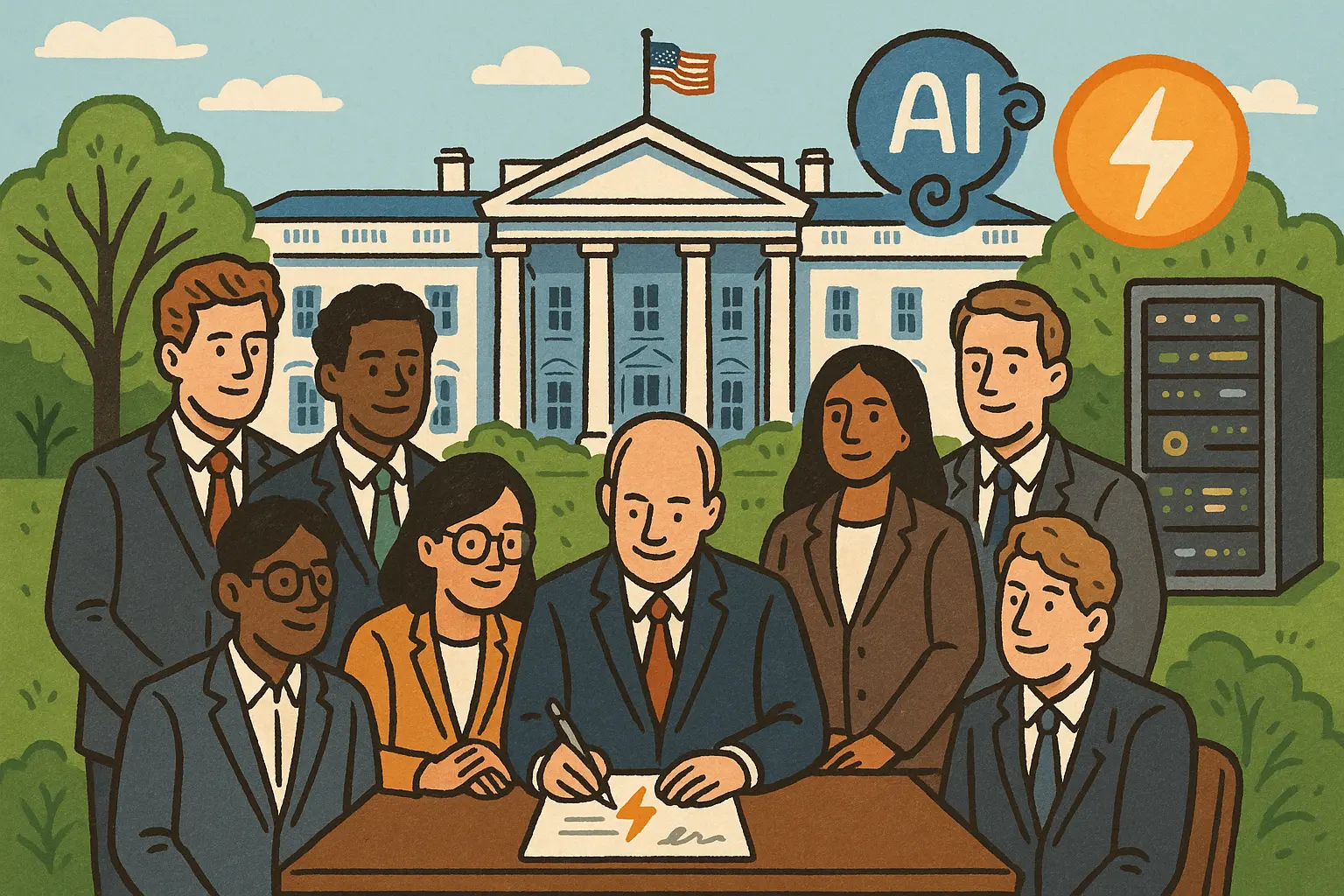
Amazon, Google, Meta, Microsoft, OpenAI, Oracle, and xAI have signed an non-binding “User Protection Commitment” at the White House on Wednesday, pledging to build, source, or purchase the energy needed for AI data centers themselves, and not to pass these costs onto consumers. This signing stems from a political promise publicly announced by Trump in his State of the Union address, with data centers potentially consuming up to 12% of the U.S. electricity supply by 2028.
Overview of the Commitment Terms: Energy Self-Supply, Cost Bearing, and Community Responsibility
The White House roundtable was attended by government officials and representatives from major tech companies. Trump openly stated that data centers “need some PR help” and emphasized that electricity prices would not increase due to data center expansion.
According to the specific terms of the “User Protection Commitment,” the seven tech giants pledge to fulfill the following obligations:
Energy Self-Supply: Build, source, or purchase all the energy required to operate AI data centers, including new and existing infrastructure.
Cost Bearing: Not to pass any energy costs of data centers onto consumers, regardless of whether the projects are thematic or commercialized.
Local Employment: Prioritize recruiting employees in the locations of the data centers and provide skills development programs.
Grid Support: Connect backup generators to the grid to help prevent power shortages.
Electricity Price Pressure: Why Are Tech Companies the Focus of Public Debate?
A February report from Harvard Kennedy School’s Belfer Center indicated that, driven by the AI boom, data centers are rapidly expanding across the U.S., with high-energy-consuming technologies exceeding local power capacities in some areas. Data from the U.S. Energy Information Administration (EIA) shows that residential electricity prices have already increased by 6% in 2025, with further rises expected in 2027 and 2028.
This context has sharply heightened the conflict between AI infrastructure development and public electricity costs, leading to some data center projects being canceled due to strong local community opposition. Trump stated at the roundtable that this commitment aims to reverse public opinion, shifting community sentiment from opposition to support.
Non-Binding Core Risks: Uncertain Enforcement Mechanisms
A key issue with this agreement is its lack of legal enforceability. The White House has not disclosed what mechanisms will be used to ensure that tech companies fulfill their commitments. The agreement does not include penalties for breach nor does it establish independent review or periodic disclosure requirements. Under the high political pressure before the midterm elections, some critics believe that the symbolic significance of this pledge may outweigh its actual binding effect, and that without legal enforcement, tech companies’ motivation to comply remains uncertain.
Frequently Asked Questions
Q: Which seven tech companies signed this White House energy commitment?
A: The signatories include Amazon, Google, Meta, Microsoft, OpenAI, Oracle, and xAI, all major investors in U.S. AI infrastructure. The pledge is a voluntary, non-legally binding statement, not a federal regulatory requirement.
Q: Will AI data centers really drive up consumer electricity bills?
A: Harvard Kennedy School estimates that data centers could consume up to 12% of U.S. electricity by 2028, and EIA records show a 6% increase in residential electricity prices in 2025. Electricity costs are influenced by multiple factors, and the direct contribution of data centers varies by region, but some high-density construction areas are already experiencing grid capacity pressures.
Q: How will the commitments of tech companies be enforced?
A: The White House has not disclosed specific enforcement mechanisms. The agreement does not include penalty clauses or independent verification frameworks. Its legal effect remains at the level of a political statement. Whether it will evolve into enforceable regulation depends on future legislative and regulatory actions by Congress and relevant agencies.
Disclaimer: The information on this page may come from third parties and does not represent the views or opinions of Gate. The content displayed on this page is for reference only and does not constitute any financial, investment, or legal advice. Gate does not guarantee the accuracy or completeness of the information and shall not be liable for any losses arising from the use of this information. Virtual asset investments carry high risks and are subject to significant price volatility. You may lose all of your invested principal. Please fully understand the relevant risks and make prudent decisions based on your own financial situation and risk tolerance. For details, please refer to
Disclaimer.


