
Polymarket listing nuclear explosion prediction contracts sparks 22% probability controversy, with trading volume exceeding $2 million. The platform has delisted the contracts and faces regulatory pressure.
Public outrage forces platform to remove “Doomsday” betting
Decentralized prediction market giant Polymarket has recently been at the center of a controversy, after allowing users to bet on whether a nuclear weapon will explode this year. This prediction contract, titled “Nuclear weapon detonation by…?” (Nuclear weapon detonation by…?), attracted significant speculative funds amid rising tensions between the US and Iran.
According to archived data, the market accumulated over $838,000 in trading volume before closing. When including similar contracts from previous years, total trading exceeds $2 million. Facing overwhelming public anger and moral criticism, Polymarket urgently delisted the market on March 4 and marked it as “archived,” without issuing any official statement.
The controversy was triggered by a post on social platform X, which stated that data showed a 22% chance of a nuclear explosion occurring before the end of this year. This information immediately drew condemnation, with critics arguing that the platform was exploiting human survival crises for commercial gain. The prediction market included multiple sub-contracts with different deadlines, predicting events for March 31, June 30, and before 2027. Supporters claimed this could provide more accurate probability estimates than traditional intelligence, but when the prediction involves destructive military conflicts, such price discovery mechanisms clearly cross social ethical boundaries.
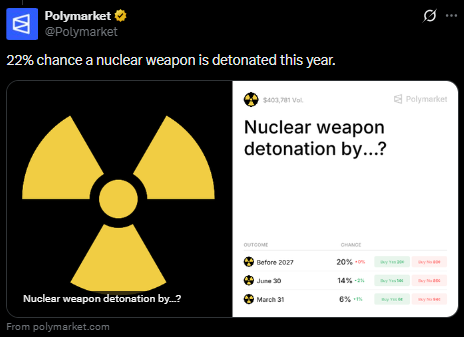
Image source: X/@polymarket Post states that data shows a 22% chance of nuclear explosion before year’s end
Moral boundaries vs. war profiteering
Prediction market analyst Dustin Gouker stated that voting on the use of nuclear weapons in conflicts is highly inappropriate. He emphasized that even if the market provides slight probability references, it cannot offset the negative impact of speculating on such tragic outcomes. Moreover, when market liquidity is insufficient, speculative behavior can send false signals, misleading the public about national security situations. Commercializing highly controversial geopolitical events like nuclear attacks has crossed moral red lines.
Well-known media personality David Sirota publicly criticized Polymarket on X, accusing it of creating a market that monetizes nuclear attacks, and questioned whether these bets might come from insiders within decision-making governments. This war betting reflects serious conflicts of interest, which are morally repugnant and could pose national security risks. If policymakers manipulate military strategies to influence prediction markets and profit from them, these markets would lose their role as neutral information tools and become hotbeds for insider trading. The disgust over profiting from national crises was a primary motivation for Polymarket to silence and delete the contracts.
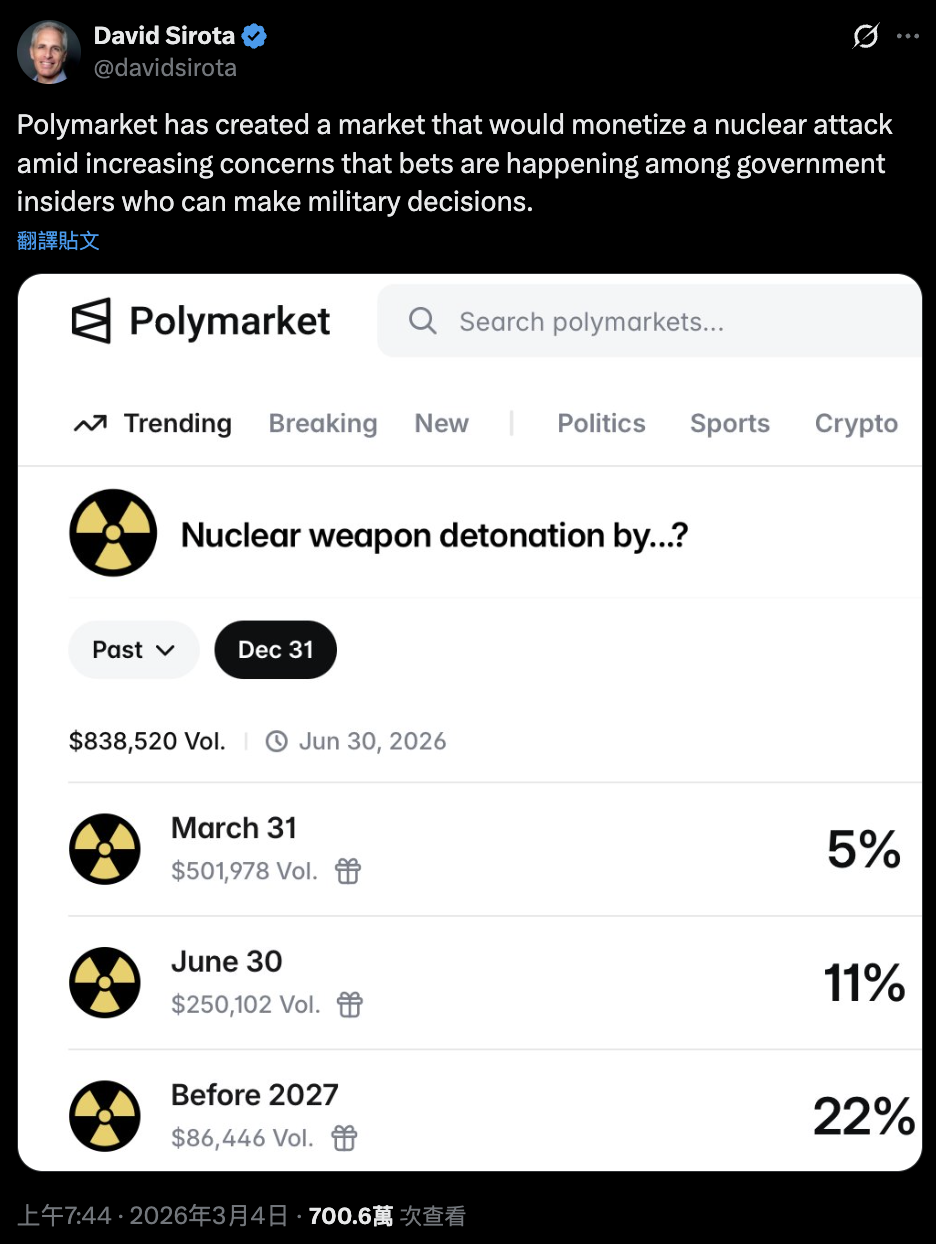
Image source: X/@davidsirota Media personality David Sirota criticizes Polymarket for creating a market that monetizes nuclear attacks and questions whether these bets come from insiders within governments
Insider trading suspicions and geopolitical prediction shadows
Beyond moral controversy, recent reports suggest possible insider trading scandals involving Polymarket.
Blockchain analysis firm Bubblemaps revealed that hours before the US and Israel launched airstrikes on Iran on February 28, six newly created crypto wallets placed precise bets on the airstrike, collectively profiting up to $1.2 million. The timing of these wallets’ activity raises suspicions of access to non-public military intelligence.
Similar incidents are not isolated. In January, an anonymous trader reportedly made over $400,000 by accurately predicting the arrest of Venezuelan President Nicolás Maduro. Recently, Israeli authorities also indicted two suspects suspected of using military secrets to profit on Polymarket.
Further reading
Predicted Iran bombing? Polymarket traders bet on US-Iran war, earning $1.2 million, sparking criticism
Venezuelan president arrested! Polymarket users predicted the event early, earning $400,000; U.S. Congress responds
These incidents have alerted regulators to the potential of prediction markets as channels for leaking national secrets. Currently, the US-Iran conflict is the hottest topic on Polymarket, with trading volume on the “Will the US attack Iran?” contract soaring to $529 million. When billions of dollars chase geopolitical outcomes, information asymmetry risks turning ordinary investors into insiders’ cash machines. This phenomenon threatens the reputation of prediction markets as legitimate forecasting tools, making them seem more like platforms for arbitrage for select groups.
Regulatory crackdown and future legal battles
As prediction markets grow in influence, regulators worldwide are accelerating rulemaking. CFTC Chair Michael Selig recently announced plans to issue clearer guidance for prediction markets, aiming to establish a unified federal standard across the US. The CFTC has submitted a proposed rulemaking notice to the White House, which is expected to prohibit regulated exchanges from listing contracts involving war, terrorism, or assassination that violate public interests. Meanwhile, several Democratic senators, including Adam Schiff, have urged the CFTC to take action against prediction markets involving political violence and death.
Meanwhile, competitors like Kalshi face similar challenges. After the death of Iran’s Supreme Leader Khamenei, Kalshi introduced a “Death Carveout” clause, which states that if the target dies of natural causes, the contract will settle at the last traded price instead of full payout.
Further reading
Kalshi’s “Iran Leader Resignation” $50 million prediction contract settlement sparks controversy! CEO: rejecting death arbitrage
This move angered investors, forcing Kalshi to pay $2.2 million in compensation to users. With the Trump administration showing a more crypto-friendly stance, Polymarket has temporarily avoided federal investigations. However, with upcoming CFTC regulations and state-level legal challenges, how prediction markets balance free speech, information value, and legal morality will be a key issue for the blockchain industry in 2026.
Further reading
South Park mocks crypto again! Latest episode ridicules Web3 prediction markets, drawing attention to absurdity
Disclaimer: The information on this page may come from third parties and does not represent the views or opinions of Gate. The content displayed on this page is for reference only and does not constitute any financial, investment, or legal advice. Gate does not guarantee the accuracy or completeness of the information and shall not be liable for any losses arising from the use of this information. Virtual asset investments carry high risks and are subject to significant price volatility. You may lose all of your invested principal. Please fully understand the relevant risks and make prudent decisions based on your own financial situation and risk tolerance. For details, please refer to
Disclaimer.


