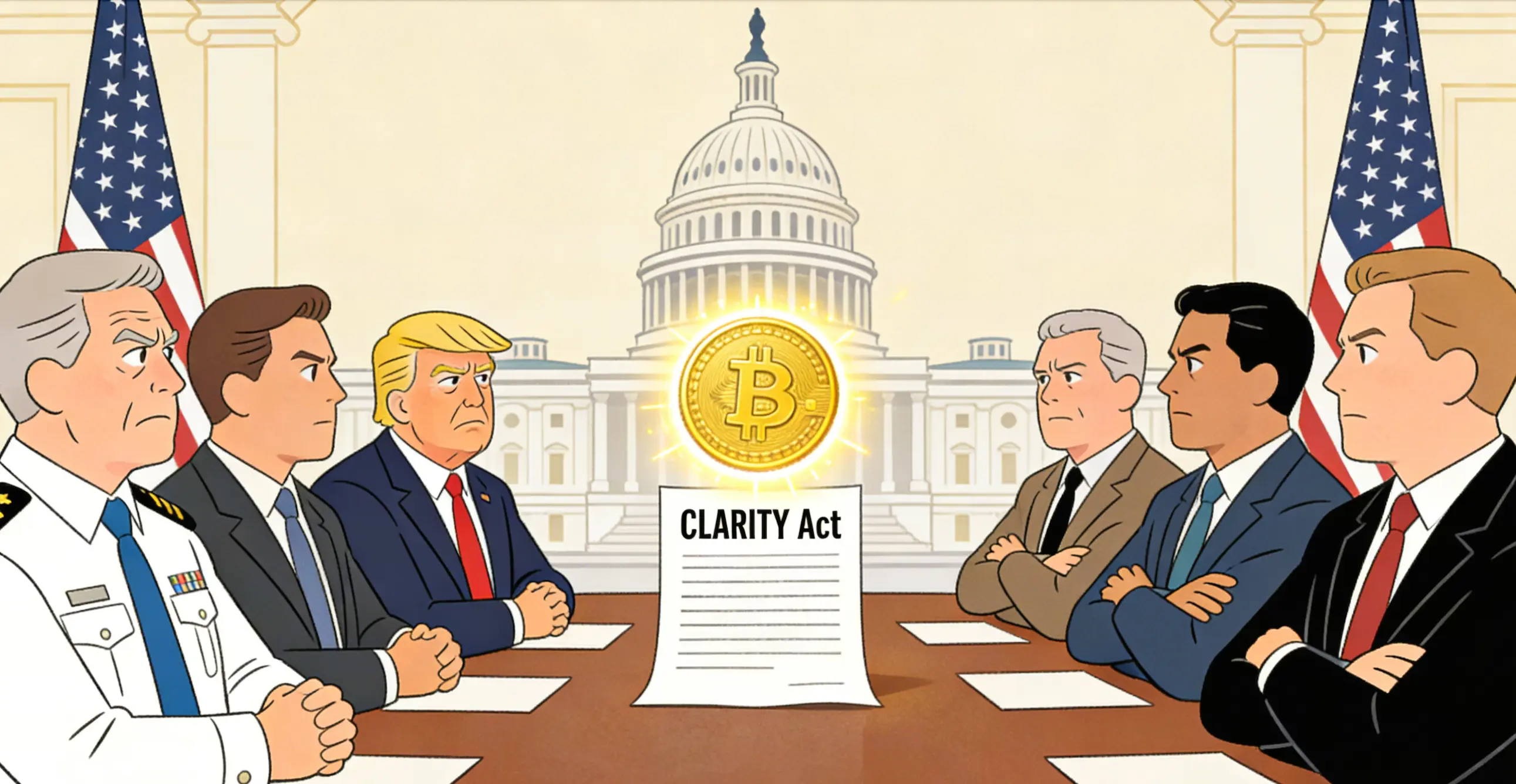
 Negotiations over the CLARITY Act, the landmark U.S. crypto market structure bill, have stalled again after banking industry representatives rejected a White House compromise that would have permitted limited stablecoin rewards for specific activities while banning them on idle holdings.
The impasse, confirmed in early March 2026, has raised doubts about whether the legislation can pass before the midterm election window closes, drawing criticism from President Donald Trump who accused lenders of trying to “undermine our powerful Crypto Agenda.”
Core Dispute: Stablecoin Rewards and Deposit Flight Concerns
The Yield Controversy
The central deadlock revolves around whether crypto platforms may offer interest-like rewards to stablecoin holders. Crypto companies including Coinbase argue that such yields—typically ranging from 3 to 5 percent—are essential for customer acquisition and represent fair competition with traditional savings accounts that currently offer 0.1 to 0.5 percent interest.
Banking organizations, led by the American Bankers Association, contend that allowing these rewards could trigger significant deposit outflows from conventional lenders. Industry estimates project that stablecoins could pull approximately $500 billion in deposits from U.S. banks by the end of 2028, with potential outflows reaching $6.6 trillion under broader scenarios. Community banks could face lending reductions of up to $850 billion, according to banking industry analysis.
GENIUS Act Framework
The GENIUS Act, signed into law in 2025, formally prohibits stablecoin issuers from directly paying interest on their tokens. However, banks argue the law created a loophole allowing crypto exchanges and other intermediaries to offer rewards through third-party arrangements, which they seek to close through the CLARITY Act.
White House Negotiations and Failed Compromise
Three Rounds of Talks
The White House convened multiple negotiating sessions between crypto industry representatives and banking trade associations throughout February 2026. Patrick Witt, Executive Director of the President’s Council for Advisors for Digital Assets, led the discussions, presenting his own draft language as a potential compromise.
The first meeting on February 2 included representatives from Coinbase, Circle, Ripple, and Crypto.com. Eight days later, a second session added banking representatives from the Bank Policy Institute and the American Bankers Association, who submitted a “Principles Document” demanding a complete ban on stablecoin rewards.
The White House Compromise
The third meeting on February 19 produced a White House proposal that would ban rewards on idle stablecoin balances—addressing banks’ core concern—while permitting rewards tied to specific activities such as peer-to-peer payments or merchant transactions. Crypto companies have largely accepted this framework.
However, banking industry representatives rejected the compromise, insisting on more severe limitations on permissible reward-generating activities. A banking industry source indicated that lenders believe the activities allowed under the compromise could still trigger deposit flight.
OCC Proposed Rules and Enforcement Framework
The Office of the Comptroller of the Currency released draft rules for implementing the GENIUS Act in late February 2026, providing insight into how regulators interpret the stablecoin yield prohibition. The 376-page proposal includes a presumption that certain arrangements involving affiliates or related third parties paying rewards to stablecoin holders would be prohibited.
The OCC’s draft explicitly distinguishes between passive holding and active use, stating the prohibition “is not intended to prevent a merchant from independently offering a discount to a payment stablecoin holder for using payment stablecoins.” This distinction mirrors the activity-based approach in the White House compromise.
Enforcement would carry significant penalties, with violations subject to fines of $500,000 per offense per day, to be overseen by the SEC, Treasury, and CFTC.
Political Dimensions and Additional Obstacles
Trump Family Crypto Interests
Democrats are pushing for conflict-of-interest provisions that would bar senior government officials and their families from engaging in digital asset ventures—a provision widely viewed as targeting the Trump family’s involvement in World Liberty Financial, which issues the USD1 stablecoin and has applied for a national trust bank charter.
Republicans oppose this proposal, believing President Trump would veto any legislation requiring his family to divest from crypto holdings. A potential compromise could delay implementation of such restrictions until after the 2029 presidential inauguration.
Senate Vote Requirements
The bill faces a 60-vote threshold in the Senate, requiring at least seven Democratic senators to support it. Democratic opposition in the Senate Agriculture Committee was unanimous in January, with no Democratic senators voting in favor amid concerns about Trump’s crypto projects and insufficient ethics rules.
Additional Democratic demands include tighter anti-money laundering rules and stronger consumer protections. These provisions would need to be reconciled with the Senate Banking Committee’s version once that panel reschedules its postponed markup.
Legislative Timeline and Outlook
Calendar Constraints
The White House’s March 1 deadline for industry agreement passed without resolution. The ongoing conflict with Iran is making it even harder to advance the crypto bill this year.
Industry observers suggest that if the bill does not reach the President’s desk by July, the window will likely close due to midterm election campaigning. Lawmakers are expected to leave Washington in the summer to begin campaigning, limiting floor time for legislative priorities.
Potential Scenarios
Analysts estimate a 50 to 60 percent chance the bill becomes law in 2026, though this outlook may be optimistic given current deadlocks. If Democrats gain seats in the November midterms, the bill’s prospects would diminish further, as Democratic lawmakers remain more divided on overhauling federal rules for cryptocurrencies.
The Senate Banking Committee has yet to reschedule its postponed markup from January, and no new date has been announced. Even if the stablecoin yield dispute is resolved, the final text must be reconciled with the Senate Agriculture Committee’s version and compete for floor time with other legislative priorities including housing policy reform.
Stakeholder Statements
Summer Mersinger, CEO of the Blockchain Association, stated that “the path to a workable agreement is clearer than it was a month ago,” expressing cautious optimism. Ripple CEO Brad Garlinghouse tweeted that “The door to a deal is wide open. The banks just need to act in good faith and walk through it.”
The American Bankers Association responded to the OCC’s proposed rules without commenting on the yield dispute, while reiterating that “the risks to economic growth and financial stability are real if policymakers don’t get this right.”
FAQ: CLARITY Act Stalemate
Q: Why are banks opposed to stablecoin rewards?
A: Banks fear that stablecoin yields of 3-5 percent will draw deposits away from traditional savings accounts offering 0.1-0.5 percent, potentially triggering hundreds of billions in outflows and reducing lending capacity, particularly at community and regional banks.
Q: What was the White House compromise that banks rejected?
A: The White House proposed banning rewards on idle stablecoin balances—addressing banks’ core concern—while permitting rewards tied to specific activities such as peer-to-peer payments or merchant transactions. Crypto companies accepted this framework, but banks insisted on more severe limitations.
Q: What other issues are blocking the CLARITY Act?
A: Beyond the stablecoin yield dispute, Democrats are demanding conflict-of-interest provisions targeting the Trump family’s crypto ventures, stricter anti-money laundering rules, and enhanced consumer protections. The bill also faces procedural hurdles, including the need for 60 Senate votes and reconciliation between Banking and Agriculture Committee versions.
Q: When is the deadline for passing the bill this year?
A: Industry observers suggest July 2026 is the effective deadline, after which midterm election campaigning will dominate congressional schedules and limit legislative floor time. If Democrats gain seats in November, the bill’s chances would diminish further.


