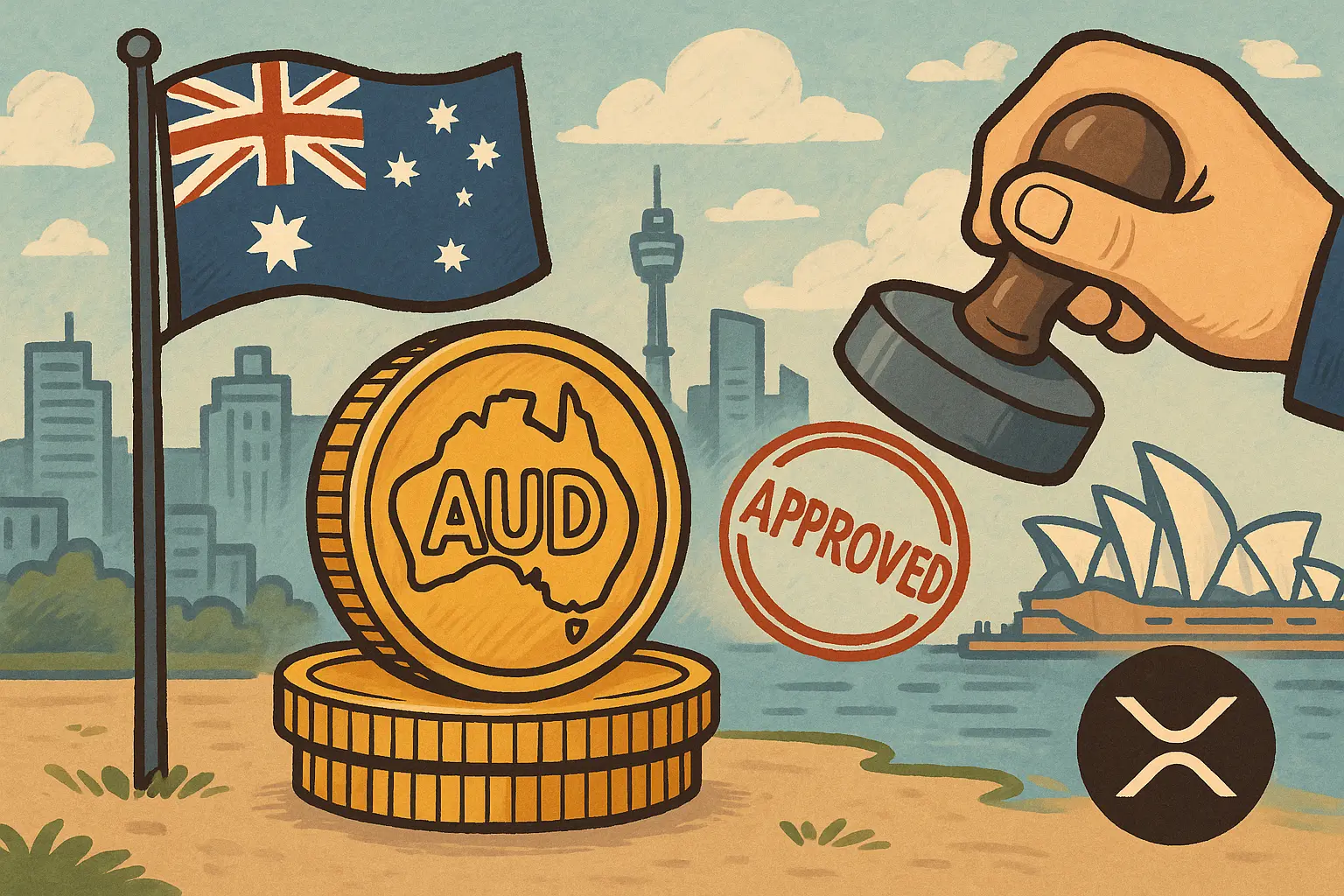
The Australian Securities and Investments Commission (ASIC) has issued a license to AUDC Pty Ltd, authorizing it to issue a regulated Australian dollar-backed stablecoin on the XRP Ledger. This approval marks an important step for Australia in balancing financial innovation with regulatory frameworks and is a significant milestone for blockchain applications in the Asia-Pacific region. The regulated AUD stablecoin is expected to help traditional finance explore on-chain payments and cross-border settlement solutions within a compliant environment.
Regulatory Logic Behind ASIC’s Approval
Australia has taken a cautious stance toward digital assets for a long time, with regulators prioritizing the prevention of systemic risks. The approval of AUDC reflects the gradual improvement of Australia’s cryptocurrency regulatory framework—current regulations now include clearer guidelines for digital asset companies, requiring transparency, investor protection, and legal compliance standards.
ASIC’s core regulatory approach is that regulated stablecoins combine the efficiency of on-chain payments with the trustworthiness of fiat currency, providing traditional financial institutions with a compliant entry point into blockchain, rather than leaving them in legal gray areas.
Why XRP Ledger Is the Preferred Underlying Technology
AUDC’s choice of XRP Ledger as the issuance platform is no coincidence. Compared to other public blockchains, XRP Ledger offers several structural advantages for financial payments:
- Near-instant settlement: Transactions are confirmed within 3 to 5 seconds, much faster than traditional cross-border transfers that take 2 to 5 business days.
- Ultra-low fees: Transaction costs are minimal, making high-frequency small payments commercially viable.
- High throughput: The network can quickly process thousands of transactions simultaneously, supporting institutional-scale payment volumes.
- Energy efficiency: Using Federated Byzantine Agreement, it consumes far less energy than proof-of-work (PoW) blockchains, aligning with financial institutions’ ESG sustainability goals.
- Scalability: Its architecture supports feature extensions, allowing developers to build payment applications and financial services on top.
Institutional Adoption Outlook: Opportunities in Australia’s Digital Finance Ecosystem
The launch of the regulated Australian dollar stablecoin opens multiple application pathways within Australia’s financial ecosystem. In wholesale payments, banks and large corporations can utilize on-chain settlement to replace some correspondent banking mechanisms, reducing clearing times and intermediary costs. In cross-border trade, Australian companies can benefit from real-time on-chain transfers to address delays and high fees in international settlements. Fintech startups can develop payment platforms and digital asset trading services based on the regulated stablecoin without needing to rebuild fiat access infrastructure.
However, large-scale adoption will still depend on the coordinated maturity of several conditions: the ability of financial institutions to integrate systems, the progress of reliable technological infrastructure, and ongoing regulatory oversight and policy adjustments.
Frequently Asked Questions
Why did Australia choose XRP Ledger instead of other public chains like Ethereum?
XRP Ledger’s core design focuses on financial payments rather than general-purpose smart contracts. Its near-instant settlement speed, extremely low fees, and high energy efficiency make it more commercially viable for institutional payment scenarios compared to PoW chains like Ethereum (ETH). AUDC’s choice reflects financial institutions’ prioritization of payment performance and operational costs when evaluating blockchain infrastructure.
What does ASIC’s approval of the Australian dollar stablecoin mean for crypto regulation in Australia?
This approval demonstrates that ASIC has established an operational regulatory framework for stablecoins, setting an important precedent for other companies wishing to issue regulated digital assets in Australia. It is expected to attract more fintech firms to apply for similar licenses, accelerating the normalization of Australia’s digital asset ecosystem and strengthening its leadership in digital financial regulation in the Asia-Pacific region.
What are the key differences between the regulated Australian dollar stablecoin and traditional digital bank accounts?
The regulated AUD stablecoin operates on public blockchains like XRP Ledger, supporting programmable transfers, peer-to-peer settlement without bank intermediaries, and interoperability with other blockchain protocols. In contrast, funds in traditional digital bank accounts are stored within private banking systems and cannot directly participate in on-chain ecosystems. There are fundamental differences in interoperability and efficiency between the two.
Disclaimer: The information on this page may come from third parties and does not represent the views or opinions of Gate. The content displayed on this page is for reference only and does not constitute any financial, investment, or legal advice. Gate does not guarantee the accuracy or completeness of the information and shall not be liable for any losses arising from the use of this information. Virtual asset investments carry high risks and are subject to significant price volatility. You may lose all of your invested principal. Please fully understand the relevant risks and make prudent decisions based on your own financial situation and risk tolerance. For details, please refer to
Disclaimer.


