
Wintermute indicates retail funds are flooding into the U.S. stock market, causing cryptocurrencies and stocks to become negatively correlated. Bitcoin volatility has shrunk to within twice its previous range, signaling market maturity.
According to the latest data research from market maker Wintermute, a structural shift has been identified: retail funds in cryptocurrencies are pouring heavily into the U.S. stock market, while the crypto market faces liquidity withdrawal challenges. Where does this capital shift come from? How should investors adjust their strategies?
Decoupling of U.S. Stocks and Cryptocurrencies, Retail Funds Show Pendulum Effect
Historical experience shows that capital flows between stocks and cryptocurrencies are usually highly correlated, often seen as the preferred investment during times of excess market liquidity and increased risk appetite. However, combined data from Wintermute and JPMorgan indicates that this positive correlation has significantly broken down by the end of 2024.
Retail investors are record-breaking in their stock market investments while becoming more cautious about cryptocurrencies. Using “total market cap of altcoins” as a long-term indicator of retail activity reveals that the relationship has shifted to a “negative correlation.” This means funds are no longer flowing into both markets simultaneously but are instead exhibiting a crowding-out effect. Currently, the surge in retail trading in stocks is effectively absorbing liquidity from the crypto market.
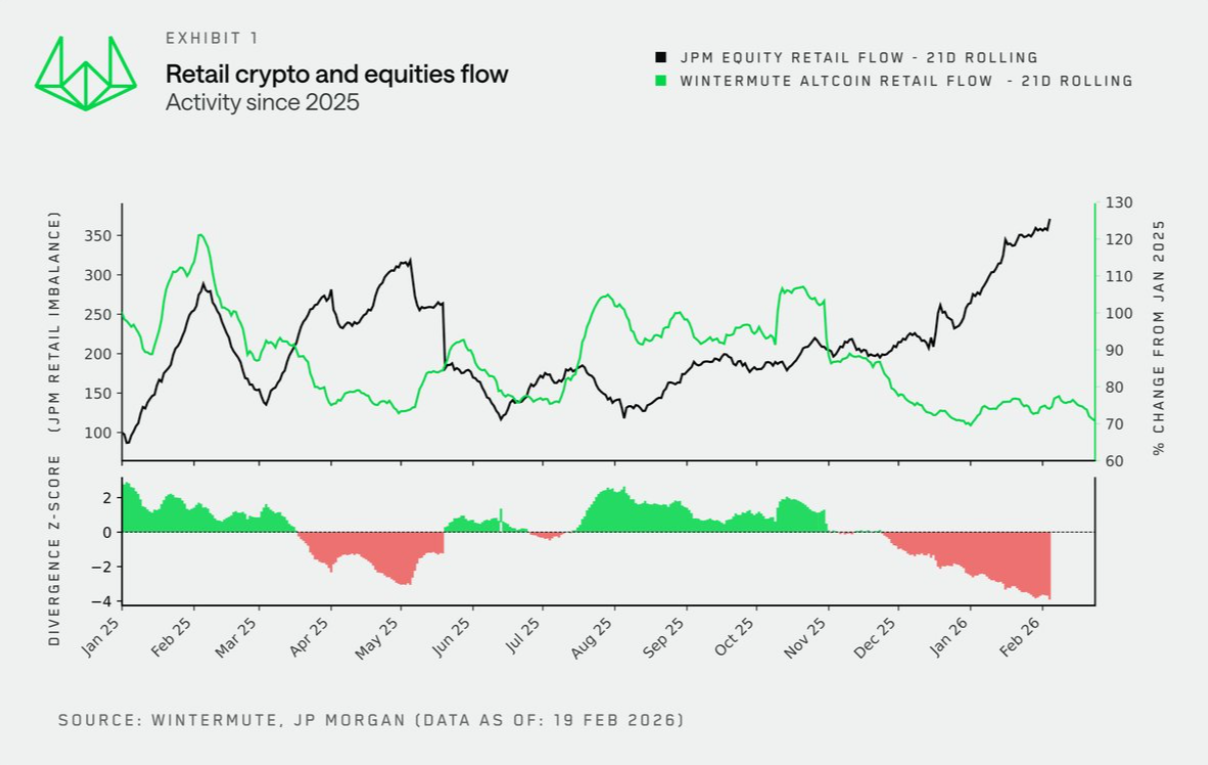
Source: Wintermute
Crypto Market Matures, Myth of Quick Riches Fades
In the past, meme coins and various altcoins experienced dramatic price swings, which attracted retail investors seeking excess returns. However, with the total crypto market cap reaching $2.3 trillion and Bitcoin spot ETFs gaining approval through institutional participation, the market structure has gradually matured.
Data shows that the volatility gap between Bitcoin and the Nasdaq 100 index continues to narrow. In the first half of 2025, the volatility ratio between the two even dropped below 2. When the market can no longer replicate the past boom-and-bust wealth effects, retail investors seeking capital efficiency and volatility naturally turn their attention to the recently strong and active stock markets.
AI Lowers Cross-Market Barriers for Retail Investors
Beyond structural changes, today’s brokerages and financial platforms have seamlessly integrated stock and cryptocurrency trading, breaking down previous barriers to capital flow between the two. Funds are no longer confined within the crypto ecosystem’s “internal cycle” but can move freely between U.S. stocks and crypto markets.
More importantly, the proliferation of generative AI and large language models (LLMs) has significantly enhanced retail investors’ ability to interpret financial reports and analyze the stock market, giving them unprecedented confidence in stock investing. In contrast, cryptocurrencies still lack a widely accepted valuation model and fundamental framework, making it harder for retail investors to develop similar analytical advantages in the crypto space.
Diversified Asset Allocation Adapts to New Landscape
Overall, retail investors have not left the market but have shifted their risk preferences toward stocks that offer advantages and volatility comparable to the current crypto environment. Cryptocurrencies have transitioned from being a “core speculative asset” to a regular component of diversified portfolios.
- This article is reprinted with permission from: Chain News
- Original title: “No More Crypto, Now Stocks? Crypto Liquidity Flows to U.S. Stocks, AI Becomes the Best Cross-Market Aid”
- Original author: Co2
Disclaimer: The information on this page may come from third parties and does not represent the views or opinions of Gate. The content displayed on this page is for reference only and does not constitute any financial, investment, or legal advice. Gate does not guarantee the accuracy or completeness of the information and shall not be liable for any losses arising from the use of this information. Virtual asset investments carry high risks and are subject to significant price volatility. You may lose all of your invested principal. Please fully understand the relevant risks and make prudent decisions based on your own financial situation and risk tolerance. For details, please refer to
Disclaimer.


