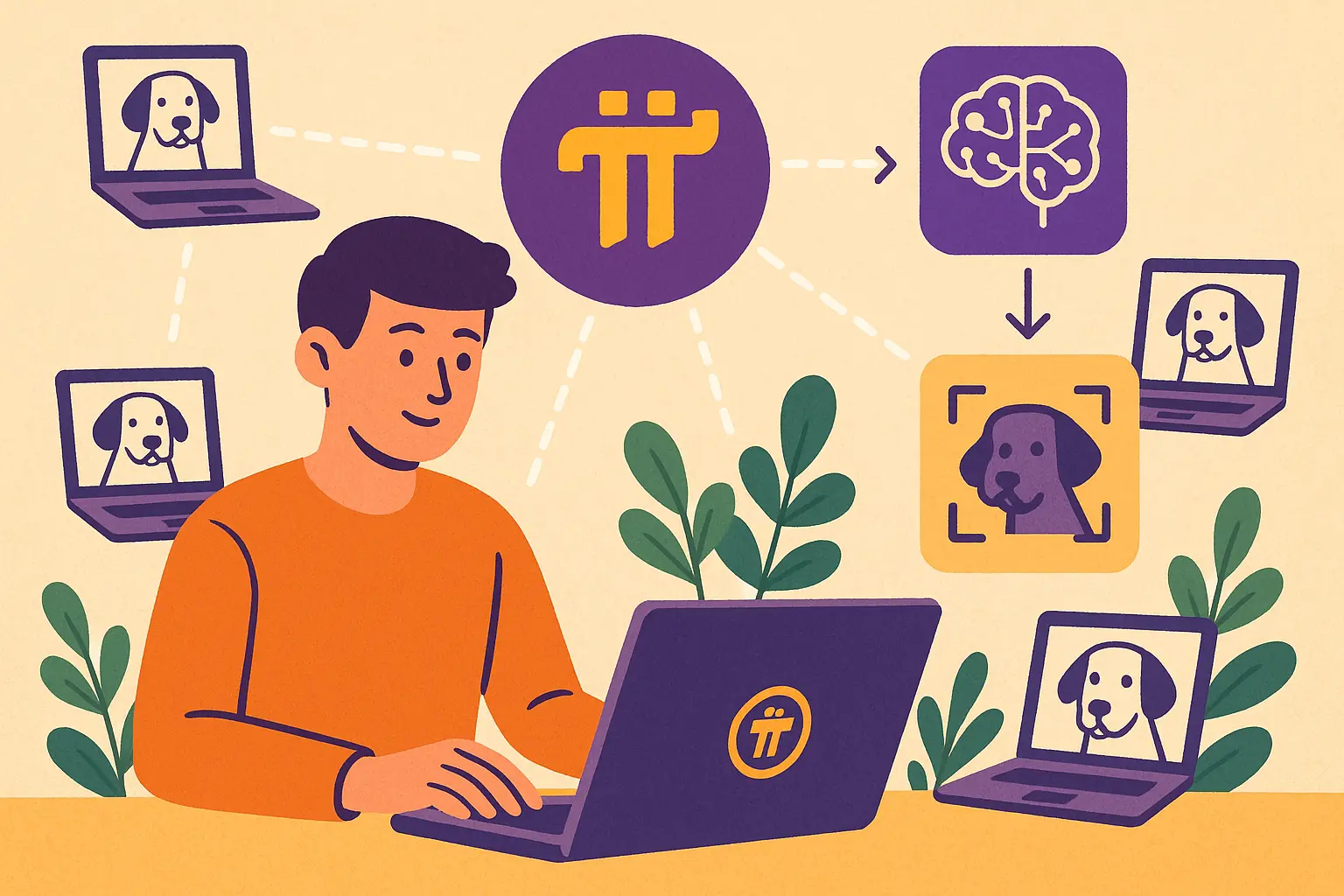
Pi Network will release a detailed case study on Saturday, confirming that over 421,000 of its nodes have successfully operated in an AI training-related proof of concept (PoC) project. The test was led by OpenMind, with seven volunteer node operators successfully returning image recognition inference results within 4 seconds, demonstrating the feasibility of idle computing power supporting AI workloads.
OpenMind Proof of Concept: Testing Process and Key Results
(Source: Pi Network website)
The core question of this proof of concept was: Can Pi’s decentralized node network reliably handle external AI-related computing tasks? OpenMind is building open-source operating systems and communication protocols for robots, requiring powerful computing support for model training, evaluation, and execution.
The test used containerized architecture: OpenMind built a container that distributes computing tasks to individual nodes; volunteer Pi node operators download and run the container locally; the system then sends image recognition tasks, with each node using OpenMind’s model to process images, aiming to identify as many discrete objects as possible within the images.
Data from the test shows all seven volunteer node operators confirmed receipt of tasks within 1 second, multiple nodes completed inference and returned results within 4 seconds, including expected object labels (such as “bus” and “person”) and corresponding bounding box data. The entire process operated normally.
Technical Significance of Decentralized AI Computing Power and Node Value Proposition
Pi states that this proof of concept aims to address two major structural challenges in AI: the capacity limitations and energy consumption of centralized data centers, and the continuously rising computing demands due to the expanding scale of AI models, agents, and services. Key technical features revealed by this test include:
Low Latency Response: Task confirmation within 1 second, inference results returned within 4 seconds, indicating the decentralized network has acceptable real-time processing capabilities.
Scalable Computing Foundation: Over 421,000 nodes represent more than 1 million CPUs, which, upon successful commercialization, could provide AI companies with a substantial alternative computing resource.
Node Operator Revenue Potential: If mature, this model could create new opportunities for node operators to participate in AI computations and earn rewards.
Pi also emphasizes that decentralized AI training is still in the research stage, and the field requires further work. Moving from single experiments to large-scale reliable deployment will need ongoing breakthroughs across technology, incentive design, and security mechanisms.
Pi Network’s AI Roadmap: Coordinated Progress with Protocol Upgrades
This proof of concept coincides with the first anniversary of Pi Network’s open mainnet launch. Pi has previously prioritized AI as a core focus in its post-upgrade mainnet strategy, alongside ecosystem tokens and identity services. On the protocol level, Pi has just completed the v19.9 migration, aiming to upgrade to v20.2 before Pi Day 2026 (March 14). The technical roadmap and AI strategic layout are progressing in tandem.
OpenMind’s proof of concept is Pi Network’s first public test case for commercializing decentralized AI computing power, providing early validation for its node tools’ potential applications. However, it still requires more systematic validation before large-scale commercial deployment.
Frequently Asked Questions
Q: How are Pi Network’s 421,000 nodes used for AI training?
Node operators can optionally download containers built by third parties (like OpenMind) to receive external AI computing tasks. They use their local idle CPU resources to perform calculations and return results. In this proof of concept, the task was image recognition, with the system successfully returning object labels and bounding boxes within 4 seconds.
Q: What are the main results of this proof of concept?
All seven volunteer node operators confirmed receipt of tasks within 1 second, with multiple nodes completing image recognition inference within 4 seconds, returning labels such as “bus” and “person” along with bounding box data. Pi Network states the overall process operated normally but emphasizes that decentralized AI training remains in the research phase.
Q: How does Pi Network’s decentralized AI computing model differ from traditional computing supply?
Traditional AI computing is highly centralized in large data centers, facing capacity limits and energy consumption issues. Pi Network’s decentralized model leverages idle nodes worldwide to provide alternative computing power, offering advantages in decentralization and potentially lower energy use, but commercial reliability and large-scale capability are still in early validation stages.
Disclaimer: The information on this page may come from third parties and does not represent the views or opinions of Gate. The content displayed on this page is for reference only and does not constitute any financial, investment, or legal advice. Gate does not guarantee the accuracy or completeness of the information and shall not be liable for any losses arising from the use of this information. Virtual asset investments carry high risks and are subject to significant price volatility. You may lose all of your invested principal. Please fully understand the relevant risks and make prudent decisions based on your own financial situation and risk tolerance. For details, please refer to
Disclaimer.


