
Greg Cipolaro, Head of Global Research at financial services firm NYDIG, pointed out in the latest weekly report that although the correlation between Bitcoin and the S&P 500, Nasdaq 100, and IGV ETF has risen to about 0.5, statistically, this only accounts for roughly 25% of Bitcoin’s price volatility. Cipolaro believes that this statistical divergence underscores Bitcoin’s irreplaceable role within diversified investment portfolios.
The Statistical Truth Behind the 0.5 Correlation: What Does 25% Explanatory Power Mean?
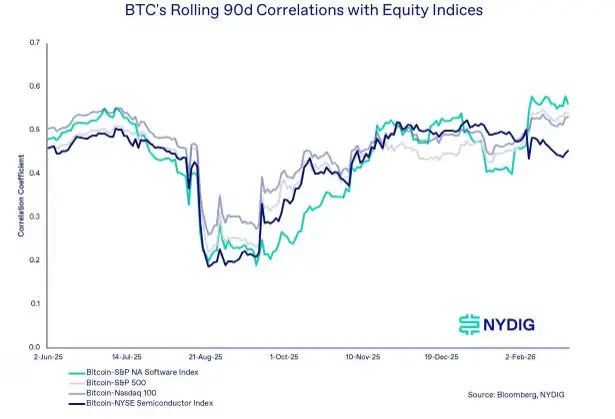
(Source: NYDIG)
A common misconception about correlation is that investors often equate “high correlation” with “similar volatility,” but this is not statistically accurate. A correlation coefficient of 0.5 indicates a moderate linear relationship between two assets, but its coefficient of determination, R² (which is 0.5 squared), is only 0.25. This means that stock market movements can only explain about 25% of Bitcoin’s price fluctuations. The remaining 75% is driven by Bitcoin’s own independent factors.
Cipolaro emphasizes that this divergence is not a flaw but rather the core value of Bitcoin as a diversification tool in investment portfolios. He writes, “Although Bitcoin currently shows a higher cross-asset correlation with stocks, this is far from determining its returns.” He believes that the recent increase in correlation more likely reflects the current macro liquidity environment rather than a structural integration between asset classes—both Bitcoin and growth stocks are sensitive to liquidity conditions and investor risk appetite, but this is a short-term market characteristic, not a long-term fundamental.
The Four Major Independent Drivers of Bitcoin
When explaining the source of Bitcoin’s 75% independent volatility, Cipolaro lists four crypto-specific drivers:
- Fund Flows: Net inflows or outflows of funds in ETFs and crypto investment funds directly impact market supply and demand.
- Derivatives Position Structure: Open interest in perpetual contracts, funding rates, and futures premiums reflect leverage levels and bullish/bearish market sentiment.
- Network Adoption Trends: On-chain active addresses, transaction volume, and holder distribution indicate growth in fundamental network usage.
- Regulatory Developments: Policy directions in various countries, the establishment or tightening of institutional compliance frameworks, influence the entry and exit barriers for institutional capital.
These four factors are fundamentally different from traditional stock market drivers such as corporate earnings or macro interest rate expectations, which is why Bitcoin remains “correlated but not identical” to stock markets.
Evolution of Bitcoin’s Role: From Survival Concerns to Reserve Asset Debate
NYDIG’s report also traces the evolution of narratives surrounding Bitcoin. Early supporters like Chamath Palihapitiya called it “Gold 2.0” in 2013, but recently he has questioned whether Bitcoin can meet the needs of sovereign balance sheets. Ray Dalio has long expressed concerns about Bitcoin’s volatility, regulatory risks, and the long-term threat posed by quantum computing.
Cipolaro believes these criticisms actually confirm Bitcoin’s evolutionary process: the debate has shifted from “Can Bitcoin survive?” to “Can Bitcoin become a sovereign reserve asset?” This shift in discussion level itself reflects maturity. He emphasizes that Bitcoin’s continued growth does not depend on central banks adopting it. Its expansion has extended from individual users to family offices, asset management firms, and ETFs—completely different from many financial innovations that initially rely on institutional capital. “Central banks holding Bitcoin might further solidify its position, but this is not a necessary condition for its ongoing growth,” Cipolaro writes.
Frequently Asked Questions
Q: Does the rising correlation between Bitcoin and tech stocks mean it has lost its diversification benefit?
According to NYDIG’s analysis, a correlation of 0.5 only explains about 25% of Bitcoin’s price volatility. This means that at any given time, 75% of Bitcoin’s fluctuations are driven by crypto-specific factors unrelated to the stock market. From a portfolio construction perspective, the true diversification benefit depends on return uncorrelatedness, not the correlation level observed over a single period.
Q: What does NYDIG see as the main driver behind Bitcoin’s independent volatility?
NYDIG lists four crypto-specific drivers: fund flows in crypto funds, derivatives position structures (like perpetual contract funding rates), network adoption trends (on-chain activity), and regulatory developments. These factors are fundamentally different from traditional stock market drivers such as corporate earnings or macro interest rates.
Q: Does Bitcoin’s long-term growth depend on central banks including it in their reserves?
NYDIG clearly states that adoption by central banks is not a necessary condition for Bitcoin’s growth. Bitcoin’s value is rooted in its globally distributed network, political neutrality, and its ability to operate independently without control by any single government or central bank. While central bank adoption might further strengthen its position, Bitcoin has already expanded from individual users to family offices, asset managers, and ETFs—this bottom-up institutionalization forms the foundation for its continued growth.
Disclaimer: The information on this page may come from third parties and does not represent the views or opinions of Gate. The content displayed on this page is for reference only and does not constitute any financial, investment, or legal advice. Gate does not guarantee the accuracy or completeness of the information and shall not be liable for any losses arising from the use of this information. Virtual asset investments carry high risks and are subject to significant price volatility. You may lose all of your invested principal. Please fully understand the relevant risks and make prudent decisions based on your own financial situation and risk tolerance. For details, please refer to
Disclaimer.


