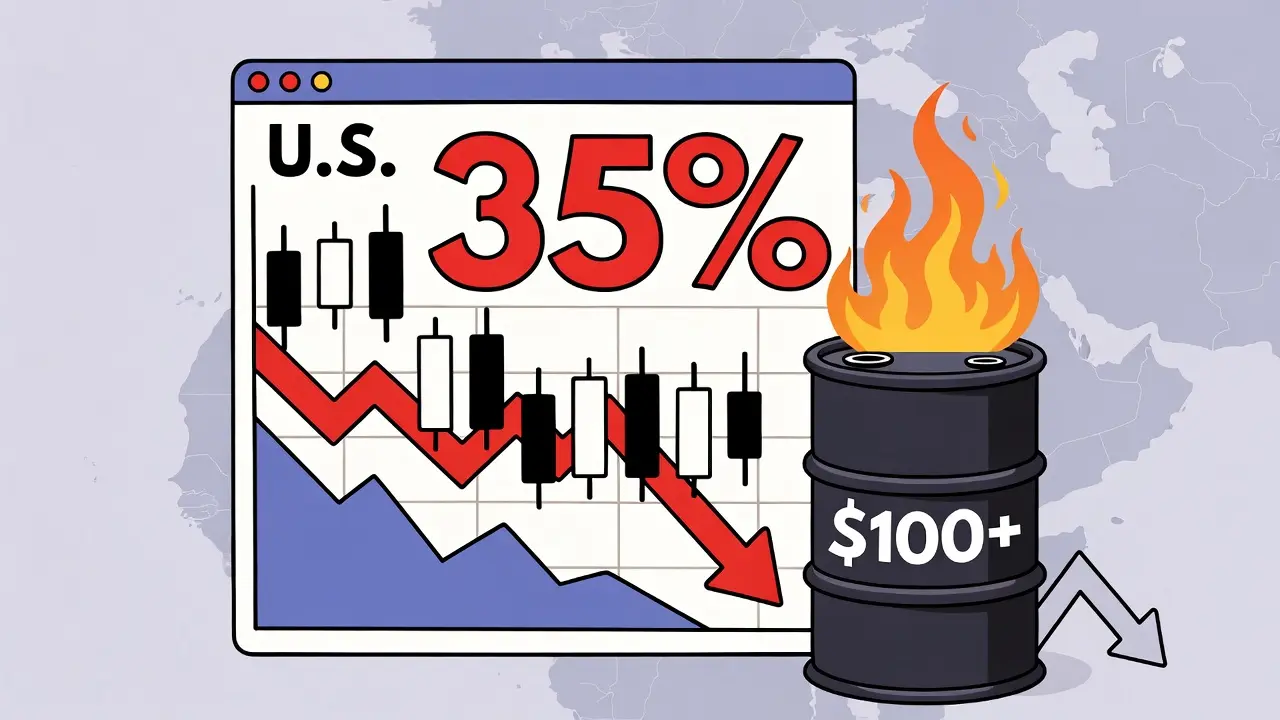
 Veteran Wall Street strategist Ed Yardeni has increased his forecast probability of a U.S. stock market crash in 2026 to 35 percent, up from 20 percent, citing escalating Iran war tensions and surging oil prices above $100 per barrel.
The founder of Yardeni Research simultaneously slashed the odds of a speculative melt-up rally to just 5 percent from 20 percent, warning that the Federal Reserve’s dual mandate faces a “sticky situation” between rising inflation risks and slowing economic growth as the Middle East conflict expands.
Yardeni’s Probability Revision and Market Context
Crash Probability Upgrade
Ed Yardeni, known for accurately predicting market trends including his December 2025 call to underweight the “Magnificent Seven” tech stocks relative to the S&P 500, has significantly revised his 2026 outlook. The probability of a stock market crash—defined as a substantial decline—now stands at 35 percent for the remainder of the year.
This adjustment reflects growing concerns that the ongoing U.S.-Iran conflict could persist, amplifying inflation shocks through higher energy costs, squeezing consumer spending, eroding corporate profit margins, and further complicating Federal Reserve policy decisions.
Melt-Up Odds Collapse
Conversely, Yardeni reduced the odds of a speculative melt-up rally to just 5 percent. Such a scenario, characterized by price increases disconnected from underlying economic fundamentals, now appears highly unlikely amid geopolitical uncertainty and tightening financial conditions.
Despite these grim near-term adjustments, Yardeni maintains his baseline “Roaring 2020s” scenario—where strong U.S. productivity growth drives sustainable expansion—at a 60 percent probability for the end of 2026. Over the longer term, he assigns an 85 percent chance to continued productivity-led growth, with a 15 percent risk of a “1970s-style stagflation” recurrence.
Oil Price Shock as Key Variable
Surge Above $100
The Iran conflict has triggered a dramatic spike in global oil prices. Brent crude surged above $100 per barrel, reaching its highest level since mid-2022, as fighting disrupted market stability and threatened supply routes. West Texas Intermediate faces similar upward pressure, with analysts warning that if Iran blocks the Strait of Hormuz—through which approximately 20 percent of global oil supply transits daily—prices could spike further.
Transmission to Broader Markets
Rising energy costs are reverberating through global financial markets. Asian stock markets heavily dependent on crude imports plunged Monday, with South Korea’s KOSPI falling sharply and Japan’s Nikkei suffering steep losses. U.S. equity futures dropped over 2 percent, while the CBOE Volatility Index surged to its highest level since April 2025.
The oil shock introduces a stagflationary dynamic: higher energy prices risk reaccelerating inflation while simultaneously acting as a tax on consumers and businesses, potentially dragging down growth. This combination creates an increasingly difficult environment for risk assets, including crypto-linked equities.
Federal Reserve’s Policy Dilemma
Dual Mandate Conflict
Yardeni highlighted the position facing the Federal Reserve: “The US economy and stock market are stuck between Iran and a hard place currently. So is the Fed. If the oil shock persists, the Fed’s dual mandate would be stuck between the increasing risk of higher inflation and rising unemployment.”
Energy-driven inflation typically constrains the Fed’s ability to cut rates, even as growth slows and job markets weaken. This policy gridlock reduces the central bank’s capacity to support markets during downturns.
Rate Cut Expectations Pushed Back
Market participants have already adjusted their Fed expectations. Traders now fully price the first rate cut for September 2026, pushed back from July expectations before the conflict intensified. Some investors are betting the Fed may not cut rates at all this year, reflecting the complex interplay between geopolitical shocks and monetary policy.
The U.S. dollar posted its steepest weekly gain in a year as investors sought safe-haven assets, while benchmark 10-year Treasury yields jumped as traders priced in higher inflation expectations from the oil shock.
Cryptocurrency Market Performance
Bitcoin Resilience Amid Equity Weakness
Despite sharp declines in global equities and surging volatility, Bitcoin has shown relative stability, trading near $67,378 as of March 9, 2026, up approximately 1.1 percent over 24 hours and essentially flat on the week. This performance contrasts with S&P 500 futures, which fell more than 2 percent in Asian trading.
Ether rose 2.3 percent to $1,981, hovering just below the $2,000 level. BNB gained 1.4 percent to $624, while Dogecoin added 1.8 percent to $0.09. Solana climbed 1.8 percent to $83.69 but remains down 1.5 percent on the week, making it the weakest major cryptocurrency over a seven-day basis. XRP traded flat at $1.35, down 1 percent on the week.
NYDIG Framework: Correlation vs. Causation
NYDIG global head of research Greg Cipolaro offered a framework for understanding Bitcoin’s price action relative to U.S. equities in a March 6 research note. Cipolaro argued that Bitcoin’s recent parallel movement with U.S. software stocks reflects “shared exposure to the current macro regime” rather than structural convergence.
Statistically, only about 25 percent of Bitcoin’s price movements are explained by correlation to equities. The remaining 75 percent is driven by factors outside traditional stock indices, including capital flows into Bitcoin funds, derivatives positioning, network adoption trends, and regulatory developments.
This differentiation supports Bitcoin’s role as a portfolio diversifier even during periods of elevated correlation with equities.
Crypto-Linked Companies Face Strategic Pressure
Mining Sector Adaptation
Many crypto-linked companies have begun pivoting strategies amid the uncertain environment. Bitcoin miner Core Scientific sold portions of its Bitcoin holdings as it shifts toward AI-focused infrastructure, a move that contributed to pressure on its CORZ stock.
Core Scientific announced it expects to monetize “substantially all” of its Bitcoin holdings in 2026 to enhance liquidity and fund its pivot toward AI and high-performance computing. The company held 2,537 BTC worth $222 million at year-end 2025 and has already sold approximately 1,900 BTC for about $175 million in January.
CEO Adam Sullivan characterized Bitcoin mining as now “essentially in runoff,” with operations maintained primarily to satisfy minimum power commitments as legacy sites convert to AI-focused colocation. This strategic pivot reflects a broader industry trend where miners increasingly view AI infrastructure as offering more stable, contracted revenue streams than volatile Bitcoin mining.
Geopolitical Escalation: Iran Names New Supreme Leader
Leadership Transition
Early Monday morning, Iran named its new supreme leader, Mojtaba Khamenei, the son of Ali Khamenei, who was killed by U.S. forces. The appointment signals the government’s desire for continuity as Iran faces ongoing attacks from the United States and Israel nine days into the war.
The Islamic Revolutionary Guard Corps immediately pledged allegiance to the new leader, voicing readiness to follow his instructions.
Threats and Retaliation
Both the United States and Israel had previously threatened to target any successor. Iran’s top security official has stated that President Donald Trump “must pay the price” for the war, suggesting further escalation is likely. Explosions were reported in Qatar, home to a major U.S. air base, as regional tensions continue to mount.
Iran fired missiles at Israel early Monday, with projectiles displayed bearing slogans in honor of the new leader, indicating that hostilities may intensify in the coming weeks.
Outlook and Key Levels
Yardeni’s revised probabilities capture a market caught between stagflation fears and geopolitical uncertainty. The trajectory of oil prices—and by extension, inflation expectations and Fed policy—will likely determine whether the 35 percent crash scenario materializes.
For Bitcoin, key levels to monitor include support near $64,000 and resistance at $68,000. Crypto stocks face continued pressure as miners liquidate holdings to fund AI pivots and overall risk sentiment remains fragile. The coming weeks, including U.S. CPI data, will provide crucial information for assessing inflation trends amid the oil shock.
FAQ: Yardeni Crash Warning and Market Impact
Q: What exactly did Ed Yardeni predict?
A: Yardeni raised the probability of a U.S. stock market crash in 2026 to 35 percent, up from 20 percent, and cut the odds of a speculative melt-up rally to just 5 percent from 20 percent. This reflects heightened geopolitical risk from the Iran war and the stagflationary impact of surging oil prices above $100 per barrel.
Q: Why are oil prices spiking and how does this affect markets?
A: Brent crude has surged above $100 per barrel due to U.S.-Iran conflict and threats to supply routes including the Strait of Hormuz, through which approximately 20 percent of global oil passes. Higher energy costs risk reaccelerating inflation while slowing growth, creating a stagflationary environment that complicates Fed policy and pressures risk assets.
Q: How is the crypto market responding compared to equities?
A: Bitcoin has shown relative resilience, trading near $67,378 and holding essentially flat on the week despite S&P 500 futures falling over 2 percent. NYDIG research indicates only about 25 percent of Bitcoin’s price movements are explained by equity correlation, with the remainder driven by crypto-specific factors.
Q: What is the status of Iran’s leadership and escalation risk?
A: Iran named Mojtaba Khamenei as its new supreme leader following the killing of his father, Ayatollah Ali Khamenei, by U.S. forces. Iran’s top security official has stated that President Trump “must pay the price,” and missiles have been fired at Israel, suggesting further escalation is likely.


