XRP has faced ongoing pressure this year, but Santiment on-chain data reveals that large whale wallets holding between 1 million and 100 million XRP have recently accumulated approximately 210 million XRP, indicating that major holders are quietly building positions during this market downturn. Technically, XRP is forming a compressed wedge pattern between $1.30 support and $1.50 resistance, suggesting a potential directional move is brewing.
Whale Accumulation: Signals from Large Investors During Market Lows
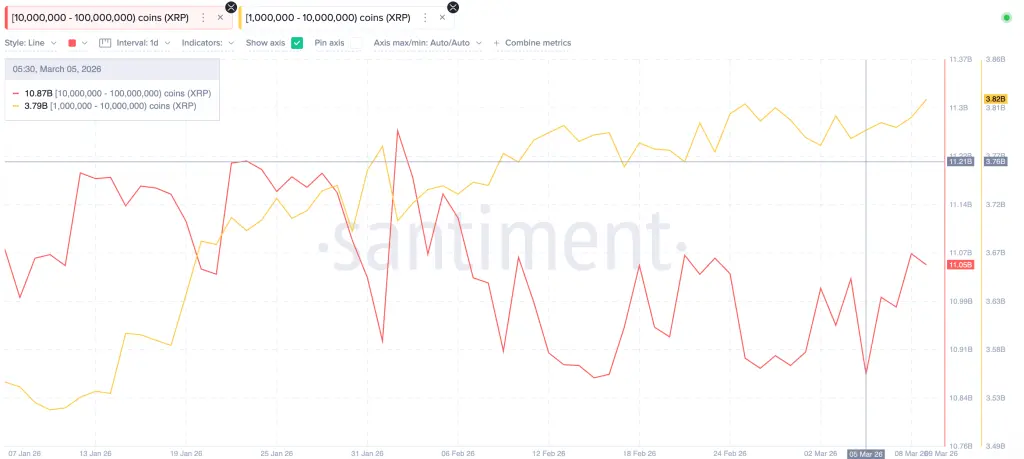 (Source: Santiment)
The most noteworthy phenomenon in this XRP market cycle is the behavioral difference between retail investors and large holders. On-chain data shows that since the beginning of the year, XRP trading activity has significantly slowed, with daily transaction volume on the ledger dropping sharply and liquidity shrinking. In such an environment, even moderate capital inflows or outflows can trigger sharp price volatility.
However, during this period of retail hesitation, whales have actually increased their buying activity. Large wallets holding between 1 million and 100 million XRP have significantly expanded their balances, accumulating about 210 million XRP recently. This behavior aligns with the typical logic of large investors: establishing positions at relatively low costs during periods of low liquidity and low retail confidence, then waiting for a market sentiment reversal to realize outsized gains.
Technical Analysis: Key Insights on the Compression Wedge
 (Source: TradingView)
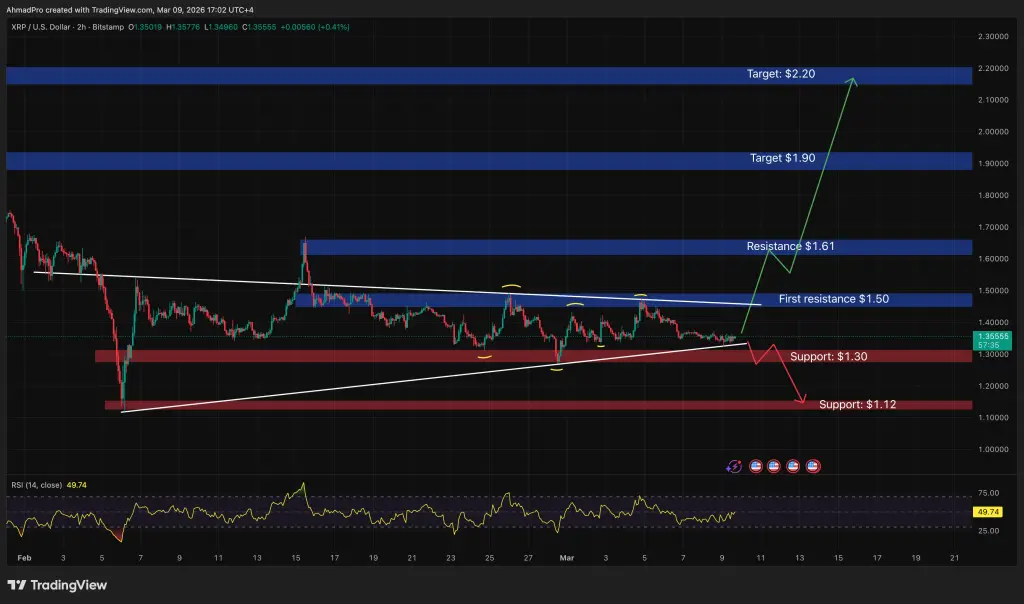
The daily chart of XRP further supports the view that a major move is imminent. Currently, XRP is forming a compression wedge between the resistance near $1.50 and the ascending support above $1.30. This structure usually indicates a temporary balance of power between bulls and bears, with momentum contracting ahead of a larger directional breakout.
Key Technical Levels to Watch
Core Support: $1.30 — the lower boundary of the wedge; holding this level is essential for a short-term bullish outlook
Key Resistance: $1.50 — a breakout above this level would confirm the release of upward momentum
First Upside Target: $1.61 (initial target after breaking $1.50)
Mid-term Upside Target: $1.90 (if momentum continues to strengthen)
Long-term Upside Target: $2.20 (if market consensus shifts strongly bullish)
Downside Risk Level: If $1.30 support fails, the decline could accelerate, with the next major support around $1.12
Low Liquidity Environment: Amplifying Signals or Risks?
The current low liquidity in the XRP market is a double-edged sword. On the positive side, if whale accumulation triggers broader buying interest, the compressed liquidity environment could amplify upward moves, allowing even modest capital inflows to generate significant gains.
However, the downside is equally real: if the $1.30 support breaks, low liquidity could reinforce selling pressure, rapidly pushing prices toward $1.12 or lower. Therefore, market focus on whether the $1.30 support holds is crucial — it is not only a key technical level but also the central node in the bulls and bears struggle in a low liquidity environment.
Frequently Asked Questions
Q: Does whale accumulation of 210 million XRP tokens indicate an imminent price rise?
Whale accumulation is a noteworthy on-chain signal, as large holders tend to have a longer-term outlook and often build positions during market lows and bearish sentiment. The accumulation of 210 million XRP suggests these major holders remain optimistic about XRP’s long-term prospects. However, accumulation alone does not guarantee a short-term price increase; a market sentiment shift and liquidity recovery are needed to trigger a rally.
Q: What does the current compression wedge pattern in XRP imply?
A compression wedge is a common technical pattern indicating that an asset is consolidating within a narrowing range, with bulls and bears in a temporary equilibrium. This pattern often precedes a significant directional breakout, but the direction—up or down—must be confirmed by volume. The wedge itself does not predict the breakout direction.
Q: If XRP falls below $1.30, how should investors assess the downside risk?
$1.30 is a critical support level in the current technical structure. Losing this level would break the wedge’s lower boundary, turning the technical outlook bearish. In a low liquidity environment, a breakdown below $1.30 could trigger stop-loss cascades, accelerating the decline. The next key support is around $1.12; if that level also fails, the short-term bottom will need to be reassessed.
Disclaimer: The information on this page may come from third parties and does not represent the views or opinions of Gate. The content displayed on this page is for reference only and does not constitute any financial, investment, or legal advice. Gate does not guarantee the accuracy or completeness of the information and shall not be liable for any losses arising from the use of this information. Virtual asset investments carry high risks and are subject to significant price volatility. You may lose all of your invested principal. Please fully understand the relevant risks and make prudent decisions based on your own financial situation and risk tolerance. For details, please refer to
Disclaimer.


