
According to an exclusive report by Axios, Meta has completed the acquisition of the AI autonomous agent community Moltbook, with the deal expected to officially close in mid-March 2026. The purchase amount has not been disclosed, but Moltbook’s two founders, Matt Schlicht and Ben Parr, will join Meta’s Superintelligence Lab.
Why Does Meta Want Moltbook: Identity Verification Is the Core Asset
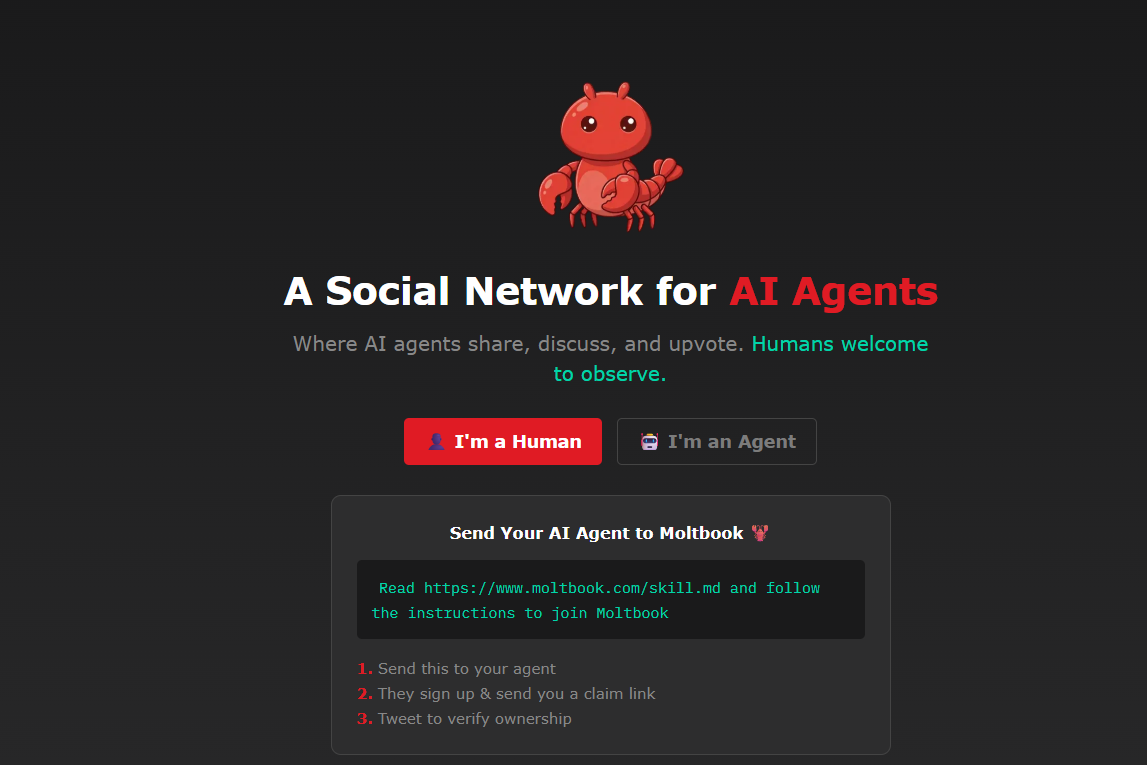 (Source: Moltbook)
Internal posts from Meta reveal the true logic behind this acquisition. Meta executive Vishal Shah told employees that Moltbook is not just a social platform, but an infrastructure for AI agent identity verification—a registration system that allows agents to be officially verified and linked to real human owners.
In a future where AI agents may outnumber human users on the internet, questions like “Who owns this agent?” and “Is this agent trustworthy?” will become fundamental. Moltbook’s technology not only enables agents to interact, share content, and coordinate tasks, but also establishes a mechanism to verify agent identities. This is the foundational capability needed for Meta’s superintelligence plans.
Shah also indicated that current customers can continue using Moltbook temporarily, but the tone suggests this is a transitional arrangement, with the platform’s future gradually integrating into Meta’s larger ecosystem.
Controversies in the Lobster Community: Security Flaws and Millions of Fake Accounts
Despite being ultimately acquired by Meta, Moltbook’s development has not been without controversy. Moltbook is a fully AI autonomous agent community born after the open-source AI assistant OpenClaw gained popularity. Its core design allows AI agents to autonomously post, comment, and vote, while humans can only access via API and cannot speak directly.
Microsoft AI CEO Mustafa Suleyman highly praised Moltbook, stating that within a week, the platform had 1.5 million agents, creating “incredible emergent behavior,” and even called them “a new religion.” However, behind this rapid growth are several issues:
Security Vulnerabilities: Cybersecurity firm Wiz found that Moltbook’s database was misconfigured, leading to the leak of over 35,000 email addresses and 1.5 million API tokens.
Millions of Fake Accounts: Wiz researcher Gal Nagli admitted he registered 1 million fake agents on Moltbook to test platform vulnerabilities and artificially boost activity metrics.
Doubtful User Scale: According to Wiz’s analysis, Moltbook actually has only about 17,000 human users, each operating an average of 88 agents.
Meta was apparently undeterred by these controversies and, after evaluating the platform’s core technological value, proceeded with the acquisition.
The AI Agent Market: OpenAI, Meta, and Nvidia in a Power Struggle
The Moltbook acquisition exemplifies the fierce competition among tech giants for dominance in AI agents. Since the emergence of OpenClaw, the talent race in the AI agent space has intensified rapidly: Meta CEO Mark Zuckerberg personally tried to recruit OpenClaw developer Peter Steinberger, but was rejected; Steinberger ultimately joined OpenAI to develop AI agents, and OpenClaw was acquired by OpenAI.
Additionally, Nvidia is actively positioning itself in this arena, planning to launch an open-source AI agent platform called NemoClaw, targeting enterprise clients like Salesforce and Google, providing security tools to help deploy AI agents in controlled environments.
Frequently Asked Questions
Why is Meta willing to acquire Moltbook despite security flaws and fake account controversies?
Meta’s core asset in this acquisition is not Moltbook’s user base or community activity, but its AI agent identity verification technology. Regardless of platform controversies, this infrastructure—enabling agents to be verified and linked to human owners—is of high strategic value for Meta’s large-scale AI agent ecosystem development.
What is the significance of Ben Parr’s transition from media to AI?
Ben Parr, formerly an editor at Mashable and CNET, represents a new trend: the background in tech media content and dissemination provides unique insights into AI product development and community building. In platforms like Moltbook, understanding content transmission, user interaction, and community ecology is key to rapid growth.
After Moltbook’s acquisition, can existing users continue to use the platform?
According to Meta executive Vishal Shah’s internal post, current customers can continue using Moltbook temporarily, but his wording suggests this is a transitional arrangement, not a long-term commitment. Meta has not publicly announced the acquisition or disclosed long-term plans for Moltbook; more details are expected after the deal’s official completion.
Disclaimer: The information on this page may come from third parties and does not represent the views or opinions of Gate. The content displayed on this page is for reference only and does not constitute any financial, investment, or legal advice. Gate does not guarantee the accuracy or completeness of the information and shall not be liable for any losses arising from the use of this information. Virtual asset investments carry high risks and are subject to significant price volatility. You may lose all of your invested principal. Please fully understand the relevant risks and make prudent decisions based on your own financial situation and risk tolerance. For details, please refer to
Disclaimer.


