Written by: Sayo
On-Chain Asset Management Vaults and Channels
No matter how many lies are woven, the truth will still illuminate the outline of light.
The interest of asset management giants in on-chain vaults is growing daily, and the mainstreaming of DeFi dreams seems to be becoming a reality.
This is the best of times—BlackRock buying $UNI tokens, Apollo promising to buy over a hundred million dollars worth of $Morpho tokens, Wall Street collectively optimistic about the future of DeFi.
This is also the worst of times—BlackRock, Blackstone, and Blue Owl facing a wave of redemptions, Aave’s founder warning that Wall Street is treating RWA as an exit channel for liquidity.
Crises always contain rare buying opportunities. Facing future asset inflation, emerging forces are heartened, ignoring the looming iceberg ahead.
Regardless of what they call it—DeFi, RWA, Vault—on-chain finance must shed its sugar coating and fight back with cannon fire. Only those skilled at breaking an old world can hope to build a new Eden.
It can even be visualized as this sweet apple—the risk-free rate.
The Dream of the Risk-Free Rate
Building a risk-free rate market based on on-chain assets stablecoins, giving traditional asset management giants bargaining power.
Starting from a question to anchor our discussion: why has DeFi yet to establish a risk-free rate?
Or, rephrased: how does “U.S. Treasuries” become the benchmark interest rate in DeFi?

Image caption: Chronology of Stablecoins
Image source: @zuoyeweb3
Beginning with the 2020 DeFi Summer, repeated failures have shaped resilience:
- Starting in 2018, DAI based on crypto assets lacked scale, and $USDS eventually became a proxy for U.S. Treasuries.
- Starting in 2021, the Ponzi-based $UST failed to survive the 2022 bank run crisis, and the story of rebuilding stable glory was abandoned.
- In 2022, post-merge stETH faced a PoS faith crisis, and Pendle ultimately abandoned LSTs to embrace USDe.
- In 2023/24, CDP-stablecoins issued by giants like Aave and Curve are not recognized by other protocols.
- By 2025, the market once believed Ethena’s $USDe was unique, revitalizing on-chain glory, but yield-bearing stablecoins ultimately split into deposits and yield activities, without challenging USDT/USDC’s dominance in their respective fields.
The facts are clear: it’s not USDT swallowing user profits, but DeFi choosing the scale effect of USDT/USDC.
Using $300 billion in U.S. Treasury profits to underpin the entire trading infrastructure, DeFi and crypto markets are not at a disadvantage.
But what is the cost?
The cost isn’t the evil claimed by challengers of yield-bearing stablecoins—Tether taking profits—or Coinbase and Trump Jr. accusing banks of selfishly banning interest.
The bitter fruit DeFi has eaten is that U.S. Treasuries, as a risk-free rate, are transmitted on-chain via stablecoins, but U.S. Treasuries are assets of the U.S. government, which doesn’t care about on-chain sentiment.
This is the fundamental reason for the collapse of tokenomics: UNI depends on A16Z, which depends on dollar financing, and the dollar is the embodiment of U.S. Treasuries. UNI is just a fourth derivative of U.S. Treasuries—so why not just buy Treasuries directly, avoiding middlemen’s margins?
U.S. Treasuries are the de facto benchmark for DeFi, but DeFi can only passively endure, unable to interact bidirectionally. This is the root of all happiness or suffering.
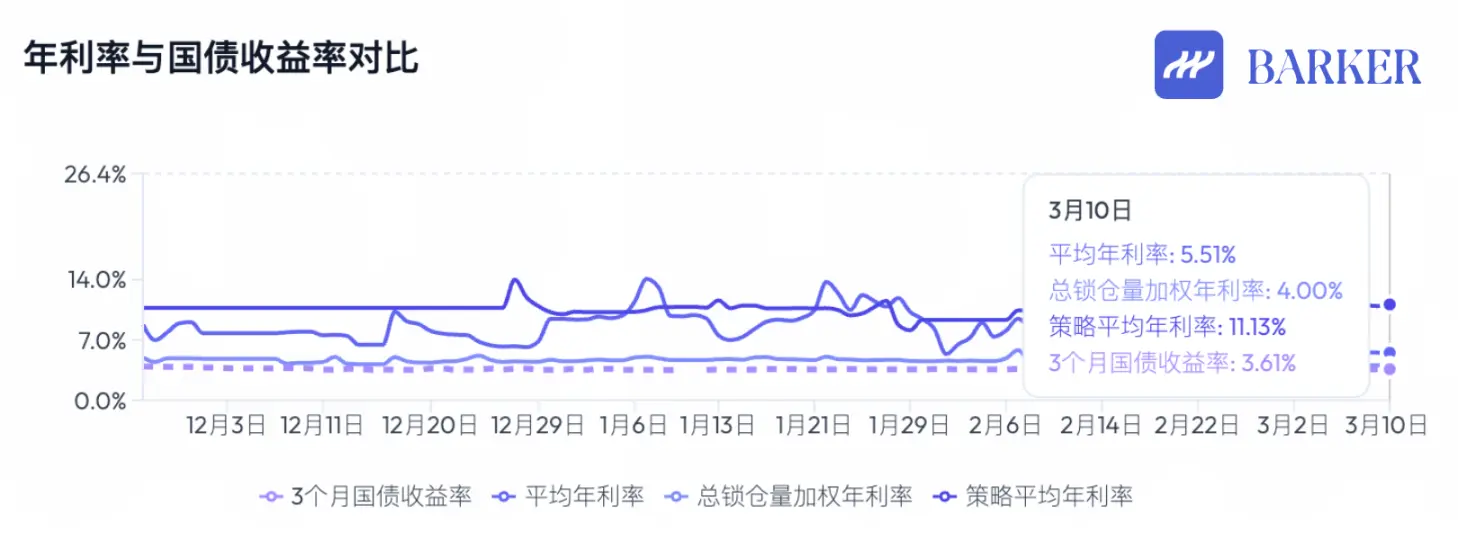
Image caption: On-chain stablecoin yields annualized vs. U.S. Treasuries
Image source: @BarkerMoneyX
The never-ending effort to save DeFi—despite tokenomics collapse and DAO governance breakdown—the overall direction remains clear:
- Fixed interest rate lending, recognized risk grading systems, unsecured credit lending → the next market mainstay, containing some form of universal product;
- The expansion phase of public chains, exchanges, and DeFi protocols has ended. New application forms are emerging as vaults, though it’s not yet certain that vaults are the form of universal product, but this is the starting point of the new phase.
Note that public chains and exchanges are no longer the central links in value capture, but this doesn’t mean a zeroing-out moment. Their asset prices have finished inflating; the next phase is only linear steady growth.
This can also extend the progression from UNI to U.S. Treasuries: Aave/Morpho are closer to asset management itself. Their business has little narrative space but is indispensable for the industry.
The truly star products will be those used by the masses, built on public chains and DeFi protocols, based on RWA-diversified assets, triggering asset price inflation mechanisms in vaults.
For mass adoption, Curators team up with exchanges; Morpho leverages Stakehouse to enter Coinbase; Aave uses MetaMask and other U cards to expand C-end users.
Based on RWA assets, Curators partner with institutions like Galaxy for custody, constantly shifting between crypto and real-world assets—Grove buying Galaxy’s CLO bonds, for example.
But what’s missing is a vault that triggers a price inflation mechanism. Even before this large-scale on-chain asset management, BlackRock’s BUILD token has launched, Circle’s USYC supports yields, but none can replicate their success.
Vaults without their own tokens aren’t crucial; asset price inflation is a mechanism. U.S. stocks, real estate, bonds, tulips, graphics cards, and Mac Minis all have their own price cycles. Currently, vaults only have yield black boxes, but two issues remain unresolved:
- Where does high yield truly come from?
- How to handle high risk?
Toward a New Financial System
Channels are evolving; vaults are not the end.
The crypto industry evolves rapidly. Before this year, we never dared to imagine a global financial system truly on-chain, but today, it’s an undeniable reality.
We’re not at a celebration yet—RWA can only serve as a funding source, and vaults remain boring deposit games. Various Curators show no brand effect; white-label vaults like Veda are close to SaaS, with operators earning management fees.
This offers no imagination for price inflation. If traditional $2 trillion asset management can withstand cyclical hardships, it’s hard to imagine vaults holding up.

Image caption: Capital flow and value distribution
Image source: @zuoyeweb3
On-chain asset management isn’t a fleeting trend. In a sense, it’s like banking IOEs—impossible to revert to paper era. Even Spark begins to unify CEX/DEX position adjustments and margin calculations; DeFi is the next step for TradFi.
Once vaults absorb enough funds, will they trigger the establishment of a risk-free rate? That’s the biggest gamble of this cycle.
During the DeFi Summer, TVL was the decisive metric—funds mapped to token wealth factors, fueling mining, yield farms, studios, and Binance Alpha. The core logic: project teams need more funds to support token growth.
But for the first time, vaults face a dilemma: high deposit demand but inability to support their own tokens’ rise. Even if Morpho captures more Aave market share, it can’t cause tokens to surge.
A comparison: Hyperliquid vs. Binance, Lighter vs. Hyperliquid—market scales and token prices show a huge inversion, a major upheaval unseen before in DeFi.
On one hand, old infrastructure continues to bleed—after listing effects fade, $BNB should decline, but CEXs still dominate the on-chain + DeFi user base. Ironically, exchanges hold retail users; protocols like Aave and Morpho are now mostly the domain of professionals.
In this context, the high risk of vaults and curators stems from code and structure:
- Immutable contracts like Curve’s may have bugs; xUSD team’s self-issuance is risky.
- Aave has ended the superficial harmony between DAO and dev team; Re7’s attacks threaten on-chain asset management credibility.
So, what do vaults and curators derive their high yields from?
I know it’s not regulatory arbitrage, HLP fees, or token incentives. Many still cling to these, believing traditional finance’s compliance has built an unbreakable reputation.
They forget that tokenomics has already collapsed, while vault deposits keep growing. Sky has deeply integrated into Morpho; Aave V4’s future is institutionalized and modular.
Moreover, the article emphasizes that vaults’ lack of a price inflation mechanism is their structural dilemma.
Vault yields fundamentally come from global market trading efficiency. If CEXs don’t offer certain vaults, they’ll be configured on-chain. Personalized curators are well-suited to mediate among various actors.
Traditional finance’s global markets—like U.S. stocks—still face long account opening, trading hours, and procedural limits. It’s not like U.S. markets are gradually becoming 24/7 for arbitrage, right?
The final question: what mechanism can trigger asset price inflation, allowing vault-accumulated funds to create legendary market cap ratios?
In other words, what does vault lack to cause asset price inflation?
It lacks channels—interconnected pathways for funds. The personalized nature of curators hampers the programmability of DeFi Lego blocks.
Currently, CEXs serve as placeholders—where funds are most quickly intertwined.
Referring to the evolution of Perp DEXs, capturing CEX contract market share, and RWA funding sources, all are vying for CEX market dominance.
CEXs only have existing assets; they can’t solve user acquisition issues, let alone help vaults reach hundreds of millions of users. When vaults launch, they do OEM branding; in the future, they’ll need to build their own super factories.
I speculate channels will take the form of some broker products.
Under high social division of labor, exchanges—integrating deposits, trading, custody, and clearing—will gradually specialize. Binance’s Abu Dhabi ADGM compliance framework exemplifies this segmentation.
This will fundamentally improve the professionalism of fund management, leveraging blockchain’s unified ledger, with vaults and curators playing a central coordinating role.
Looking at Robinhood/Trade Republic and other neo-brokers, attracting young, retail users into professional trading, then building asset management and wealth management services, with stablecoins as the front end and curators managing vaults—this model is more efficient.
In summary, Binance monopolizes capital flow, BNB gains the strongest empowerment. Next, brokers will handle fund interactions—certain asset forms or even pure business flows will be highly profitable, after all, Robinhood is just a profit-driven market maker’s alias.
Closing Remarks
Compared to code and trading, regulation and tokens are actually more stable.
The suspension of private credit and RWA cycles, the premonition of the 402 document, suggest DeFi isn’t incapable of serving as an exit channel for liquidity, but it lacks a mechanism for asset price inflation.
Asset management ≈ Aave/Morpho—gradually ending their historical mission like public chains. They will exist long-term, but only with scale growth and token price stabilization.
Vault & Curator ≈ star fund managers—rapidly acquiring customers and monopolizing markets. Signs of giantization are emerging, but whether they can sustain value capture remains doubtful.
Channels ≈ CEX (temporary)—they still hold the most space for innovation, facilitating capital mobility, and will always be highly rewarded.
A highly efficient global market is operating on public chains that don’t even need traditional tokens. This is the next era’s challenge—everyone must find their answer.


