Prediction markets tracking U.S. politics are heating up as traders wager millions on the 2026 midterms and the 2028 presidential race, with activity on Polymarket and Kalshi revealing how bettors think Washington’s next political chapter might unfold.
Traders Rotate Bets as Democrats Lead Midterm Odds and Rubio, Newsom Rise in 2028 Race
The “Balance of Power: 2026 Midterms” market on Polymarket has drawn more than $3.3 million in trading volume as participants speculate on which party will control Congress after the elections. The largest share of wagers currently points to a Democratic sweep of both chambers, priced at roughly 45% odds and backed by about $906,000 in trading.
A divided Congress is the next most popular outcome among traders. Markets currently assign a 37% probability to Republicans winning the Senate while Democrats retain the House, reflecting $653,000 in trading volume. An outright Republican sweep sits much lower at 18%, though wagers totaling nearly $750,000 show bettors are still hedging their political portfolios.
One scenario appears almost nonexistent in the betting pool: Democrats holding the Senate while Republicans control the House. That outcome carries only about a 1% probability despite nearly half a million dollars in trades, illustrating how prediction markets sometimes host heavy volume even when the consensus probability is tiny.
Over on Kalshi, which also competes with Polymarket as an event-contract exchange, traders are making similar wagers on congressional control. The platform’s “2026 Midterms: Congress Balance of Power” market currently prices a Democratic House and Democratic Senate outcome at about 48%, followed by a Democratic House and Republican Senate configuration at roughly 40%. Republican control of both chambers trails at 15%.
While the midterm markets focus on the immediate political horizon, prediction traders are already piling into bets on the 2028 presidential race. On Polymarket, the “Presidential Election Winner 2028” market has generated nearly $389 million in total trading volume — a staggering figure considering the election is still more than two years away.

Among the early favorites in that market is JD Vance, currently priced at about a 21% probability with nearly $7.9 million in trading tied to his contracts. Close behind is Gavin Newsom at roughly 18%, followed by Marco Rubio at about 15%.
The prediction market’s chart shows Gavin Newsom climbing back toward roughly 17–18% in the Polymarket 2028 presidential market after drifting lower through late January and February, suggesting traders recently rotated capital back into the California governor’s contracts.
The move appears to coincide with the pullback in contracts tied to JD Vance, implying bettors may be rebalancing positions as the field tightens near the top of the market.
Several other prominent political figures also appear in the betting mix. Alexandria Ocasio-Cortez carries roughly 6% implied odds, though her contracts have drawn more than $9 million in volume, indicating strong speculative interest. Kamala Harris trails at about 3%, despite over $5.4 million traded.
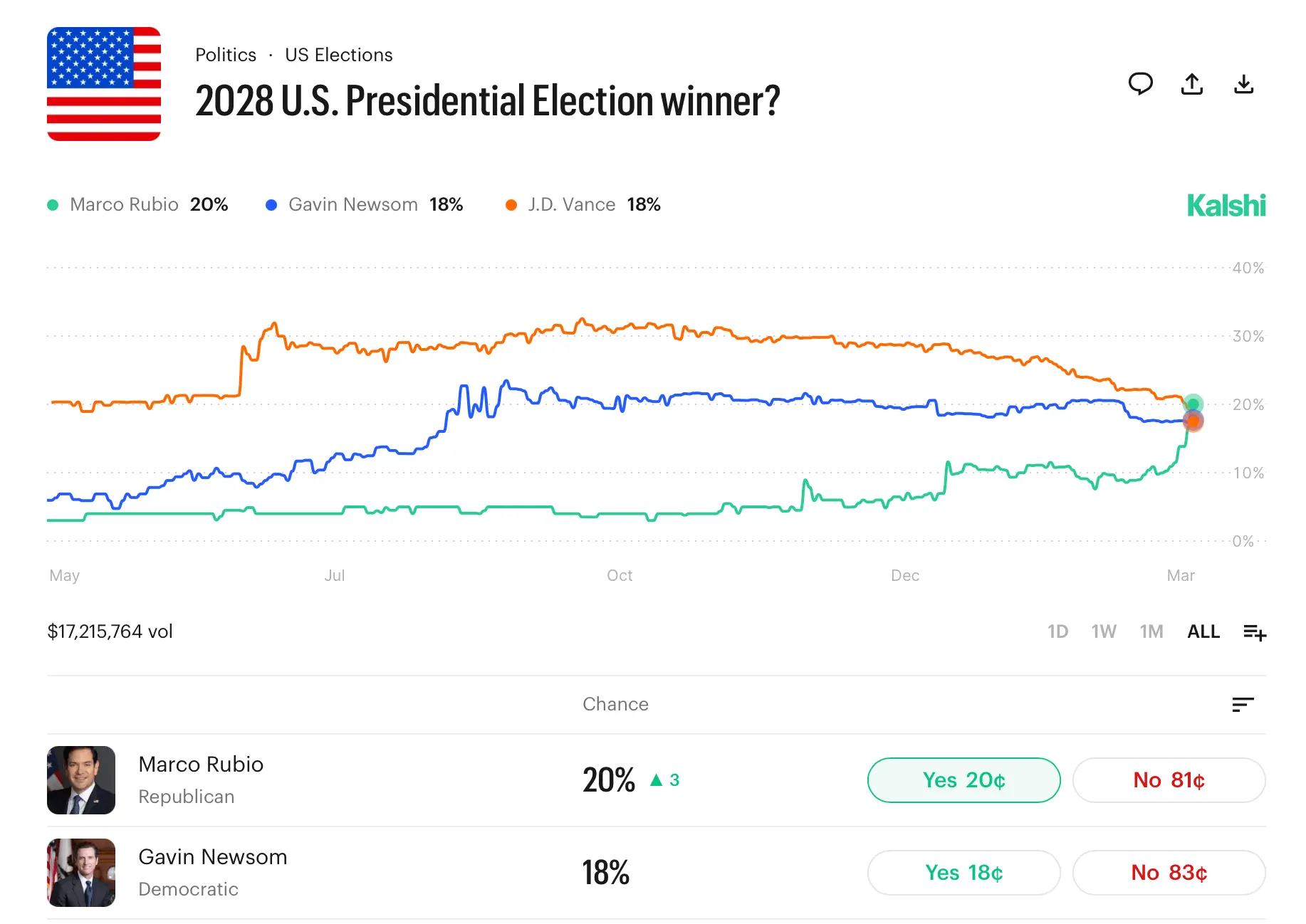
Kalshi’s parallel market for the 2028 election paints a similar — though slightly reshuffled — picture. On that platform, Rubio currently leads with a roughly 20% probability, followed by Newsom at 18% and Vance at 17%. The market has attracted more than $17 million in trading volume and will ultimately resolve when the president inaugurated in 2029 takes office.
Prediction markets operate much like financial exchanges, allowing participants to trade contracts tied to real-world outcomes. Prices fluctuate as traders respond to polling data, political developments, and shifting public sentiment, effectively turning the platforms into real-time gauges of political expectations. With that in mind, the odds could easily shift during the next two years.
Recent polling may partly explain why some traders appear to be hedging their bets. Surveys conducted after the Feb. 28 U.S. and Israeli airstrikes on Iran show President Donald Trump’s approval rating dipping in several polls.
A Reuters/Ipsos survey conducted as the strikes began recorded 39% approval, down one point from the previous poll, while a Daily Mail/J.L. Partners poll placed approval at 44%, four points lower than a week earlier. A Quinnipiac survey conducted March 6–8 showed approval at 37%, marking a second-term low for that pollster.
Despite the declines, broader tracking averages from major poll aggregators indicate Trump’s overall approval rating has remained relatively steady near the low 40% range. Republican voter support remains strong, limiting the magnitude of any broader shift.
For prediction market traders, however, even small changes in political momentum can ripple through odds and contract prices. With billions of dollars in political power at stake in the coming years, bettors on Polymarket and Kalshi appear more than willing to place their wagers early — sometimes years before the ballots are cast.
FAQ 🐴 🐘
- What are prediction markets like Polymarket and Kalshi?
Prediction markets allow traders to buy and sell contracts tied to real-world outcomes such as elections, with prices reflecting the market’s estimated probability.
- Who is leading the 2028 presidential prediction markets right now?
Current odds on Polymarket and Kalshi place JD Vance, Gavin Newsom, and Marco Rubio among the top contenders.
- What do prediction markets say about the 2026 midterms?
Current betting markets slightly favor Democrats holding the House and possibly both chambers of Congress.
- Do prediction markets accurately forecast elections?
While not perfect, prediction markets often track political sentiment in real time by incorporating money-backed expectations from traders.
Disclaimer: The information on this page may come from third parties and does not represent the views or opinions of Gate. The content displayed on this page is for reference only and does not constitute any financial, investment, or legal advice. Gate does not guarantee the accuracy or completeness of the information and shall not be liable for any losses arising from the use of this information. Virtual asset investments carry high risks and are subject to significant price volatility. You may lose all of your invested principal. Please fully understand the relevant risks and make prudent decisions based on your own financial situation and risk tolerance. For details, please refer to
Disclaimer.


