
The tokenization of real-world assets (RWA) market reached a historic high of $26.7 billion in early March, a 309% increase compared to $6.5 billion a year earlier. Despite the overall cryptocurrency market being in a state of extreme fear long-term, capital inflows into this category have continued to grow against the trend. Among all blockchain networks, Ethereum dominates this tokenization race with over 57% market share, supporting approximately 675 tokenized projects.
Tokenized RWA Hits Record High: Countercyclical Growth in a Bear Market
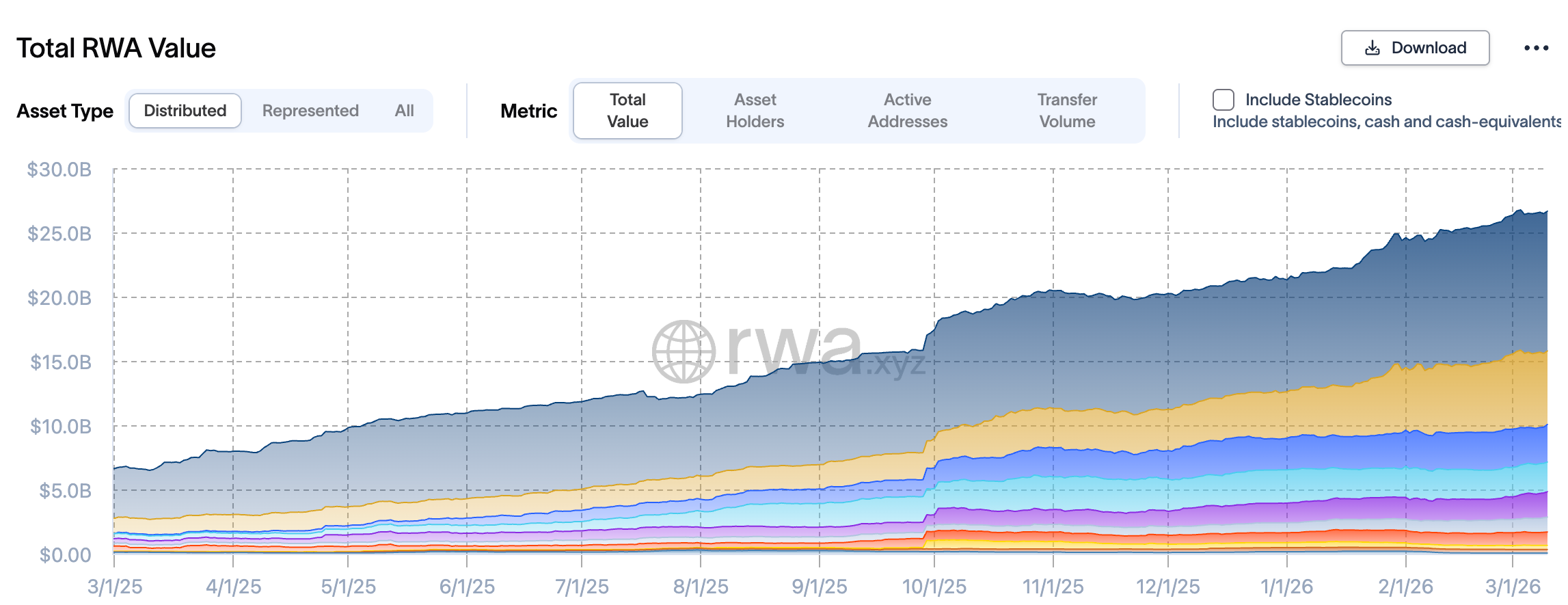 (Source: RWA.xyz)
The total value of decentralized RWA reached $26.7 billion in early March, a milestone worth noting especially because it occurred amid low levels of the crypto market fear index. The 309% year-over-year growth indicates that institutional investors and traditional financial institutions’ interest in tokenized assets has not fluctuated in line with short-term market sentiment.
By early 2026, the number of RWA holders on Ethereum, Solana, Arbitrum, and BNB Chain has all increased significantly, showing multiple chains are attracting more deployment of tokenized assets. In December last year, JPMorgan launched its first tokenized money market fund on Ethereum, further strengthening traditional finance giants’ institutional trust in Ethereum.
Why Institutions Still Choose Ethereum: Risk Management Over Sentiment
Standard Chartered’s Global Head of Digital Assets Research, Geoff Kendrick, clearly states the core logic behind institutional preference — it’s not about ideology, but a rational choice for risk management.
He said, “I believe that with the involvement of traditional finance (TradFi), Ethereum may dominate in the coming years. As banks and other institutions build various applications on blockchain, I think almost all applications will be realized on Ethereum in the future.”
Kendrick further explains the institutional logic with a popular industry saying: “If you do something wise and it goes wrong, you might still keep your job; but if you do something unwise, you’re likely to lose it.” For institutional investors responsible to boards and compliance departments, Ethereum represents a “defensible default choice”—once this institutional bias forms, it’s hard to change easily with just technological advantages.
Advantages of Ethereum’s Institutional Position
- Years of Security Record: Longest operational history among major public blockchains
- Most Extensive Institutional Ecosystem: JPMorgan, BlackRock, Franklin Templeton, and others have deployed tokenized projects
- Mature Compliance Tools: More complete legal frameworks and technical standards supporting tokenization
- Deep Liquidity: DeFi ecosystem’s TVL still led by Ethereum, providing greater liquidity for tokenized assets
Challengers’ Space: Potential Opportunities for Solana and Permissioned Chains
Solana’s fast, low-cost transactions have surpassed Ethereum in user numbers, indicating stronger daily usage appeal among broader end-user groups. Kendrick believes that institutional adoption of networks like Solana may happen “later,” as Ethereum’s current advantage is more about first-mover effects and institutional inertia.
Bitwise CIO Matt Hougan points out another potential competitive dimension — permissioned (private) blockchains. These networks offer higher control, privacy, compliance flexibility, and predictable transaction costs, which are attractive in heavily regulated industries. However, these advantages come at the expense of decentralization and openness inherent in permissionless public chains. Hougan believes that as institutional adoption increases, some permissioned networks may eventually gain significant popularity in specific niches, but this does not necessarily threaten Ethereum’s dominance of public chains.
FAQs
Solana has surpassed Ethereum in RWA holder numbers. Does this mean Ethereum’s dominance is declining?
Holder count and market share are different metrics. Solana has about 157,682 RWA holders, slightly more than Ethereum, reflecting its popularity among retail and small-scale tokenized asset users. However, Ethereum still dominates high-value institutional tokenization projects, controlling over 57% of the decentralized RWA market cap. Institutional capital flows and deployment of high-value assets remain primarily on Ethereum.
What drives the 309% annual growth in the tokenized RWA market?
Three main factors:
- Regulatory improvements (EU’s MiCA, US stablecoin legislation) reducing compliance uncertainty for institutions;
- Demonstration effects from giants like BlackRock and JPMorgan launching tokenized products, encouraging more institutions to follow;
- Post-low interest rate environment, increasing institutional demand to tokenize government bonds, money market funds, and other liquid assets to improve capital efficiency.
Could permissioned blockchains eventually replace Ethereum’s dominance in tokenization?
Permissioned chains offer control and compliance advantages, making them competitive in heavily regulated use cases. However, Ethereum’s decentralization and established institutional ecosystem create network effects that are hard to replicate. The more likely scenario is a “hybrid adoption”: different types of tokenized assets are routed to public chains (mainly Ethereum) or private chains based on needs, rather than permissioned chains fully replacing public chains.
Disclaimer: The information on this page may come from third parties and does not represent the views or opinions of Gate. The content displayed on this page is for reference only and does not constitute any financial, investment, or legal advice. Gate does not guarantee the accuracy or completeness of the information and shall not be liable for any losses arising from the use of this information. Virtual asset investments carry high risks and are subject to significant price volatility. You may lose all of your invested principal. Please fully understand the relevant risks and make prudent decisions based on your own financial situation and risk tolerance. For details, please refer to
Disclaimer.


