Author: BiyaNews
Recently, a piece of news in the crypto industry has caused many investors to frown. Blockchain payments giant Ripple announced a buyback plan of up to $750 million, which could boost its company valuation to around $50 billion. This should have been a strong confidence boost, but market reactions have been quite divided: on one side, the company shows confidence; on the other, its native token XRP continues to struggle at low levels, even breaking through key psychological and technical support levels.
This strange scene of “company moving left, token moving right” naturally raises the question: Is Ripple’s “cash ability” to buy back shares a “big pie” for shareholders, or a “poison” for XRP holders? What deeper market logic is hidden behind this?
The “Strategic” Behind the Buyback: Confidence, Control, and Market Signals
When a company chooses to spend real money on share buybacks amid macro uncertainty and low market sentiment, it’s far more than just a financial move. It’s primarily a “confidence declaration” to shareholders and the market.
From a psychological perspective, buybacks reduce the number of circulating shares, which, with profits unchanged, increases earnings per share (EPS). This directly enhances the “value” of existing shares. Especially now, as global tech stocks and crypto markets face stress tests, this proactive “market support” can effectively stabilize core investor sentiment and prevent panic-driven sell-offs. I recall in the 2022 tech bear market, cash-rich giants like Apple and Google used large-scale buybacks to signal long-term confidence, with immediate positive effects.
Deeper still, buybacks are a strategic move to strengthen control. By repurchasing shares from the open market or early investors, Ripple’s management and founders can further consolidate control, reduce external shareholder interference, and pave the way for executing long-term, sometimes controversial, blockchain strategies. An analyst pointed out that this clearly shows the company’s strong confidence in its growth, especially in expanding blockchain application scenarios.
However, there’s another side. Where does the money for this massive buyback come from? Although Ripple’s financials as a private company are opaque, a disturbing market speculation has begun circulating: Is the company continuously selling its large XRP holdings to fund the buyback? Such speculation is not unfounded; it hits at Ripple’s most sensitive nerve.
XRP’s “Darkest Hour”: Technical Breakdown and Confidence Erosion
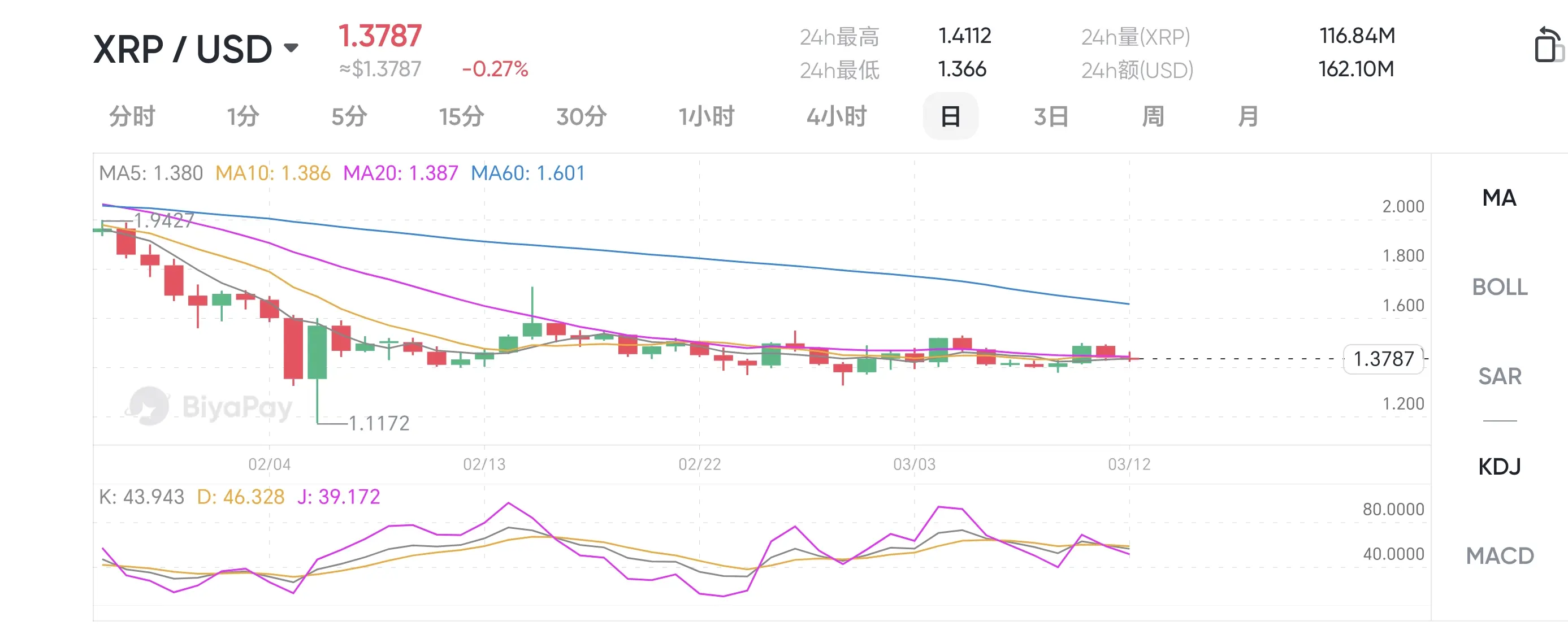
While Ripple’s board envisions a $50 billion valuation, XRP traders are watching bleak candlestick charts. The token’s price not only remains well below its previous bull market high but has recently broken below the critical $1.80 support, dropping as low as below $1.50, forming textbook bearish structures.
This weakness extends from the charts to on-chain data. On-chain activity shows signs of retail investor capitulation. Many addresses are holding “unrealized losses,” especially after XRP experienced a deep correction of over 16% in February. This persistent decline saps morale, shifting holders from “faith-based holding” to “doubt and despair,” with every rebound becoming an opportunity to reduce positions and escape.
The sharp question then becomes unavoidable: if Ripple is truly raising funds by selling XRP to buy back shares, it’s effectively creating ongoing selling pressure in the open market. This forms a strange cycle: the company uses proceeds from token sales to boost its equity value, while token holders bear the brunt of falling prices. The “see-saw” effect between corporate strategy and token value has never been clearer.
This divergence isn’t new. Over the past few years, Ripple has been active in expanding globally—collaborating with central banks on CBDC projects, developing payment corridors across Asia-Pacific, Europe, and beyond. Good news on the fundamental side has been plentiful. But these positive fundamentals seem like stones thrown into a deep pond, with ripples on XRP’s price surface growing smaller and smaller. The market appears to be learning to price “Ripple Inc.” and “XRP token” as two separate assets.
The “Company-Token” Paradox in Crypto: What Are We Really Investing In?
The divergence between Ripple and XRP exposes a long-standing fundamental confusion in the crypto world: when investing in a blockchain company with a native token, what are we actually investing in? The company’s technology, team, and business contracts, or the token that operates on a decentralized network and whose price is determined by all network traders?
In traditional stock markets, company value and stock price are tightly linked through equity. Profit growth and buybacks lead to rising stock prices, directly benefiting shareholders. But in Ripple’s case, this logical chain appears “disconnected.” Legally, XRP is defined as a non-security (at least in the current US case), and it does not represent ownership or dividend rights in Ripple. Its value depends more on its utility within RippleNet, market liquidity, and speculative demand.
This creates an awkward situation: no matter how well Ripple develops, if demand for XRP as a cross-border settlement medium doesn’t grow as expected—or if more efficient competitors emerge—XRP’s price can still weaken independently. Conversely, even if XRP surges due to market hype, Ripple’s stock value may remain stagnant if it cannot translate that into stable revenue and profits.
I recall during the DeFi summer, many protocol tokens experienced similar phases. Protocol usage exploded, but token prices lagged or moved inversely until more sophisticated tokenomics models—like linking protocol revenue to buybacks and burns—were introduced to partially address this divergence. For Ripple and XRP, establishing a more direct, transparent value transfer mechanism might be key to restoring market confidence.
The Road Ahead: Regulation, Utility, and Market Patience
Looking forward, Ripple and XRP face multi-dimensional challenges.
First, the regulatory sword of Damocles remains unresolved. Although Ripple achieved some key victories in its legal battle with the SEC, the global regulatory environment remains complex and volatile. Any adverse rulings or policy tightening could impact both the company’s business and token confidence.
Second, proving real-world utility is urgent. XRP needs to demonstrate that it’s not just an experimental product of Ripple but an indispensable, efficient, low-cost component of the global payment system. This requires adoption by mainstream financial institutions and sustained growth in cross-border payment volumes. Recent trials by regional banks using Ripple’s technology are promising, but scale remains to be seen.
Finally, market patience is being tested. Crypto cycles are shortening, and investor attention can shift rapidly. If XRP cannot show price growth aligned with Ripple’s development over the long term, capital and interest may flow to other narratives with faster growth or stronger fundamentals.
For investors, the current situation demands clearer thinking. You must ask yourself: Are you investing in Ripple as a potentially future-listed, technologically capable company, or in XRP as a utility token? These are fundamentally different investment logics with distinct risk and return profiles.
Perhaps Ripple’s buyback plan will ultimately succeed in boosting its valuation and paving the way for an IPO. Or XRP might find a breakout point in a large market due to its settlement efficiency, gaining independent momentum. But until then, the “company versus token” decoupling saga will continue to test market participants’ wisdom and resolve. The market is always changing, and the only constant is the need to keep asking: Where does true value come from?


