Author: Frank, PANews
In recent times, the hottest topic in the tech and startup circles isn’t a major company releasing a new model, but the nationwide craze of “Lobster Farming.”
On one hand, the “Lobster Farming” boom has driven growth in related industries, with large model companies and cloud server providers making huge profits. On the other hand, how much real benefit Openclaw can bring to users remains a mystery. Although social media is filled with myth-like stories, a closer look reveals most are virtual stories designed to attract traffic.
Is lobster farming truly profitable? If so, who is actually making the money?
PANews has compiled data from TrustMRR, public cases on social media, project official websites, and cross-verified reports from multiple sources. To distinguish “verified real income” from online myths, we excluded many rumors based solely on one-sided claims or unverified information.
According to TrustMRR, the OpenClaw category page shows a total of 153 recorded projects in this ecosystem, with nearly $358,600 in combined revenue over the past 30 days. Analyzing the top 30 samples, their combined income accounts for 97.3% of the total.
Breaking down these projects and their underlying monetization logic by “industry value chain,” reveals a stark truth: The first to make money aren’t those using lobsters as products, but those who help others farm lobsters, teach others how to do it, or rely on hype to promote MEME tokens.
However, this isn’t the most genuine answer we’re after. How exactly are those truly using Openclaw making money? To answer this, PANews has summarized five monetization strategies behind OpenClaw.
First: Selling “Shovels” and services — quick cash from exploiting “cognitive gaps”
The most discussed and revenue-bright products in OpenClaw are often not specific applications but encapsulation tools and one-click hosting services.
OpenClaw functions more like an infrastructure layer rather than a ready-to-use consumer product, creating high barriers for non-technical users. Once complexity exists, services will emerge.
Among the approximately $35,860 in the TrustMRR sample revenue over 30 days, “hosting deployment” and “one-click cloud hosting” projects alone contributed about $12,010, accounting for 34.5%.
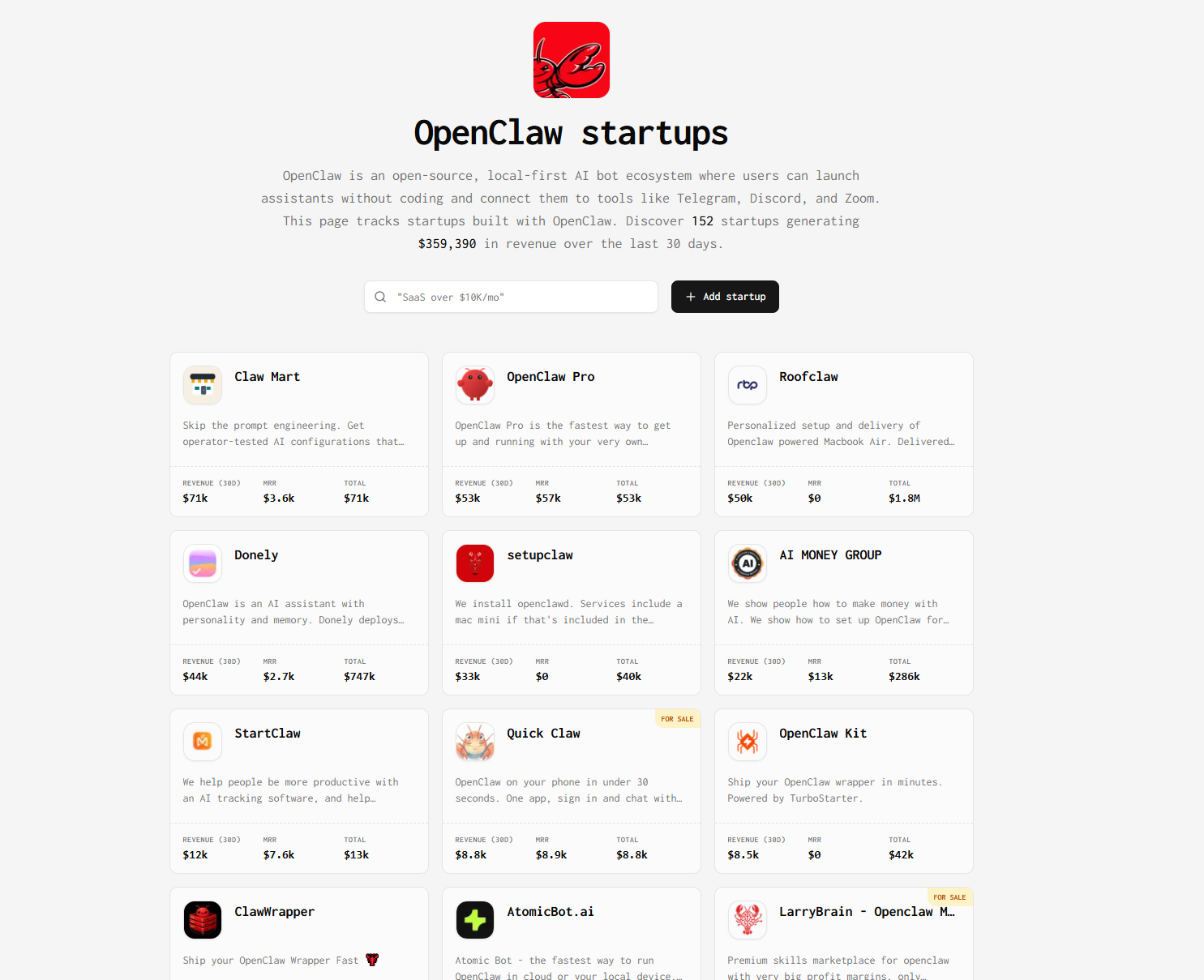
A typical example is QuickClaw, which packages underlying capabilities into a mobile app priced at $3.99/week or $49.99/year, generating about $8,782 in 30 days.
In Chinese communities, this logic manifests more plainly: “Lobster farming” services on second-hand platforms.
According to media reports, recently, “OpenClaw deployment” services on platforms like Xianyu and Xiaohongshu have exploded. Remote installation costs range from 100-300 RMB, while on-site services cost 400-1000 RMB. During certain periods, daily transaction volume for related services increased by 150% compared to the previous quarter.
This logic essentially profits from “information and perception gaps.” Users are willing to pay to save 30 minutes of hassle, but this is a “window period” business. As official one-click deployment tools mature, the red ocean of pure deployment services will quickly fade.
Second: Packaging AI expert personas — when “storytelling” becomes the most expensive product
Moving up the chain, another more valuable layer in the OpenClaw ecosystem emerges: not just deploying for you, but training your Agent.
In the top 30 TrustMRR samples, projects related to templates, skill packs, and configurations contribute 26.4% of revenue.
One of the most credible and complete business cases at this level is FelixCraft.
In early 2026, creator Nat Eliason launched an experiment. He named his OpenClaw robot “Felix,” invested $1,000 as startup capital, and let it build a business autonomously. Within a week, Felix generated about $3,500 via Stripe.
Additionally, the crypto community issued related MEME tokens on-chain, sharing 60% of daily transaction fees, allowing Felix to earn tokens worth up to $100,000 in a week.
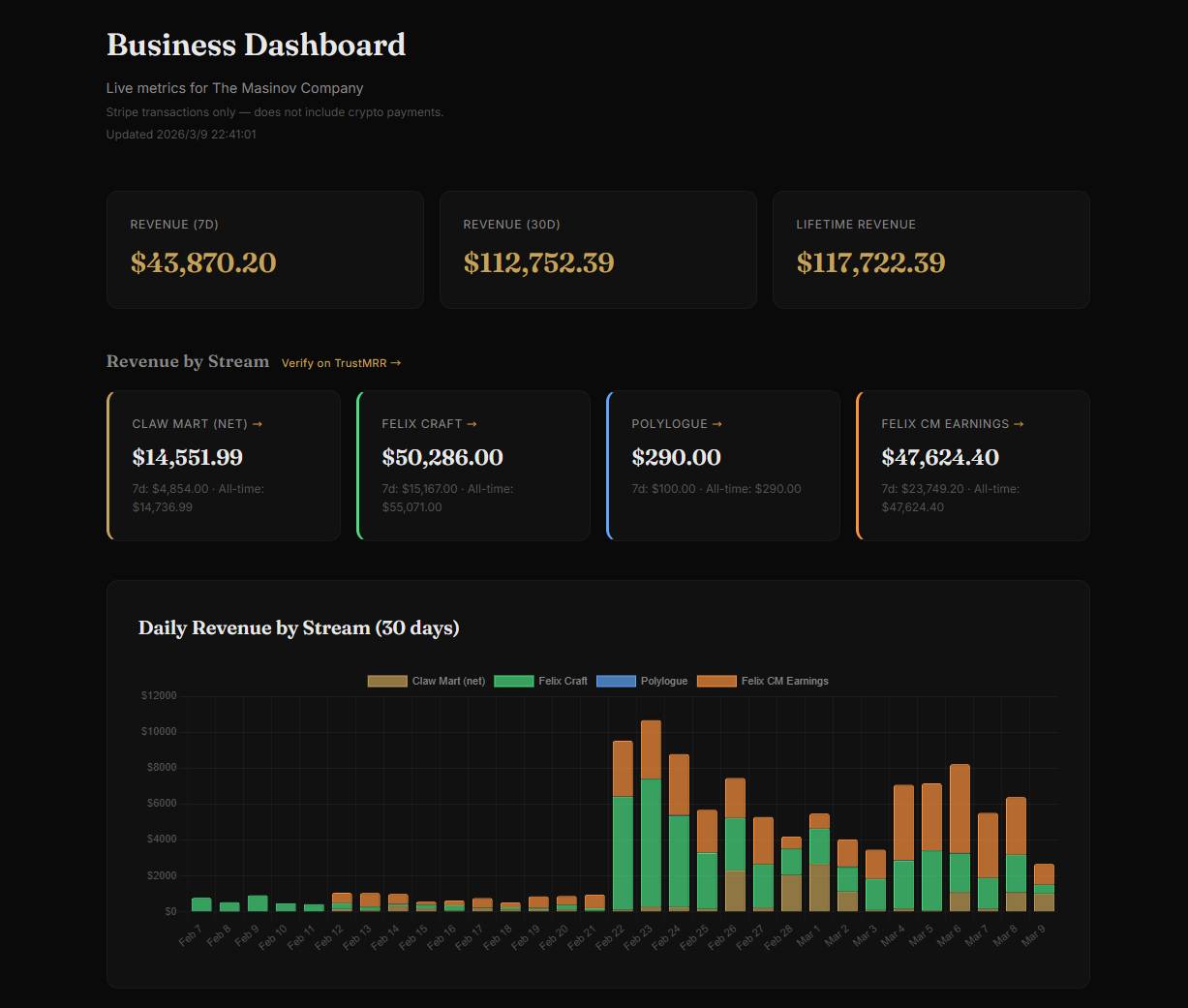
As a case worth deep analysis, Felix has several features: Nat Eliason granted the AI high permissions, allowing it to autonomously post on Twitter, retweet, and interact in communities. Before launch, Eliason spent significant effort building the framework, including memory modules, security settings, and workflows.
He admits that the profit was an unexpected outcome. Fundamentally, Felix’s main revenue still comes from packaging his training process and results as a product. The MEME token gains are largely driven by the story and hype it creates.
Interestingly, the top-earning project in TrustMRR’s OpenClaw category, Claw Mart (a marketplace for Agent skills), was created by Felix. Its total revenue has reached $71,300. The story of Felix as an autonomous agent creating projects and automating work is the strongest endorsement for this product. 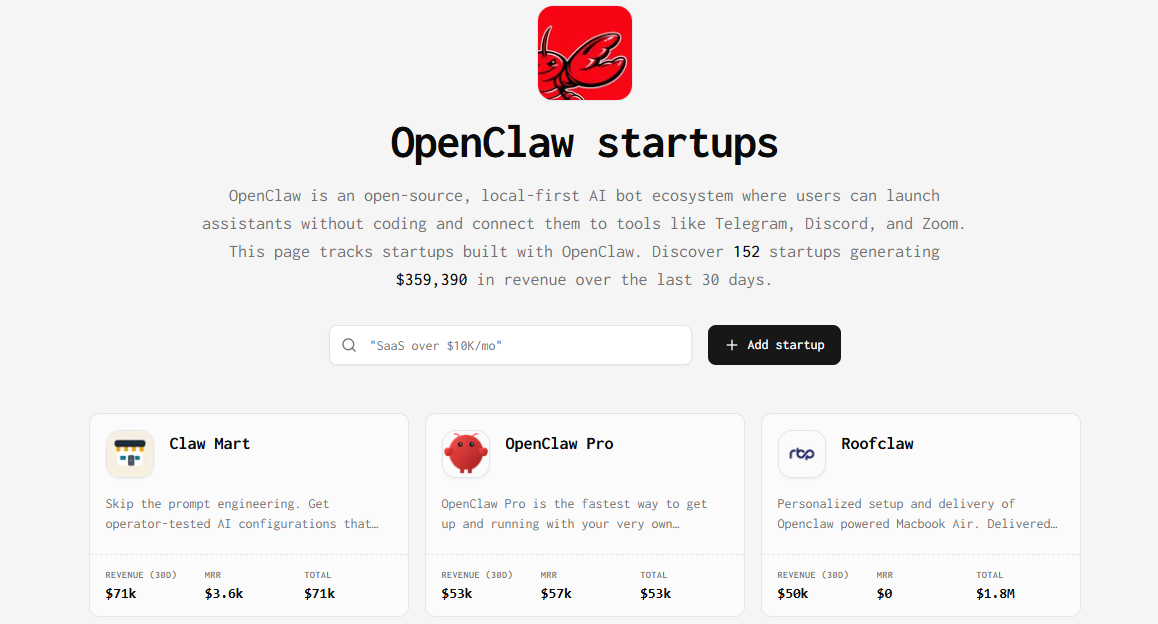
Felix’s success reveals a high-level monetization path: giving Agents continuous identity. When OpenClaw is branded as a specific name (Felix), a sellable guide, a set of reusable skill packs, plus a compelling narrative of “AI starting a business,” it transforms into a powerful personal brand with viral potential.
However, the core obstacle isn’t AI itself but the strong agent training skills and branding ideas of Nat Eliason behind it.
Third: Selling efficiency myths — using AI to work, monetizing through storytelling
Among all monetization paths, the most recognized might be: replacing manual work with OpenClaw, and profiting from the cost savings.
In content operations, this has become a reality. Developer Oliver Henry named his agent “Larry,” responsible for a TikTok account. Larry automatically calls large models to generate images, write titles, and upload drafts. Henry only spends 60 seconds daily choosing background music and clicking publish.
Henry states that within five days, Larry’s videos surpassed 500,000 views, bringing in about $588 in revenue (from paid app recommendations in his videos). Additionally, Larry generated $4,000 through MEME tokens.
Interestingly, Henry’s tweet about this story has already reached 7.1 million views. Like Felix, the story itself seems more commercially valuable than the agent.

Fusheng, founder of猎豹移动, built a team of eight agents called “30,000,” achieving daily updates from a few articles per year to over ten, and hitting a record of over 1 million reads on Bosheng’s account, attracting social attention. The viral post about agent operation was also a story about how the agent works.

In content creation, whether an agent’s content can go viral remains unproven. Most viral stories are about agents making money or improving work efficiency.
The biggest current topic in content creation is the “little lobster” story.
Fourth: Deep industry customization — breaking out of tool competition and earning “service premiums”
If “deployment” earns the “entry barrier” money, then packaging “lobsters” into personalized products is another level.
RoofClaw is a typical example. TrustMRR shows it earned about $49,800 in 30 days, with total revenue reaching $1.8 million. It offers “personalized customization and delivery of a MacBook Air equipped with OpenClaw.”
This means their business isn’t just pre-installing a lobster but encapsulating it within a MacBook, along with customized services to train the lobster into a tailored Agent.
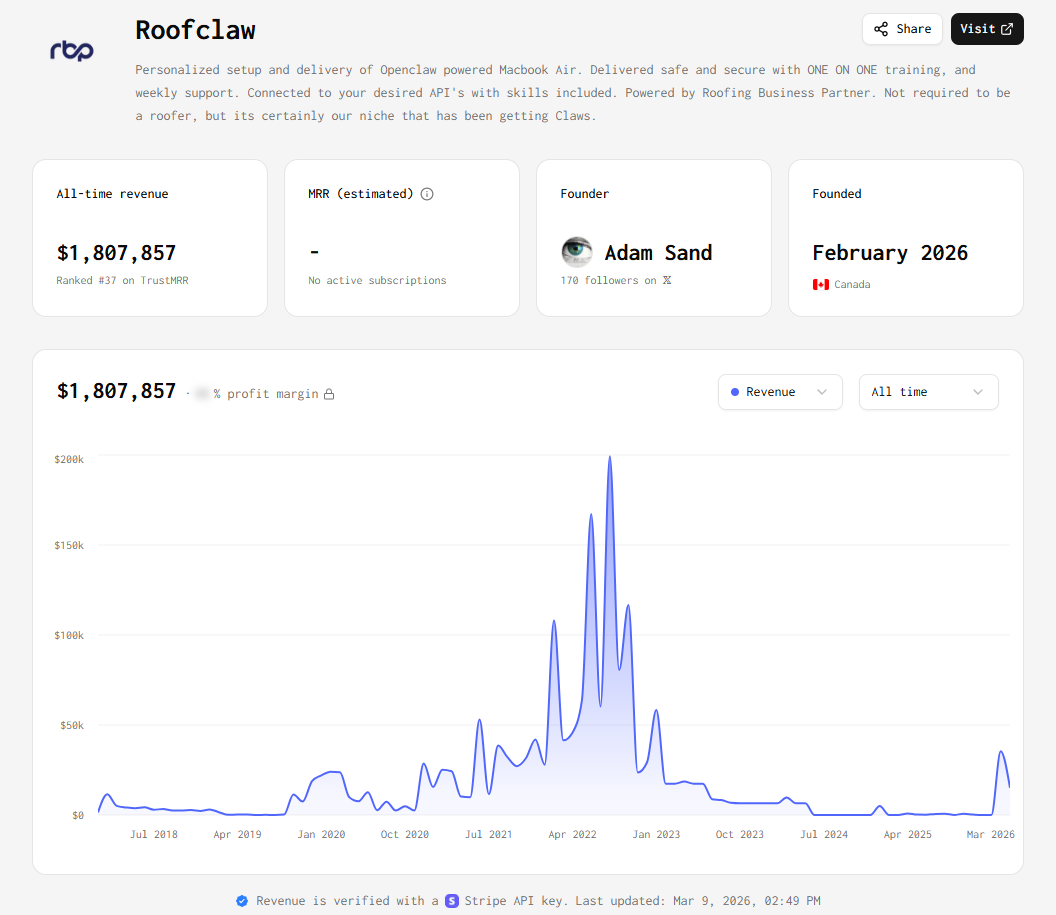
This type of service likely taps into the future real commercial needs of “lobsters.” Users probably don’t want a ready-to-use “lobster,” but a fully trained, customized one. Behind this demand is the need for deep, tailored services for Agents.
Simply put, we foresee many companies relying on Agents in the future, but how to train or “coach” these Agents will become an unavoidable necessity.
Fifth: On-chain transaction legends — the most tempting poisoned apple and traffic bait
On social media, the most sensational stories about OpenClaw are always about getting rich quickly.
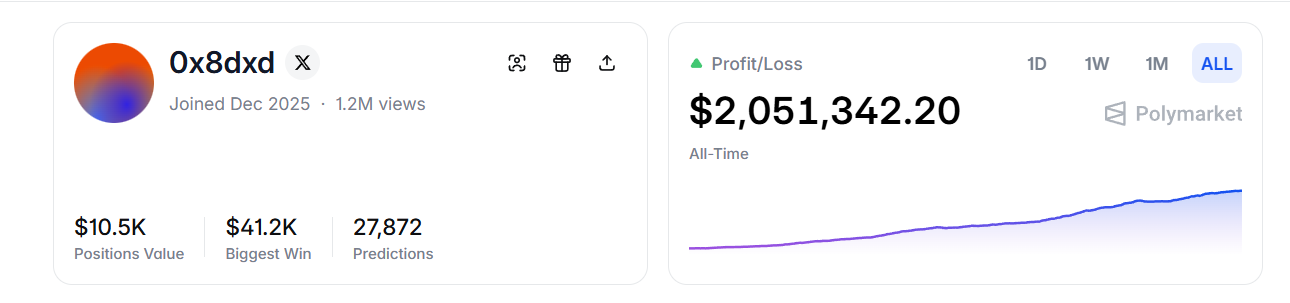
Currently, one verifiable on-chain account is 0x8dxd on the prediction market Polymarket, which is a high-frequency trading bot. Many social media posts speculate that this bot relies on OpenClaw for high-frequency trading, but PANews’s analysis shows the actual controller behind this address has never published such claims.
Stories claiming “OpenClaw designed an automated trading system that earns $10,000 a month” are just soft articles, mostly promoting their automated trading programs.
This case is listed as a warning: as previous PANews research shows, Agents and high-frequency trading bots are not the same. People are often misled and fantasize about their mystery.
Final thoughts: Teaching you how to make money is the real winning strategy
After analyzing the entire ecosystem, we found a phenomenon more worth pondering than any single case: sharing “I made X amount with OpenClaw” on social media is itself a very stable business.

When a post like “I earn 50,000/month with OpenClaw” goes viral, traffic becomes a lure. The author naturally directs viewers to paid communities, consulting, or product links.
“Showing off income” is the top of the customer acquisition funnel, and “money-making myths” are the strongest marketing material. This creates a perfect self-reinforcing cycle: selling stories of making money — attracting traffic — monetizing traffic — sharing “secrets” as a mentor — leveraging bigger gains.
Essentially, this has spawned a new business chain: bottom layer is deployment and infrastructure, middle layer is skill packs and workflow replacements, top layer is industry solutions and consulting.
If you understand sales, marketing, and have traffic, OpenClaw can drastically reduce costs and amplify productivity.
Many on the market share how they optimized workflows with OpenClaw, achieving many conveniences, but it’s far from a secret to wealth. The real core of this “herd effect” is that when you desperately push to the front of the crowd, you find nothing there — and you are the one waiting.
(PS: This article was not created using “little lobsters”)
Disclaimer: The information on this page may come from third parties and does not represent the views or opinions of Gate. The content displayed on this page is for reference only and does not constitute any financial, investment, or legal advice. Gate does not guarantee the accuracy or completeness of the information and shall not be liable for any losses arising from the use of this information. Virtual asset investments carry high risks and are subject to significant price volatility. You may lose all of your invested principal. Please fully understand the relevant risks and make prudent decisions based on your own financial situation and risk tolerance. For details, please refer to
Disclaimer.


