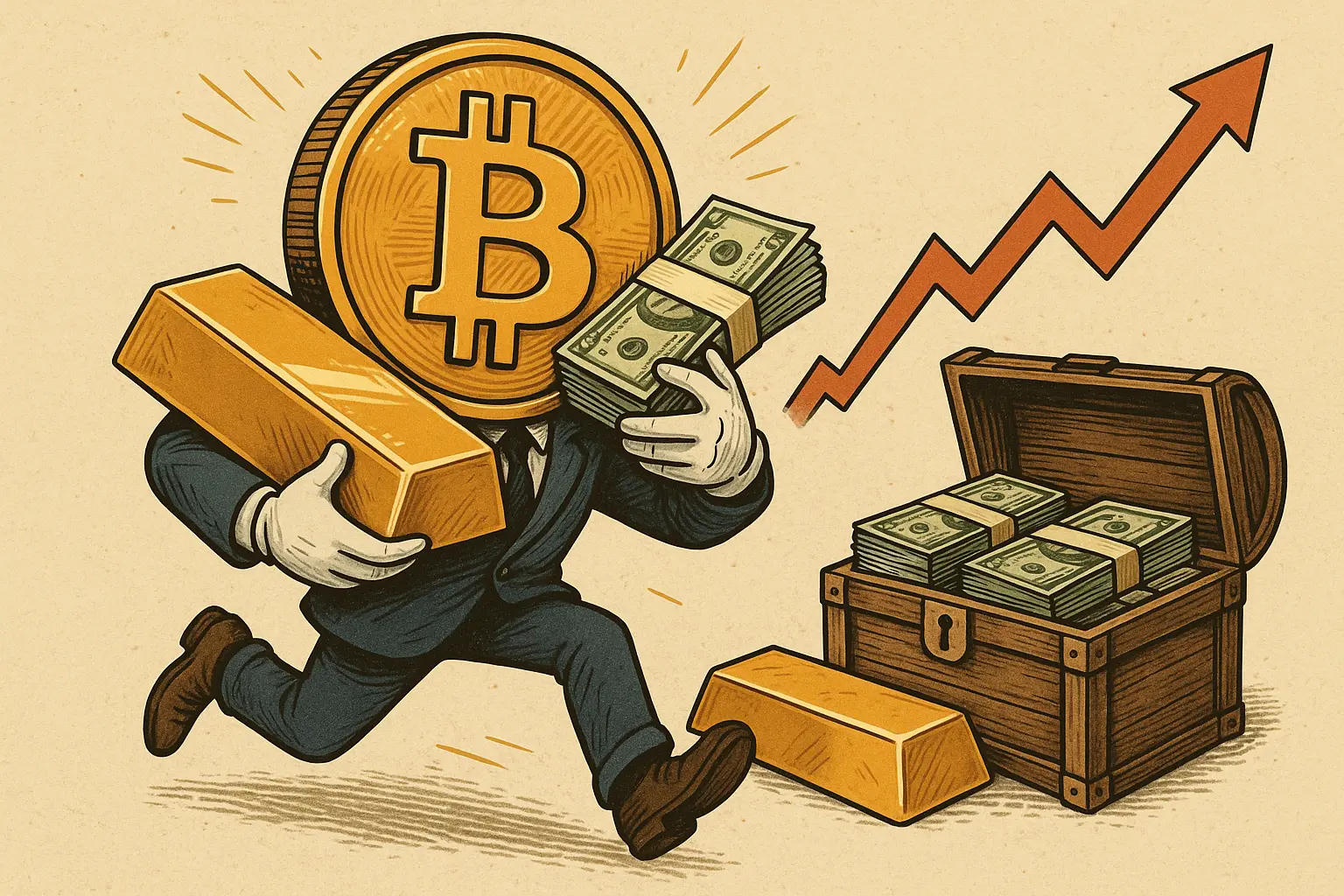
Bitwise Asset Management Chief Investment Officer Matt Hougan reiterated this week that if Bitcoin can capture a larger share of the global store of value market currently dominated by gold, government bonds, and other defensive assets, its price could eventually reach $1 million. He noted that Bitcoin’s long-term upside depends on how much of the global wealth preservation market it absorbs over time, rather than short-term market cycles.
Hougan’s $1 Million Argument: Global Store of Value Market Share Model
Hougan cited data showing that the global store of value market has grown from about $2.5 trillion in 2004 to nearly $40 trillion today, with Bitcoin currently accounting for only about 4% of this market. His framework suggests that if Bitcoin can take about half of the market share, its price could approach $1 million within ten years; if the broader store of value market continues to expand, Bitcoin would need only a smaller market share to reach the same level.
Hougan also pointed out that Bitcoin’s fixed supply of 21 million coins and its decentralized network give it structural characteristics similar to traditional stores of value like gold.
Major Industry Predictions for $1 Million
Besides Hougan, several industry heavyweights have publicly made similar forecasts:
- Cathie Wood (Ark Invest): Predicts Bitcoin could reach $3.8 million by the end of this decade
- Bernstein (2024 forecast): Projects $1 million by 2033
- Arthur Hayes (Legendary Trader): Believes the target could be reached as early as 2028
- Brian Armstrong (Coinbase CEO): States it could hit $1 million by 2030
- Jack Dorsey (Block Co-founder): Says it could reach $1 million within five years
- Eric Trump (Son of U.S. President Trump): Recently reiterated his $1 million Bitcoin prediction
Analyst Perspectives: Supportive but Divergent on Timeline
Several market analysts agree that Hougan’s long-term forecast is logically grounded, but most see it as a ten-year adoption scenario rather than a near-term prediction.
Marty Greenspan, founder of Quantum Economics, explained that the $1 million figure is essentially a “concise way to express that Bitcoin can rival gold and become a store of value,” emphasizing that the exact number isn’t crucial. What matters is Bitcoin’s share of global wealth. He noted geopolitical tensions are strengthening Bitcoin’s value proposition—during uncertain times, investors seek neutral stores of value, and Bitcoin is increasingly being categorized alongside gold. However, reaching such a valuation could take a decade or more.
Jason Fernandes, co-founder of AdLunam, warned of a “static denominator fallacy”: many investors use today’s market size of the store of value sector to gauge Bitcoin’s potential valuation, rather than considering a future much larger market. He pointed out that if Bitcoin captures about 17% of the projected $121 trillion global store of value market in ten years, it could support a $1 million price.
Nima Beni, founder of Bitlease, believes that if confidence in traditional “safe” assets collapses, this timeline could accelerate—potential sovereign debt crises or turmoil in the gold market could act as catalysts.
Frequently Asked Questions
What is the basis of Matt Hougan’s $1 million Bitcoin prediction?
Hougan’s forecast is based on a model of Bitcoin’s potential market share within the global store of value sector. The total market (including gold, government bonds, etc.) has grown to nearly $40 trillion, with Bitcoin at about 4%. If Bitcoin continues to attract a larger share, it could reach a $1 million valuation within ten years.
What are the main disagreements among analysts regarding the $1 million Bitcoin target?
Most analysts agree on the long-term trend of Bitcoin capturing more of the global wealth preservation market, but there is significant divergence on the timeline. Many see this as a ten-year or longer adoption scenario requiring ongoing institutional buying, regulatory clarity, and macroeconomic support, rather than short-term events.
Why is the comparison of Bitcoin’s market share to gold so critical for this prediction?
Gold is one of the largest components of the global store of value market. If Bitcoin gradually gains assets traditionally allocated to gold—whether through direct institutional shifts or new capital inflows—it will directly boost Bitcoin’s valuation. Analysts note that this substitution doesn’t need to fully replace gold; continuous market share growth within an expanding global store of value sector is sufficient.
Disclaimer: The information on this page may come from third parties and does not represent the views or opinions of Gate. The content displayed on this page is for reference only and does not constitute any financial, investment, or legal advice. Gate does not guarantee the accuracy or completeness of the information and shall not be liable for any losses arising from the use of this information. Virtual asset investments carry high risks and are subject to significant price volatility. You may lose all of your invested principal. Please fully understand the relevant risks and make prudent decisions based on your own financial situation and risk tolerance. For details, please refer to
Disclaimer.


