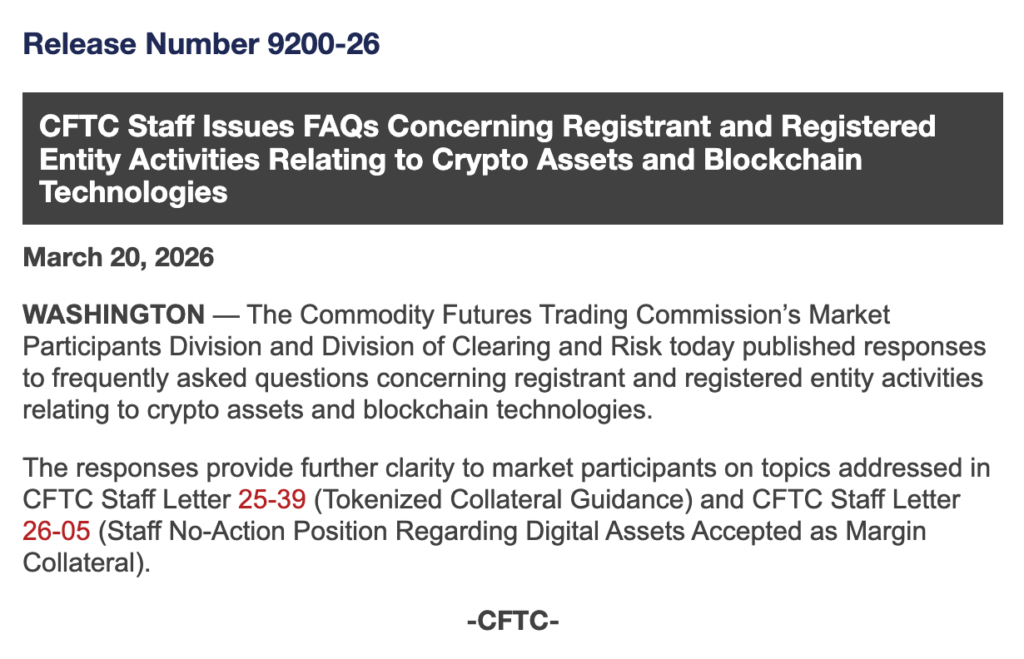
CFTC Market Participants Division and Clearing Risk Division jointly release FAQ to clarify the previous December pilot plan letter in detail, specifying that the capital deduction rates for Bitcoin and Ethereum are 20%, and 2% for stablecoins, providing concrete operational guidance for institutional use of crypto assets as collateral for derivatives.
(Background: The US SEC and CFTC issued a joint declaration on “coordinated regulation”: exploring prediction market thresholds and introducing perpetual contracts)
(Additional context: The US CFTC Chairman announced a “new blueprint for crypto regulation”: partnering with the SEC to launch Project Crypto, with DeFi and prediction markets set to receive clear regulations)
Table of Contents
Toggle
- First three months of pilot: limit to three cryptocurrencies, weekly reporting
- After three months: expand to more cryptocurrencies, relax reporting requirements
- Three major implications of allowing cryptocurrencies as collateral
The US Commodity Futures Trading Commission (CFTC) Market Participants Division and Clearing Risk Division released a FAQ earlier this week to clarify common questions arising from last December’s pilot plan letter.
The core of this pilot is to allow cryptocurrencies to serve as collateral in the derivatives market, meaning institutional investors can legally use assets like Bitcoin and Ethereum as margin for futures contracts in the future.
The FAQ provides a clear figure for the most concerned aspect: the capital charge rates. Bitcoin and Ethereum are both set at 20%, while stablecoins used for payments are at a lower 2%. This means institutions must hold corresponding capital buffers to manage the risks associated with crypto price volatility.
CFTC also explained that these capital deduction rates were established after cross-agency coordination with the SEC, reflecting a move toward regulatory alignment on crypto oversight.
First three months of pilot: limit to three cryptocurrencies, weekly reporting
The first three months of the pilot have strict transitional rules. During this period, futures commission merchants (FCMs) can only accept collateral in Bitcoin, Ethereum, and stablecoins; other cryptocurrencies are not yet included.
Additionally, before accepting client crypto as collateral, FCMs must notify the CFTC of the start date and related arrangements.
Regarding reporting obligations, during the pilot, FCMs are required to report weekly the total amount of crypto they hold, and must immediately notify regulators of any cybersecurity incidents. These requirements aim to enable regulators to monitor overall exposure before the market is fully opened.
After three months: expand to more cryptocurrencies, relax reporting
Following the initial three-month observation period, regulations will be significantly eased. FCMs will be permitted to accept a broader range of cryptocurrencies as collateral, no longer limited to the initial three, and the weekly reporting requirement will be lifted, returning to normal regulatory procedures.
For derivatives clearing organizations (DCOs), the FAQ states that if the submitted crypto assets meet CFTC standards for credit, market, and liquidity risks, DCOs can accept these assets as initial margin. This opens greater operational flexibility for compliant clearinghouses.
Three major implications of allowing cryptocurrencies as collateral
First, capital efficiency. Crypto markets operate 24/7, but traditional banking transfers do not. If Bitcoin crashes over the weekend, institutions holding crypto can only wait until Monday to transfer USD to cover margin, creating systemic risk. Allowing direct use of BTC or USDC as collateral aligns the timing of asset availability.
Second, the geopolitical competition for pricing power. Trading volume in crypto derivatives has increasingly moved offshore over recent years, largely due to overly strict US regulation, causing institutions to hesitate to lock funds in inefficient frameworks. The implicit message of this pilot is: if the US doesn’t update its rules to match market realities, liquidity and pricing power will continue to flow out.
Third, paving the way for bigger strategic moves. If BTC and stablecoins can be used as collateral, what about tokenized government bonds or stocks? If the test succeeds and becomes permanent, it effectively opens the door for tokenized assets to enter traditional clearing systems. This is the most profound long-term impact, as traditional financial infrastructure begins to incorporate on-chain assets.
In summary: this is not just about the CFTC becoming more crypto-friendly. It marks the beginning of the US financial infrastructure officially integrating blockchain-based assets into its trust system, with the collateral system being the foundational gear of this trust framework.

Disclaimer: The information on this page may come from third parties and does not represent the views or opinions of Gate. The content displayed on this page is for reference only and does not constitute any financial, investment, or legal advice. Gate does not guarantee the accuracy or completeness of the information and shall not be liable for any losses arising from the use of this information. Virtual asset investments carry high risks and are subject to significant price volatility. You may lose all of your invested principal. Please fully understand the relevant risks and make prudent decisions based on your own financial situation and risk tolerance. For details, please refer to
Disclaimer.


