Growth slows as machine removals increase, with North America still driving the majority of global activity.
Crypto ATM growth has slowed after years of rapid expansion. Fresh data shows the industry came close to 40,000 machines but slipped back before reaching that mark. Early 2026 brought new installations, yet removals outweighed additions by a wide margin. Current figures point to a market still expanding in some places while contracting in others.
Crypto ATM Market Shrinks in March, Erasing February’s Gains
Coin ATM Radar data recorded on March 29, 2026, shows a net reduction of 774 crypto ATMs for the month. That decline came after the year started with a loss of 139 machines in January. February brought some relief with 231 new installations, but March reversed that progress.
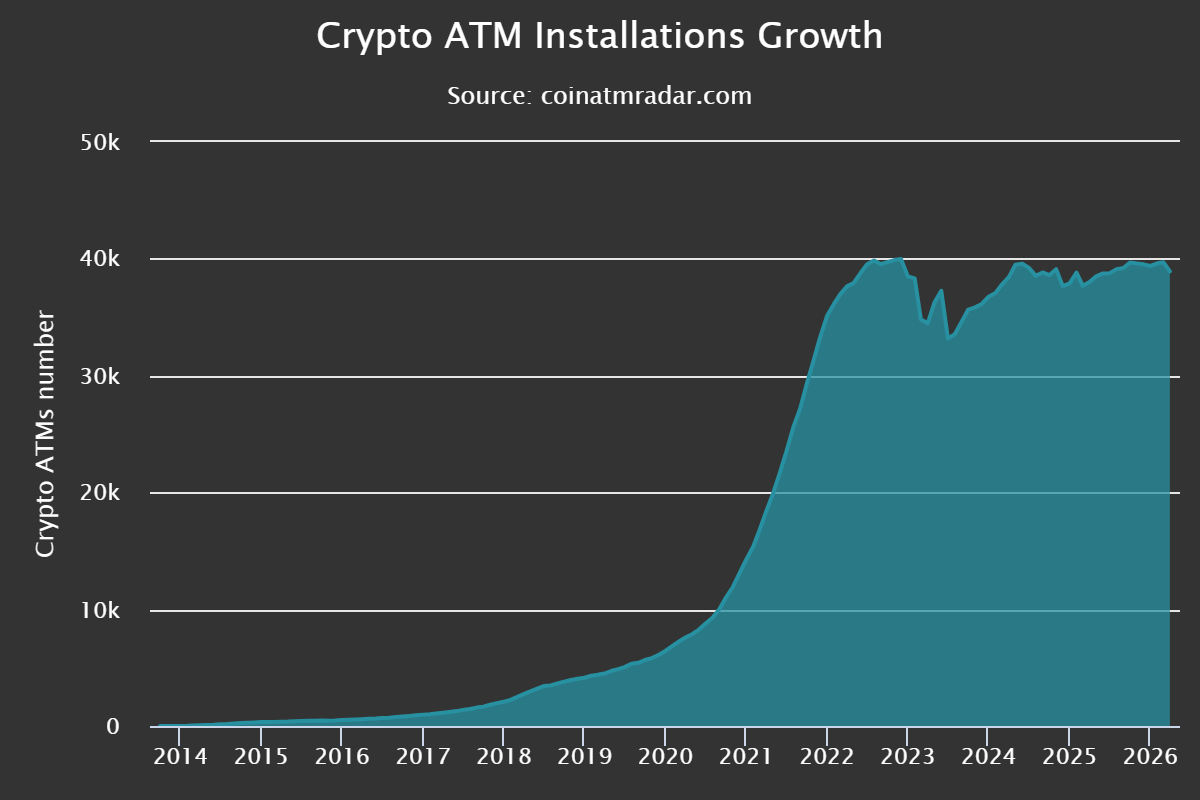
Image Source: Coin ATM Radar
At the start of March, operators added another 80 machines, according to Coin ATM Radar’s net growth logs. Still, 769 removals during the month pushed the year’s running total into negative territory. As such, 2026 has posted a net loss of 597 crypto ATMs so far.
In addition, the global machine count now stands at 38,928. That figure keeps the sector within reach of the 40,000 milestone, though recent cuts show the mark remains difficult to cross.
Top Operators Control 78% of Crypto ATMs as Industry Remains Consolidated
Geographic distribution shows a clear concentration of crypto ATM infrastructure in North America, with the United States accounting for the majority of global installations. Data from Coin ATM Radar indicates the U.S. hosts 30,247 machines, representing 77.7% of the worldwide total. Canada follows with 3,839 units, or 9.9%, reinforcing the region’s dominant position.
On the other hand, Europe maintains a significantly smaller footprint, with 1,727 machines, equal to 4.4% of the network. Combined, the U.S., Canada, and Europe account for 92% of global crypto ATM installations. The remaining 8% is spread across Asia, Oceania, and other regions, indicating limited penetration outside core Western markets.
Operator data reflects a similarly concentrated structure. The top ten providers collectively manage 30,450 machines, representing 78.2% of all installations worldwide.
General Bytes leads the sector with 13,388 machines, giving it a 34.4% market share. BitAccess ranks second with 9,949 units, accounting for 25.6%, while Athena Bitcoin holds third position with 4,045 machines, or 10.4%.
BitAccess follows with 9,949 machines, giving it 25.6% of the market. Athena Bitcoin ranks third with 4,045 machines, equal to 10.4%. Large providers continue to shape the sector’s direction, while smaller firms fill in the rest.
Altcoin Support Becomes Standard as Multi-Asset Access Expands Globally
Asset support across crypto ATMs reflects a broad shift beyond single-asset functionality. Nearly all machines offering Bitcoin also provide access to at least one altcoin, indicating that multi-asset availability has become standard across the network. As a result, altcoins are effectively supported across all 38,928 machines tracked in the dataset.
Among individual assets, Ethereum leads altcoin integration, with availability at 21,296 locations. Litecoin follows closely, supported by 19,897 machines, while Tether appears at 14,999 locations globally. The distribution suggests operators prioritize high-liquidity and widely recognized digital assets when expanding beyond Bitcoin offerings.
Functionality across the network remains largely one-directional. Approximately 91.6% of crypto ATMs are configured for purchase-only transactions, limiting users to converting fiat into digital assets. A smaller share of machines supports both buying and selling, indicating that two-way functionality remains less common.
Recent figures point to a period of adjustment within the sector. While the global network continues to approach the 40,000-machine threshold, progress has slowed due to ongoing reductions in active units. The balance between new deployments and machine removals will determine whether that milestone is reached in 2026.
Disclaimer: The information on this page may come from third parties and does not represent the views or opinions of Gate. The content displayed on this page is for reference only and does not constitute any financial, investment, or legal advice. Gate does not guarantee the accuracy or completeness of the information and shall not be liable for any losses arising from the use of this information. Virtual asset investments carry high risks and are subject to significant price volatility. You may lose all of your invested principal. Please fully understand the relevant risks and make prudent decisions based on your own financial situation and risk tolerance. For details, please refer to
Disclaimer.


