

Trade
Basic
Futures
Futures
Hundreds of contracts settled in USDT or BTC
TradFi
Gold
Trade global traditional assets with USDT in one place
Options
Hot
Trade European-style vanilla options
Unified Account
Maximize your capital efficiency
Demo Trading
Futures Kickoff
Get prepared for your futures trading
Futures Events
Participate in events to win generous rewards
Demo Trading
Use virtual funds to experience risk-free trading
Earn
Launch
CandyDrop
Collect candies to earn airdrops
Launchpool
Quick staking, earn potential new tokens
HODLer Airdrop
Hold GT and get massive airdrops for free
Launchpad
Be early to the next big token project
Alpha Points
Trade on-chain assets and enjoy airdrop rewards!
Futures Points
Earn futures points and claim airdrop rewards
Investment
Simple Earn
Earn interests with idle tokens
Auto-Invest
Auto-invest on a regular basis
Dual Investment
Buy low and sell high to take profits from price fluctuations
Soft Staking
Earn rewards with flexible staking
Crypto Loan
0 Fees
Pledge one crypto to borrow another
Lending Center
One-stop lending hub
VIP Wealth Hub
Customized wealth management empowers your assets growth
Private Wealth Management
Customized asset management to grow your digital assets
Quant Fund
Top asset management team helps you profit without hassle
Staking
Stake cryptos to earn in PoS products
Smart Leverage
New
No forced liquidation before maturity, worry-free leveraged gains
GUSD Minting
Use USDT/USDC to mint GUSD for treasury-level yields

More


Trending Topics
View More69.92K Popularity
163.64K Popularity
40.81K Popularity
7.57K Popularity
417.01K Popularity





Pin
Elon Musk Drops Another "Ace": Can SpaceX Truly Reshape "Space Economics"?
Since the end of 2025, commercial spaceflight has seen a surge in attention in the capital markets. In this report, we attempt to provide an entry point for researching investment opportunities in commercial space by analyzing the causes and consequences.
The main trigger for market attention on commercial space is the news that SpaceX is about to go public and raise funds. SpaceX’s revolutionary aspect lies in its reusable rocket technology, which directly reduces satellite launch costs. In this report, we focus on SpaceX to explore the following questions:
How did SpaceX grow, and how much can its reusable rocket technology reduce costs?
Why is SpaceX eager to go public now, contrasting with Elon Musk’s previous stance of avoiding IPOs? What has changed?
How feasible is Musk’s vision of space-based computing power, and what is the current industry progress?
Below is a detailed analysis
1. Building Rocket and Satellite Technologies, Securing NASA Contracts
In 2002, Musk founded SpaceX in California. Inspired by science fiction, his vision was to go to Mars, aiming to make humanity a “multi-planetary species” so that human civilization could endure longer.
He believed that humanity’s inability to reach Mars at the time was not due to technical limitations but because of the high cost of rocket launches. His goal was to reduce launch costs by making rockets reusable, “like airplanes.”
Meanwhile, Musk understood that to go to Mars, the first step was to generate revenue in Earth’s orbit. So, his plan was to start with commercial launches, lowering costs through reusable rocket technology, and earn money from commercial projects.
However, merely mastering rocket technology was not enough (initially, rocket tech was not fully mastered). He also needed to develop satellite technology. In 2005, SpaceX acquired SSTL, which specialized in low-cost small satellites and rapid deployment, aligning well with SpaceX’s needs.
In 2006, NASA faced difficulties: the Columbia disaster accelerated the retirement of the space shuttle, and the International Space Station faced challenges with unmanned cargo and crew missions. Seizing this opportunity, SpaceX secured NASA’s Commercial Orbital Transportation Services (COTS) contract. That same year, SpaceX began developing the Dragon spacecraft.
In 2008, Falcon 1’s fourth launch finally succeeded, and the same year, SpaceX secured a $1.6 billion commercial cargo contract with NASA.
2. Falcon 9 Achieves First-Stage Reusability
Dragon entered orbit and was recovered after the first Falcon 9 flight in 2010. In 2012, Dragon successfully docked with the International Space Station and returned. Since then, SpaceX has become a core contractor for NASA.
In 2014, Starlink was officially initiated. What is Starlink? We will discuss later, but the core idea is that SpaceX believes this project can provide long-term cash flow, based on reusable rocket technology. Indeed, this project has become SpaceX’s main source of revenue to date.
In 2015, the Falcon 9 first stage finally achieved successful land-based recovery.
The key difference between Falcon 9 and traditional rockets is the reusability of the first stage.
In overall rocket costs, the manufacturing cost of the main body is a significant portion, while fuel costs are relatively low.
Structurally, most liquid-fuel rockets use a two-stage design, roughly consisting of the fairing, the second-stage engine, and the first-stage engine. The first stage often accounts for the highest cost.
During launch, the first-stage engine ignites first. After the rocket is propelled to high altitude away from dense atmosphere, the first and second stages separate, with the second-stage engine igniting to continue the mission (the fairing is also shed). Ultimately, the payload (e.g., satellites) is delivered to the target orbit.
Why adopt this staged architecture? Mainly for two reasons: first, to maximize efficiency by reducing weight step-by-step—discarding the first stage significantly lowers the rocket’s mass; second, to allow specialized engine design, since engines optimized for dense atmosphere differ from those for vacuum. For example, the first stage’s engine nozzle is shorter and wider, while the second stage’s vacuum engine has a longer, bell-shaped nozzle.
This explains why multiple recoveries of the first stage can significantly reduce costs (detailed calculations follow later).
3. Moving Toward Full Reusability
In 2016, Falcon 9’s first stage was successfully recovered at sea on an autonomous drone ship. Sea recovery greatly enhances flexibility, especially for high-orbit and heavy payload launches.
In 2017, SpaceX successfully launched a satellite using a recovered first stage, marking the start of operational reuse. The same year, SpaceX became the world’s leading commercial satellite launch provider.
In 2018, the latest prototype of Starship, called Starhopper, began production and small-scale short-distance tests.
Starship aims for full reusability—meaning not just the first stage, but also the second stage should be recoverable—while significantly increasing payload capacity. The goal is to reduce near-Earth launch costs to around $100 per kg, enabling an order-of-magnitude reduction in launch costs.
In 2020, Crew Dragon transported two astronauts to the ISS, marking SpaceX’s crewed mission capability.
From 2021 onward, prototypes of Starship SN, V1, and V2 have undergone continuous testing. So far, the first-stage “booster” has been captured mid-air, and vertical sea landings of the second stage have been tested.
Currently, the V3 version has completed ground testing, with a planned first flight in March 2026. The V3 mainly focuses on recovery technology and orbital refueling, which is critical for deep-space exploration.
4. How Much Cost Reduction Can Falcon 9 and Starship Achieve?
Let’s do some estimates:
Given the lack of publicly available precise data on rocket costs, these calculations are approximate and for reference only.
It’s clear that Falcon’s cost advantages stem from market-driven, vertically integrated manufacturing and the use of reusable first stages. However, the cost savings from reuse have not yet resulted in a drastic reduction in launch prices. If Starship achieves full reusability and higher reuse cycles, launch costs could be further reduced by orders of magnitude.
What are the downstream demands for rocket launches? For SpaceX, they can be broadly categorized as: SpaceX’s own Starlink, commercial satellite orders, and U.S. government and military contracts—these are the main current sources of orders. Additionally, future potential includes the highly discussed space-based computing power.
We won’t do a comprehensive review of all the demands mentioned above, but aim to understand the main cause-and-effect.
Recent news about SpaceX’s upcoming IPO has heightened market interest in commercial space.
This raises a question: Elon Musk has repeatedly stated he does not want SpaceX to go public, fearing that short-term profit pursuits by the capital markets could compromise its long-term mission. These risks haven’t changed, yet Musk is eager to IPO. Most likely, some other practical factors have shifted.
To understand this, it’s crucial to consider Musk’s own perspective.
Based on his recent public statements, we can roughly grasp Musk’s logic:
1. The biggest change stems from a bottleneck in computing power
(1) Integration of Technologies: Space Exploration Needs AI
In Musk’s future tech blueprint, information technologies like AI can enhance human “software” efficiency, while humanoid robots can improve material production “hardware.” He believes these will soon merge, pushing human civilization into a new phase.
Musk’s business ventures include autonomous driving, then shifting focus to humanoid robots; brain-machine interfaces; founding OpenAI, then creating xAI; acquiring Twitter; and establishing SpaceX. After investing in these key areas, his main goal is to integrate them.
Recently, SpaceX announced a merger with xAI, exemplifying this integration.
(2) How to understand this fusion? A simple example—
Inspired by science fiction, Musk’s grand goal is to make humans a multi-planetary species. This concept is inspired by Soviet astronomer Kardashev’s classification of civilizations: Type I can harness planetary energy, Type II can harness stellar energy, and interstellar survival implies reaching at least Type II (though we have yet to achieve Type I).
Why does Musk want humanity to become multi-planetary early? He believes it can extend civilization’s longevity. A civilization confined to a single planet is vulnerable; a catastrophic event on Earth could wipe out human civilization.
Science fiction also fuels Musk’s curiosity about the universe’s secrets. If humans are stuck on a small planet, technological leaps are harder, and the universe’s mysteries remain distant.
This explains Musk’s strong focus on Mars exploration. As mentioned earlier, developing Starship is a key part of reaching Mars. His vision of “Mars colonization” depends on Starship’s capabilities.
Meanwhile, deploying humanoid robots to Mars first, rather than humans directly, is a more feasible plan—these robots must have AI capabilities.
Thus, SpaceX, humanoid robots, and AI are tightly linked.
(3) Rapid AI development and power supply bottlenecks
In recent years, AI technology has advanced rapidly. For Musk, AI is critically important.
He has repeatedly emphasized that AI is evolving faster than expected. He aims to win the AI race and understands that one key to winning is to deploy computing resources more efficiently than competitors.
This involves investing in and building AI computing infrastructure in the U.S., which is not the main focus here, but a key point is:
Currently, the biggest bottleneck for U.S. data centers is energy. Industry leaders like Huang Renxun have repeatedly discussed the energy constraints in the U.S. Simply put, data centers consume a lot of electricity, but the U.S. grid, transmission, and generation infrastructure are severely lagging and hard to upgrade quickly.
(4) Those who can break the energy bottleneck first will have a chance to leapfrog
Musk’s idea: deploy data centers in space. Because space-based solar power can overcome energy limitations.
Solar panels in geostationary orbit can generate continuous power 24/7, with higher efficiency than ground-based panels. Space solar arrays are unaffected by atmospheric interference, and solar irradiance is stronger due to the absence of atmosphere. Importantly, space data centers wouldn’t be limited by U.S. power grid constraints.
Imagine deploying large solar arrays in space—akin to Freeman Dyson’s hypothetical “Dyson sphere” for Type II civilization.
SpaceX is already taking action. Musk plans to launch AI satellites within 2-3 years. Recent FCC filings reveal plans for a “space-based data center system” with 1 million satellites. Meanwhile, SpaceX is heavily investing in large-scale solar energy projects, targeting 100 GW capacity.
This requires enormous capital expenditure, which we believe is the main reason SpaceX is eager to raise funds now.
Of course, there may be other reasons.
2. External Environment and Internal Pressures on SpaceX
(1) First, look at Starlink: expanding capital expenditure
Market data shows Starlink accounts for about 50-80% of SpaceX’s revenue.
Starlink’s core is deploying a large constellation of satellites in low Earth orbit to create a global broadband network. These satellites act like relay nodes, switches, and base stations in traditional ground networks.
Its advantage is that it’s not limited by terrestrial geography, providing coverage anywhere on Earth, since satellites can fly over any location.
This is especially valuable for remote areas lacking ground infrastructure, ships at sea, and aircraft, offering connectivity options ground networks can’t.
How does Starlink differ from traditional satellite communication?
Primarily in scale: V1 has thousands of satellites; V2 will have tens of thousands. Launching such large constellations via traditional rockets is prohibitively expensive. Reusable rockets like SpaceX’s greatly reduce launch costs, enabling the business model.
In reality, U.S. communication infrastructure lags: remote areas lack infrastructure, and high costs of fiber deployment keep broadband expensive. The monopoly of a few carriers also keeps prices high. That’s why satellite networks are more valuable in the U.S. compared to China.
Space-based computing power is still in its infancy, so Starlink is currently a real cash flow source. Its maturity also supports future government and military contracts.
Let’s do a rough estimate: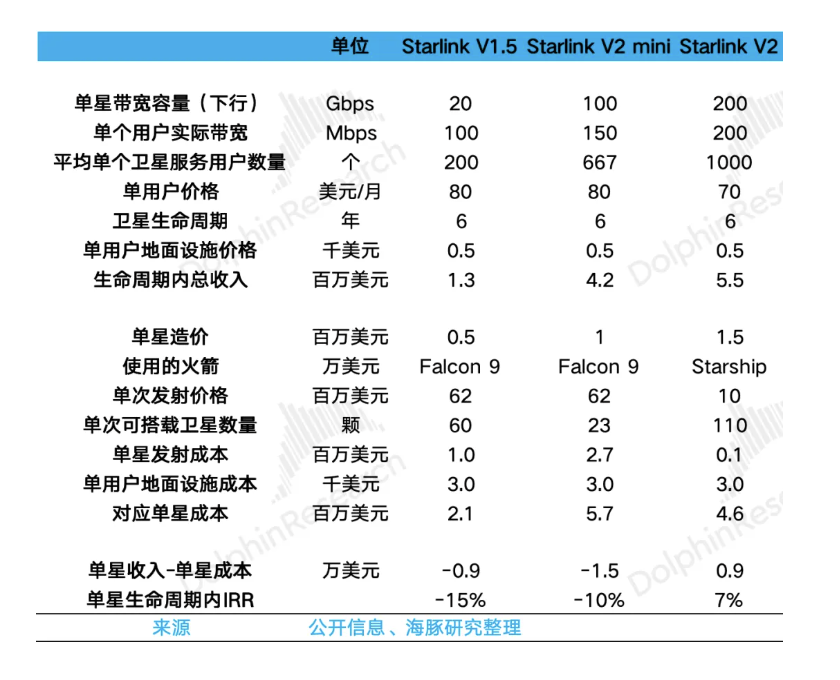 Currently, Starlink’s active satellites are mainly V1 (V1.5 and V2 mini). As user demand surges, bandwidth drops, limiting growth.
Future launches will deploy V2 satellites. Based on estimates, V2 will significantly increase capacity, but at huge costs: V1.5 satellites cost about $1.5 billion each, while V2 could cost over $600 billion.
These are theoretical estimates, but in reality, Starlink will face competition, and dominance is unlikely to last. The profitability of V2 may be overly optimistic.
(2) Competition and challenges
SpaceX’s global connectivity faces competition from Bezos’s efforts, China’s rapid progress, and other players like AST SpaceMobile in direct satellite-to-phone links.
Spectrum and orbital slots are limited. During the Russia-Ukraine conflict, Starlink demonstrated its military value, making spectrum and orbital resource competition a matter of national security.
The competition for spectrum and orbital resources is urgent and strategic.
We will discuss industry competition and players’ strategies in the next article.
(3) Instability of government contracts and political factors
Partnerships with NASA are uncertain: after conflicts with Trump, he threatened to cut SpaceX’s billions in subsidies and contracts, and withdrew Musk’s NASA administrator nomination. Subsequent delays in Starship tests and Artemis plans led NASA to open lunar lander contracts to competitors like Blue Origin.
Additionally, SpaceX faces strict regulatory scrutiny from FAA and others. Going public might help SpaceX strengthen its narrative, become “too big to fail,” which could be a strategic consideration.
Is space-based computing power truly feasible?
1. Progress in the US and China from experiments
Some companies and institutions have begun preliminary deployments, mainly in the US and China: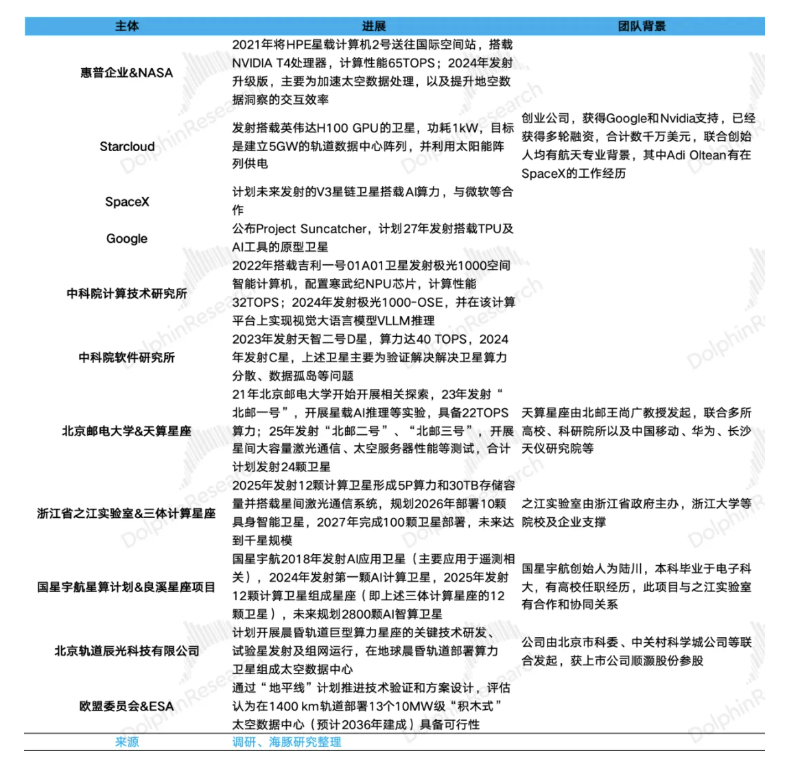
2. What are the main technical bottlenecks?
Key challenges include:
(1) Launch costs
This is a focus for SpaceX.
According to Google’s calculations, if satellite launch costs drop below $200/kg, space data centers become economically viable. Their estimates show that at this cost, the overall cost of Starlink V2 satellites would be $810–7,500 per kW/year, comparable to ground data center energy costs ($570–3,000 per kW/year).
(2) Radiation protection
Space radiation (cosmic rays, high-energy particles) causes TID (total ionizing dose) effects and SEEs (single event effects), leading to data errors.
Solutions involve radiation-hardened chips, which increase costs. Traditional chips are larger and less affected by radiation but less powerful; advanced chips require fault-tolerant architectures, impacting efficiency.
Figures compare radiation-hardened processors with terrestrial COTS.
Sources: “Computing over Space: Status, Challenges, and Opportunities,” Liu Yaoqi et al., Dolphin Research; and others.
(3) Vacuum cooling
In space, no air means cooling relies on radiation. Large radiators can compensate but increase costs. Fluid cooling systems face technical hurdles.
Figures illustrate space data center thermal management.
Sources: same as above.
(4) Power supply
Space solar arrays in GEO could provide continuous power, with higher efficiency than ground panels. However, deploying large arrays is challenging; current main technology is GaAs, with future options like p-HJT or perovskites, but costs remain high.
(5) Data transmission
Starlink already uses laser links capable of 100 Gbps, and China is developing similar tech. But bandwidth needs for computing clusters may reach 10 Tbps or more, requiring more advanced laser systems, which add weight and cost.
Google’s estimates suggest that using COTS DWDM transceivers, each link could aggregate up to 10 Tbps, but long-distance links are less feasible. A practical approach is to form satellite clusters within hundreds of kilometers to reduce costs.
Figures show the relationship between bandwidth and distance for inter-satellite links.
Sources: Google, Dolphin Research.
(6) On-orbit maintenance
Current space robot maintenance tech is experimental. Failures require satellites to have self-diagnosis and repair capabilities; otherwise, frequent replacements are needed. Replacing entire satellites is costly, as in-ground repairs are impossible.
Summary: While solutions exist in theory, practical application faces many technical and cost challenges—mainly whether the economics make sense.
From demand perspective, Starlink has established a viable profit model, and the race for space resources offers growth certainty. Space-based computing power is feasible, especially under power shortages, giving commercial space a real option value. Overall, we remain optimistic about industry growth.
Within the industry, SpaceX has pioneered a viable reusable rocket model—significantly reducing costs through reusability, both technically and commercially.
This not only provides growth certainty but also opens opportunities for other companies to follow, leveraging latecomer advantages for rapid progress. In the next article, we will analyze industry players and competitive landscape.
Source: Dolphin Research
Risk Warning and Disclaimer
Market risks exist; investments should be cautious. This article does not constitute personal investment advice and does not consider individual user’s specific investment goals, financial situation, or needs. Users should evaluate whether the opinions, views, or conclusions herein are suitable for their circumstances. Investment is at your own risk.