Bitcoin miners are back to business as usual after last month’s Arctic blast iced operations across the U.S., and the network’s hashrate has clawed its way back above the 1 zettahash per second (ZH/s) mark. Even so, mining revenue is painfully lean to start March at under $30 per petahash per second (PH/s), and difficulty is projected to climb yet again.
Bitcoin Mining Faces Lean Stretch
Bitcoin mining revenue is plumbing depths not seen since the digital currency’s formative years, and on Feb. 24, it dipped below $28 per PH/s. As of Sunday, March 1, data from hashrateindex.com places the current hashprice at $29.01 per petahash of daily output.
In plain terms, miners are earning far less for the same computational grind, tightening profit margins and leaving little room for error. Even with revenue on a tight leash, the network’s hashrate remains north of the 1 ZH/s threshold, equal to 1,000 exahash per second (EH/s).
Data shows miners have kept the network perched above that level since the second week of last month. That persistence accelerated block intervals and triggered a massive 14.73% difficulty adjustment spike, the steepest increase since 2021.
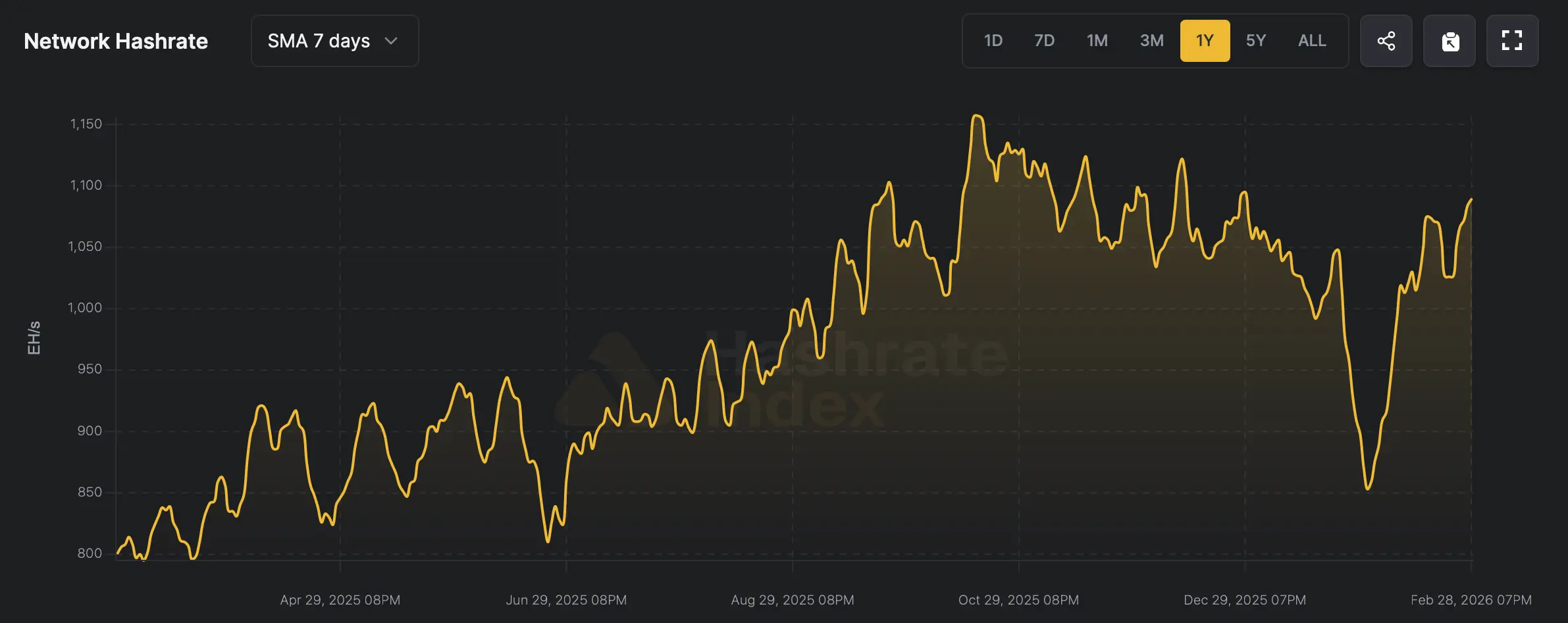
With the hashrate currently at 1,085 EH/s and block intervals averaging 9 minutes 48 seconds, the next epoch is poised for a modest uptick. Projections show that the next difficulty change is expected to occur on March 5, 2026.
It’s also worth noting that activity on the Bitcoin blockchain has been rather subdued, and over the past day, onchain fees have accounted for just 0.47% of the total block reward. In effect, miners are leaning almost entirely on BTC’s spot price, as transaction fees are offering virtually no cushion.
The question now is whether bitcoin can regain its footing after nearly two months of dreary price downturns and persistent bearish signals. For miners operating on razor-thin margins, the answer may determine who weathers the pressure and who powers down.
Compressed mining revenue, elevated difficulty, muted onchain fees, and a hashrate still hovering above 1 ZH/s paint a picture of an industry grinding through a lean stretch with little relief in sight. Until things change, efficiency, scale, and access to low-cost energy remain the decisive advantages in a market that is offering miners no margin for complacency.
FAQ 🔎
- Why are bitcoin miners earning less in March 2026? Mining revenue has fallen below $30 per PH/s as of March 1, 2026, squeezing margins for operators across the United States.
- What is bitcoin’s current hashrate? The bitcoin network is running above 1 zettahash per second (ZH/s), or about 1,085 exahash per second (EH/s), even after February’s Arctic storm disruptions.
- When is the next bitcoin difficulty adjustment expected? The next bitcoin difficulty change is projected to occur around March 5, 2026, following a recent 14.73% increase.
- How much of bitcoin miner revenue comes from transaction fees right now? Onchain fees currently account for just 0.47% of total block rewards, leaving miners largely dependent on bitcoin’s spot price.
Disclaimer: The information on this page may come from third parties and does not represent the views or opinions of Gate. The content displayed on this page is for reference only and does not constitute any financial, investment, or legal advice. Gate does not guarantee the accuracy or completeness of the information and shall not be liable for any losses arising from the use of this information. Virtual asset investments carry high risks and are subject to significant price volatility. You may lose all of your invested principal. Please fully understand the relevant risks and make prudent decisions based on your own financial situation and risk tolerance. For details, please refer to
Disclaimer.
Related Articles
In the past hour, the entire network has liquidated $90.08 million, and crude oil futures contracts have liquidated $29.2 million.
Gate News Report, March 9th, Coinglass data shows that in the past hour, the total liquidation across the entire network reached $90,084,300, with long positions liquidated at $43,935,600 and short positions at $46,148,700. By asset type, XYZ:CL (Crude Oil Futures Contract) liquidation was $29.2 million, and BTC liquidation was $22.12 million.
GateNews32m ago
Bitcoin Price Bounces, But Bears Are Still in Control: Analysis
In brief
Bitcoin is up 4.78% today trading at $69,128.
Last week's apparent triangle breakout closed as a massive bullish wick — a classic false breakout signal.
On Myriad, prediction market traders are split among bulls and bears, with no clear consensus on which way the squeeze
Decrypt52m ago
BTC 15-minute increase of 1.42%: On-chain capital inflow and technical breakout points resonate to trigger buying interest
From 19:15 to 19:30 on March 9, 2026 (UTC), the BTC price experienced a 15-minute return of +1.42%, with trading ranges between 68,377.3 and 69,365.3 USDT, and a volatility of 1.44%. This fluctuation far exceeds the regular intraday volatility levels, with market attention significantly heightened, and short-term buying surges intensifying the volatility.
The main driver of this movement was net inflow of on-chain funds, triggered by large transfers from major holder accounts, along with buy orders breaking through key technical resistance levels.
GateNews1h ago
Bitcoin Leads $619M Weekly Inflows Amid Geopolitical Jitters and Oil-Driven Pullback
The digital asset market showed a strange kind of calm last week, not reckless, not euphoric, just strangely stubborn. According to CoinShares, investment products tied to cryptocurrencies pulled in a net US$619 million, a sign that, even amid geopolitical jitters tied to Iran, a meaningful chunk of
BlockChainReporter1h ago


