


Ether Price Declines 60% From 2025 Highs Amid Institutional Ethereum Adoption Push

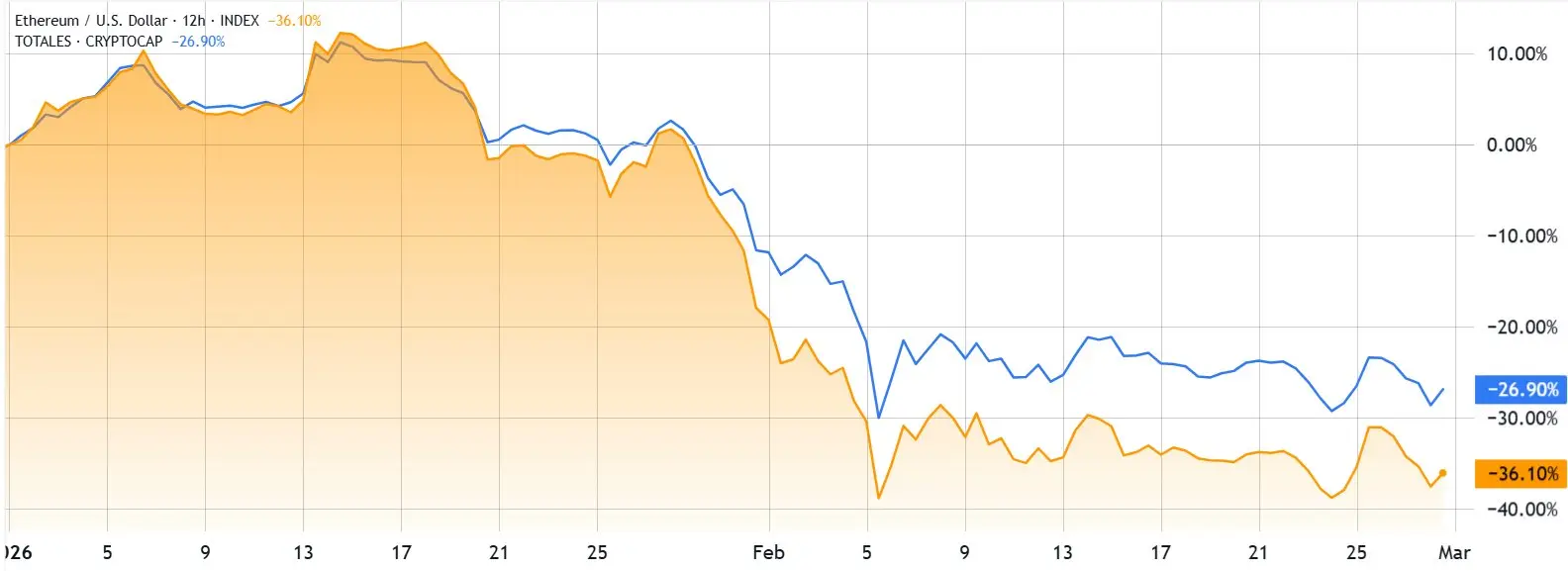
Ether has declined approximately 60% from its October 2025 all-time high of $4,800, trading near $1,900 on March 2, 2026, as the asset underperforms the broader cryptocurrency market by 9% year-to-date.
Despite price weakness, institutional adoption of the Ethereum network continues to accelerate, with the platform maintaining a 57% market share in total value locked at $52.4 billion, rising to 65% when including layer-2 solutions. Major financial institutions including JPMorgan Asset Management, Citi, Deutsche Bank, and BlackRock have recently launched onchain projects on Ethereum, while Ethereum Foundation researchers continue development of base layer scalability improvements, zero-knowledge EVM implementation, and quantum-resistant cryptography.
Price Performance Diverges From Network Fundamentals
Ether has recorded five consecutive monthly declines through February 2026, with the asset down 36% for the year and approximately 60% below its October 2025 peak. The $3,000 level remains out of reach as selling pressure persists across digital asset markets.
 (Source: TradingView)
Decentralized exchange volumes on the Ethereum network fell 55% over the past six months to $56.5 billion in February 2026, down significantly from a peak of $128.5 billion in August 2025. Competitor Solana experienced a more modest 21% decline over the same period, with monthly volumes reaching $95.5 billion in February.
This contraction in onchain activity has weighed on network fees and decentralized application revenue, reducing immediate incentives for holding Ether from a cash flow perspective. Critics have pointed to these metrics as evidence of Ethereum losing competitive ground to alternative layer-1 blockchains.
Institutional Preference for Ethereum Despite Market Conditions
Despite recent underperformance, Ethereum maintains dominant market share across multiple metrics. Total value locked on Ethereum stands at $52.4 billion, representing 57% of the entire decentralized finance ecosystem. When including layer-2 solutions such as Base, Arbitrum, Polygon, and Optimism, Ethereum’s dominance rises to 65% of TVL.
For comparison, Solana’s TVL sits at $6.4 billion, while BNB Chain holds approximately $5.5 billion locked in smart contracts. Hyperliquid, despite recent growth, maintains a relatively modest $1.5 billion in TVL.
In the real-world assets sector, Ethereum commands a 68% market share of tokenized assets. Major financial institutions continue to select Ethereum for blockchain initiatives. JPMorgan Asset Management, Citi, Deutsche Bank, and BlackRock have all launched onchain projects using Ethereum infrastructure in recent months, ranging from tokenized funds to dedicated layer-2 rollups and bank-issued stablecoins.
Technical Roadmap Addresses Scalability and Future-Proofing
Ethereum co-founder Vitalik Buterin has outlined intentions to reduce dependence on rollups by targeting base layer scalability improvements. Proposed changes include parallel block verification, alignment of gas costs with actual execution time, and implementation of a zero-knowledge Ethereum Virtual Machine.
These updates are planned for gradual implementation. Buterin recommends that a minority of network participants initially adopt new systems before moving toward mandatory block confirmation mechanisms relying on ZK-EVM technology.
Ethereum maintains a roadmap addressing quantum computing risks, which includes consensus-layer signatures based on privacy-focused proof systems. Buterin has acknowledged that quantum-resistant signatures are significantly larger and more difficult to verify, noting that lattice-based solutions currently face efficiency challenges. The proposed approach involves fixing protocol-layer recursive signature and proof aggregation while developing vectorized math precompiles to reduce gas costs.
Competitive Positioning and Long-Term Considerations
Ethereum’s strategic decision to prioritize layer-2 scalability via rollups has drawn criticism as competing chains like Tron and Solana currently lead in network fee generation. However, no alternative blockchain has matched Ethereum’s monetary value or institutional adoption levels.
The network’s first-mover advantage in establishing decentralized trust and developer ecosystems requires years to replicate. Ethereum’s focus on base layer security and gradual scalability improvements positions the platform to capture potential future surges in demand for institutional-grade onchain activity, should market sentiment shift back toward cryptocurrencies.
FAQ: Ethereum Market Position and Development
Why has Ether underperformed other cryptocurrencies despite strong institutional adoption?
Ether has declined 36% year-to-date and underperformed the broader crypto market by 9% due to multiple factors including a 55% decline in DEX volumes over six months, reduced network fee revenue, and broader risk-off sentiment affecting digital assets. However, institutional adoption metrics including TVL market share and real-world asset tokenization continue to favor Ethereum over competitors.
What technical upgrades are planned for Ethereum?
Ethereum’s roadmap includes base layer scalability improvements through parallel block verification, alignment of gas costs with execution time, and implementation of zero-knowledge EVM technology. The network is also developing quantum-resistant cryptography solutions, including consensus-layer signatures based on privacy-focused proof systems and vectorized math precompiles to reduce gas costs.
How does Ethereum’s market share compare to competing blockchains?
Ethereum maintains 57% market share of total value locked at $52.4 billion, rising to 65% when including layer-2 solutions. Solana holds $6.4 billion in TVL, while BNB Chain holds approximately $5.5 billion. In real-world assets, Ethereum commands 68% market share, with major institutions including JPMorgan, Citi, Deutsche Bank, and BlackRock launching projects on Ethereum infrastructure.
Related Articles
Data: If ETH breaks through $2,048, the total liquidation strength of mainstream CEX short positions will reach $869 million.
Block Street releases BSB tokenomics: total supply of 1 billion tokens, initial circulation of 20.775%
BitMart Market Report: Altcoin Activity Shows Clear Segmentation, Mainstream Assets Still Dominate Overall Volatility
Bitcoin and Ethereum ETFs have seen over $9 billion outflow in four months! Institutional funds are withdrawing, shaking confidence in the crypto market?
Ethereum (ETH) has declined for six consecutive months, setting a recent record. Can the key support level of $1900 hold?