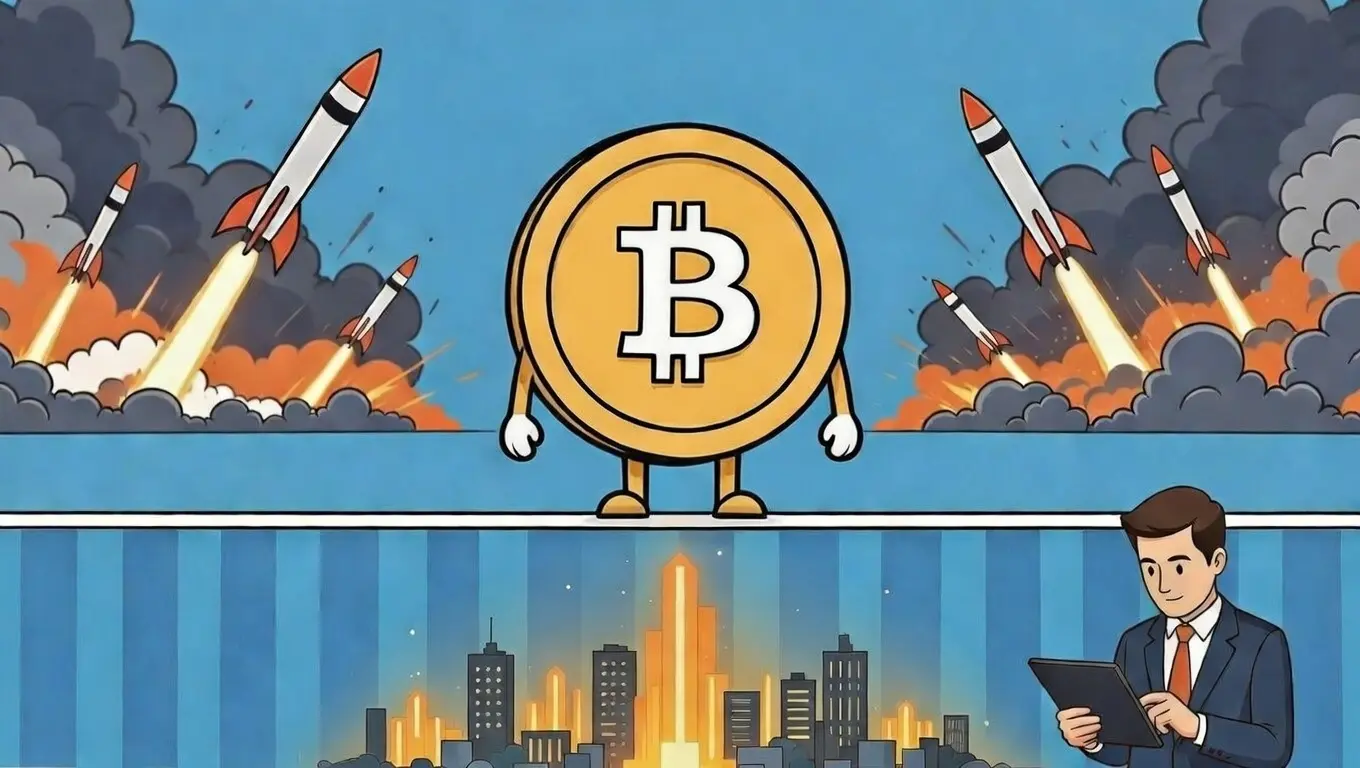
 Bitcoin traded within a range of approximately $65,000 to $70,000 over the weekend of February 28 to March 2, 2026, following U.S. and Israeli military strikes on Iran, demonstrating resilience despite heightened geopolitical uncertainty.
Bitwise Chief Investment Officer Matt Hougan argued in a March 2 memo that the event marked a turning point where crypto-enabled markets served as the primary venue for global price discovery while traditional markets were closed, accelerating the shift toward onchain finance that professional traders now “no longer have a choice” but to adopt. The asset remains approximately 47% below its October 2025 all-time high of $126,000, with experts divided on whether the conflict will ultimately fuel a rally or suppress Bitcoin’s recovery prospects.
Bitwise CIO Argues Onchain Finance Becomes Necessity After Weekend Event
Hougan’s memo, titled “The Weekend That Changed Finance,” described how President Donald Trump’s February 28 announcement of military action at 2:30 a.m. exposed the structural limitations of traditional financial markets. With U.S. stock and futures markets, foreign exchange venues, European exchanges, and most Asian markets inactive, investors turned to 24/7 crypto-based systems for price discovery and risk management.
“For most of Sunday, onchain finance was the center of the financial world,” Hougan wrote. “It was the first time I remember crypto-enabled markets being ‘the market,’ full stop.”
The Bitwise CIO highlighted significant activity spikes on platforms including Hyperliquid, particularly in perpetual futures contracts tied to both crypto assets and real-world commodities such as crude oil. Tether’s tokenized gold product XAUT recorded over $300 million in 24-hour trading volume, while prediction markets including Kalshi and Polymarket reached new volume highs. Bitcoin and Ethereum also attracted heightened attention.
Hougan acknowledged that he previously expected crypto-enabled markets to develop gradually over five to ten years, primarily serving crypto natives and those outside traditional financial systems. “This weekend proved me wrong,” he stated. “Now I’m convinced it’s going to happen much faster than that.”
He concluded that hedge funds, banks, and competitive traders now have no choice but to engage with onchain finance, from establishing stablecoin wallets to learning Hyperliquid trading mechanics and understanding assets such as XAUT and tokenized equities. “Because even if you don’t, everyone else will,” Hougan added.
Expert Views on Bitcoin’s Trajectory Amid Geopolitical Conflict
Arthur Hayes, chief investment officer at Maelstrom, argued that the conflict will shake Bitcoin out of its recent trading range by forcing Federal Reserve liquidity support for U.S. war efforts. Hayes pointed to decades of data showing that U.S. military conflicts historically precede monetary easing and rate cuts, which typically incentivize investment in risk assets including Bitcoin.
Jake Ostroviskis, head of over-the-counter trading at Wintermute, emphasized that oil price dynamics may matter more for crypto than geopolitics itself. Following Iran’s effective closure of the Strait of Hormuz—through which approximately one-fifth of global oil flows—Brent crude surged toward $85 per barrel. Ostroviskis warned that sustained oil prices above $80 could harden re-inflation narratives, pushing potential Federal Reserve rate cuts further into the future. CME FedWatch Tool data indicates traders currently price only a 2.4% chance of a March rate cut, with probabilities rising to 18% in April and 41% in June.
Analysts from the London Crypto Club presented a binary outlook, suggesting Bitcoin could benefit regardless of conflict duration. A prolonged war would create an extreme risk-off scenario driving investors toward Bitcoin as a hedge, while a swift resolution could unleash buying momentum. In either case, they expect central bank liquidity support for war financing to benefit risk assets.
James Butterfill, head of research at CoinShares, noted Bitcoin’s remarkable resilience but cautioned that extended conflict could introduce opposing forces. Energy-driven inflation might delay monetary easing, pressuring traditional risk assets, while eroding confidence in global financial structures and trade routes could benefit scarce, non-sovereign assets like Bitcoin over the medium term.
Pratik Kala, head of research at Apollo Crypto, highlighted technical risks stemming from Bitcoin’s prolonged $65,000 to $70,000 trading range. A sustained breakout above that range could invite profit-taking, potentially triggering liquidations that reverse gains.
Bitcoin Technicals and Market Positioning
Bitcoin’s weekend price action saw the asset dip toward $63,000 immediately following strike announcements before recovering to test $70,000, ultimately settling near $66,000 as Asian markets reopened on March 2. The 7-day performance showed approximately 6% gains despite heightened volatility.
The $60,000 level remains a critical support threshold identified by multiple analysts, with a sustained break below potentially opening the path toward the mid-$50,000 range. Upside resistance sits at the February high near $70,000, followed by psychological levels at $75,000 and $80,000.
Derivatives markets exhibited elevated activity, with funding rates turning negative during peak uncertainty before normalizing. Open interest across major exchanges remained relatively stable, suggesting limited forced liquidations despite price swings.
FAQ: Bitcoin and Iran Conflict Market Impact
How did Bitcoin perform during the weekend Iran strikes?
Bitcoin initially dropped toward $63,000 following news of U.S. and Israeli strikes on February 28, then recovered to test $70,000 before settling near $66,000 by March 2. The asset traded within its established $65,000 to $70,000 range, demonstrating resilience amid heightened geopolitical uncertainty. Total cryptocurrency market capitalization saw moderate fluctuations without dramatic sell-offs.
Why does Matt Hougan argue the weekend changed finance permanently?
Hougan contends that the event marked the first time crypto-enabled markets served as the primary venue for global price discovery while traditional markets were closed. Platforms including Hyperliquid, Kalshi, and Polymarket recorded significant volume spikes as investors sought exposure to both digital assets and real-world commodities like oil. He argues this accelerates the timeline for mainstream adoption, making onchain finance tools a necessity for competitive traders rather than optional.
What are the conflicting expert views on Bitcoin’s trajectory?
Experts diverge on whether the conflict ultimately benefits or hinders Bitcoin. Arthur Hayes and London Crypto Club analysts anticipate Federal Reserve liquidity support for war efforts will boost risk assets. Jake Ostroviskis and James Butterfill caution that sustained oil price increases could delay rate cuts, tightening financial conditions. Pratik Kala notes technical risks from potential profit-taking if Bitcoin breaks above its trading range.


