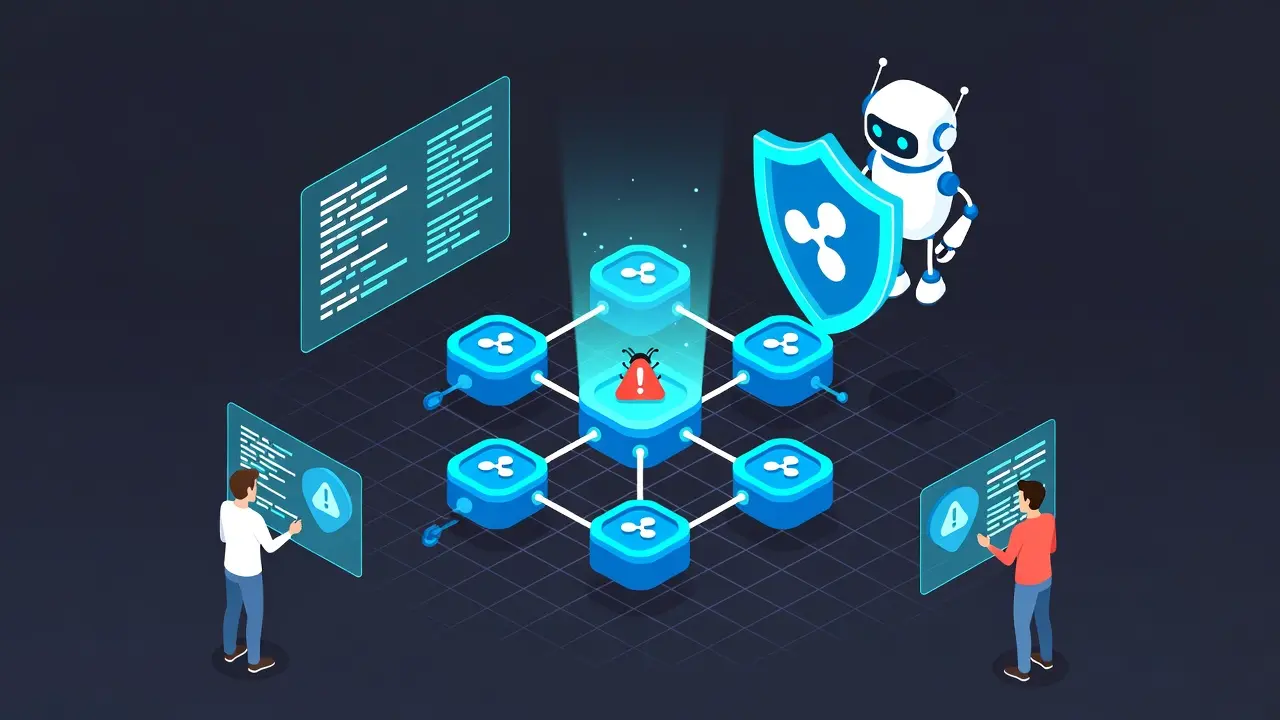
 Ripple developers are introducing artificial intelligence–based security tools into the XRP Ledger (XRPL) development workflow following the discovery of a software bug related to batch transaction processing.
The issue, identified by engineers within the Ripple ecosystem, raised concerns about potential network disruptions if exploited. RippleX engineering teams have confirmed that AI-assisted systems will now be used to detect vulnerabilities earlier in the development cycle and strengthen the security of future XRPL upgrades.
Ripple Introduces AI-Assisted Security Tools for XRPL Development
Ripple’s developer platform RippleX announced that new AI-driven tools will be integrated directly into the XRP Ledger software development process. According to RippleX Head of Engineering J. Ayo Akinyele, the objective is to improve vulnerability detection before software updates are deployed to the live network.
The initiative follows the identification of a software bug associated with batch transaction handling. Although the issue did not result in a confirmed network failure, the discovery highlighted potential edge-case vulnerabilities that could affect transaction processing under specific conditions.
To reduce similar risks in future updates, developers plan to use AI systems that assist with:
-
Automated code reviews
-
Detection of logical invariants in protocol behavior
-
Large-scale edge-case testing
-
Simulation of potential attack scenarios
One of the primary technologies being implemented is an agent-based fuzzing system, which automatically generates thousands of abnormal transaction patterns in controlled testing environments. This allows developers to identify weaknesses that may not appear during standard testing procedures.
Security Focus Expands as XRPL Ecosystem Grows
The integration of AI tools reflects the increasing importance of protocol security as the XRP Ledger ecosystem expands. XRPL is used for cross-border payments, tokenization applications, and decentralized finance infrastructure.
As blockchain networks mature, development teams are increasingly adopting automated security frameworks to detect vulnerabilities earlier in the development lifecycle. AI-assisted testing environments are becoming a common approach for identifying rare failure conditions that could affect consensus, transaction validation, or ledger integrity.
RippleX engineers stated that strengthening security processes is essential as the ledger continues to support a growing number of applications and institutional integrations.
Hidden Road Integration Highlights Ripple’s Institutional Strategy
Separately, Ripple’s broader institutional expansion has drawn attention after Hidden Road Partners CIV US LLC was added to the National Securities Clearing Corporation (NSCC) Market Participant Identifiers directory.
The NSCC, a subsidiary of the Depository Trust & Clearing Corporation (DTCC), provides clearing, settlement, and risk management services for U.S. securities transactions. Inclusion in its directory indicates that a firm is connected to infrastructure used by traditional financial institutions for post-trade processing.
Ripple announced plans to acquire Hidden Road, a multi-asset prime brokerage platform, in April 2025 and completed the $1.25 billion acquisition later that year. Following the transaction, the company rebranded the platform as Ripple Prime.
Ripple previously stated that post-trade infrastructure developed through the brokerage platform could eventually interact with the XRP Ledger, potentially expanding the types of institutional financial flows linked to the network.
Former Ripple CTO’s Bridge Asset Framework Resurfaces
Recent discussions about Ripple’s institutional strategy have also revived earlier comments from former Ripple Chief Technology Officer David Schwartz regarding the long-term role of XRP.
In earlier explanations published several years ago, Schwartz addressed a common criticism that banks could use Ripple’s payment software without directly holding XRP. He noted that while Ripple’s messaging and settlement software can function independently, XRP could gain value if it becomes a bridge asset for international payments.
Under this model, XRP would act as an intermediary currency connecting different fiat markets. Financial institutions could potentially hold the asset as working capital for cross-border settlements if it reduces transaction costs compared with existing foreign-exchange mechanisms.
This framework remains consistent with Ripple’s broader strategy of integrating blockchain infrastructure with traditional financial market systems.
XRP Market Activity and Analyst Views
Market analysts remain divided regarding XRP’s price outlook. Some analysts argue that expanding institutional infrastructure around Ripple’s services could support future demand for the asset.
Crypto analyst Alex Carchidi previously noted that XRP has historically traded above the $3 level, reaching an all-time high near $3.65 in 2025. According to the analysis, factors that could influence future market performance include:
-
Development of the XRPL Ethereum Virtual Machine (EVM) sidechain, launched in 2025
-
Institutional financial infrastructure tied to Ripple’s acquisitions and services
-
Broader cryptocurrency market conditions
Other analysts caution that market conditions remain uncertain. Analyst Dominic Basulto has noted that XRP has declined significantly from its 2025 peak and continues to trade well below that level amid broader crypto market volatility.
On-chain metrics have shown mixed signals. Some indicators, including changes in the Network Value to Transactions (NVT) ratio and reduced exchange activity, suggest potential shifts in underlying network demand. However, technical indicators such as the Elder-Ray Index have indicated continued selling pressure in recent months.
At the time of reporting, XRP was trading near $1.40, representing a decline of roughly 12% over the previous month.
Frequently Asked Questions (FAQ)
Why is Ripple integrating AI into the XRP Ledger development process? Ripple developers are introducing AI-assisted tools to improve vulnerability detection, automate code analysis, and simulate attack scenarios during testing. The goal is to identify potential security issues before software upgrades are deployed to the XRP Ledger network.
What issue prompted the new security measures on XRPL? A software bug related to batch transaction handling was recently discovered during development testing. Although it did not result in a network failure, it highlighted the possibility of edge-case vulnerabilities that could disrupt ledger operations under certain conditions.
How does Hidden Road relate to Ripple’s infrastructure strategy? Hidden Road is a prime brokerage platform acquired by Ripple in 2025 and later rebranded as Ripple Prime. The platform provides institutional trading and post-trade services, and Ripple has indicated that its infrastructure could eventually connect with the XRP Ledger ecosystem.
What role could XRP play in international payments? According to explanations previously provided by former Ripple CTO David Schwartz, XRP could function as a bridge asset that connects different fiat currencies in cross-border transactions. Institutions could potentially hold XRP as working capital if it offers cost advantages compared with traditional foreign-exchange settlement methods.
Disclaimer: The information on this page may come from third parties and does not represent the views or opinions of Gate. The content displayed on this page is for reference only and does not constitute any financial, investment, or legal advice. Gate does not guarantee the accuracy or completeness of the information and shall not be liable for any losses arising from the use of this information. Virtual asset investments carry high risks and are subject to significant price volatility. You may lose all of your invested principal. Please fully understand the relevant risks and make prudent decisions based on your own financial situation and risk tolerance. For details, please refer to
Disclaimer.


