Bitcoin surrendered its $70,000 support level, triggering a broader crypto market retreat that wiped out $329 million in leveraged positions. This downturn was fueled by a perfect storm of geopolitical and macroeconomic pressures.
Wiping out the ‘War Gains’
Bitcoin’s midweek resilience crumbled Friday, March 6, as the cryptocurrency surrendered the psychological $70,000 stronghold. After a morning spent oscillating in a tight range between $70,000 and $71,000, the dam finally broke: bitcoin plummeted from $70,131 to $68,300 in a frantic two-hour window. Despite a brief, spirited attempt at a reversal, relentless selling pressure forced a further retreat to a session low of $67,753.
This correction saw bitcoin’s market capitalization retreat below the $1.4 trillion threshold—returning to where it stood before the Middle East conflict ignited seven days ago. The broader crypto economy followed suit, shedding 2.7% in 24 hours to settle at a total valuation of $2.41 trillion.
Notably, the “decoupling” narrative failed today; bitcoin moved in lockstep with bleeding global equities. Meanwhile, gold surged approximately 1%, signaling a definitive flight to traditional safe-haven assets.
The Geopolitical and Energy Squeeze
The primary catalyst remains the escalating conflict in the Middle East. Now in its seventh day, the war is no longer just a headline—it is a tangible economic weight. Brent crude rose to $94 per barrel, a staggering leap from its Feb. 26 baseline of $70. In the U.S., gasoline prices reportedly spiked to their highest levels since President Donald Trump’s inauguration last January, while European markets are reeling as electricity costs—still tethered to volatile gas prices—soar.
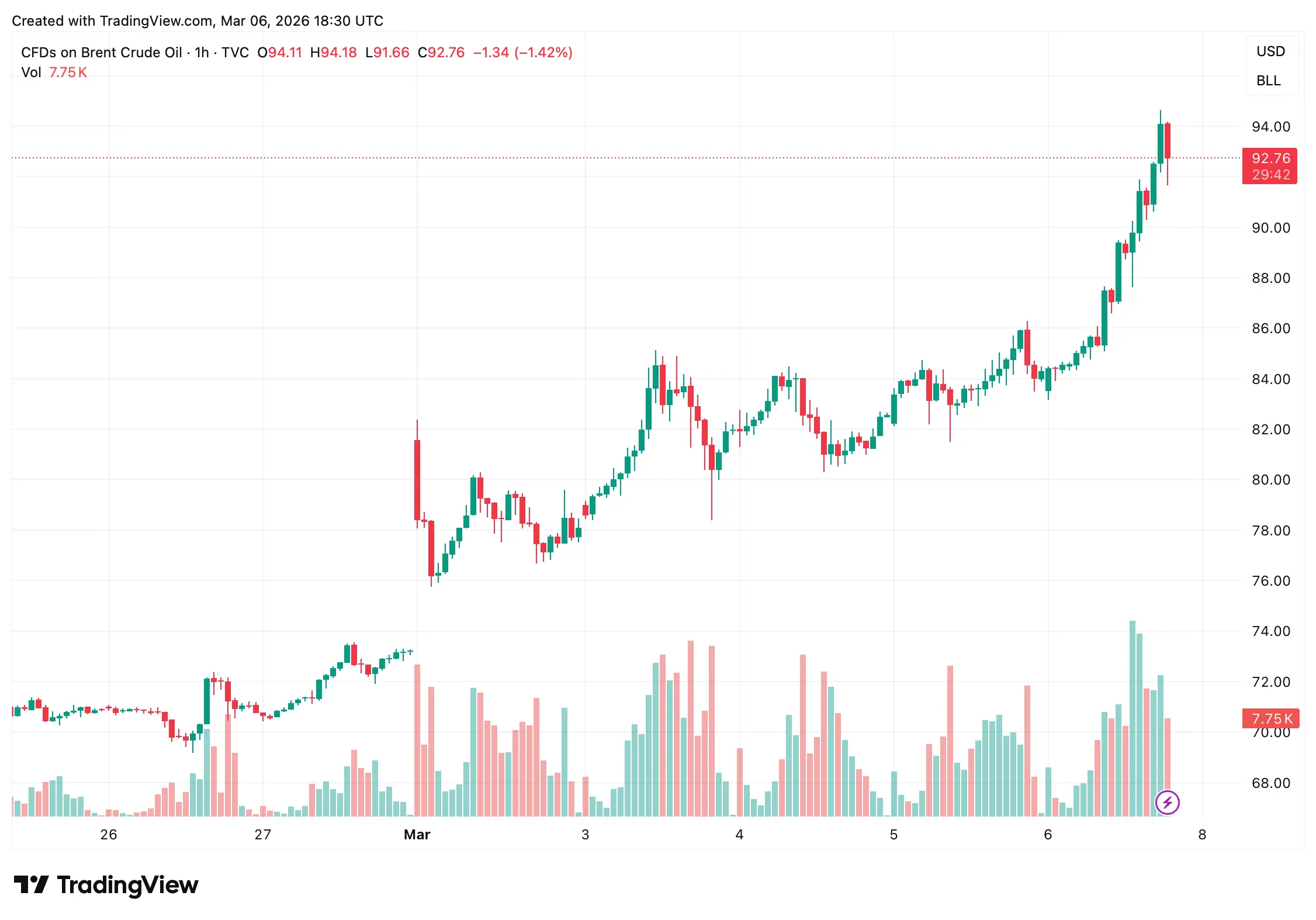 Brent Crude (UKOIL) on March 6, 2026.
While the war set the stage, the Bureau of Labor Statistics provided the knockout blow. Fresh data revealed that U.S. employers unexpectedly cut more jobs than they created last month. This creates a nightmare scenario for the Federal Reserve: weakening labor demand paired with energy-driven inflation. This “stagflation trap” dashes investor hopes for aggressive rate cuts, as the Fed may be forced to keep rates high to combat rising costs despite a cooling economy.
Brent Crude (UKOIL) on March 6, 2026.
While the war set the stage, the Bureau of Labor Statistics provided the knockout blow. Fresh data revealed that U.S. employers unexpectedly cut more jobs than they created last month. This creates a nightmare scenario for the Federal Reserve: weakening labor demand paired with energy-driven inflation. This “stagflation trap” dashes investor hopes for aggressive rate cuts, as the Fed may be forced to keep rates high to combat rising costs despite a cooling economy.
As the price floor dropped, the “longs” were caught leaning. According to Coinglass data, the 24-hour window saw a massive $329 million in total crypto liquidations. Out of $160 million in bitcoin liquidations, a lopsided $133 million were long positions. Overall, the total 24-hour liquidated longs hit $257 million, suggesting that the market was over-leveraged for a breakout that never came.
FAQ ❓
- What caused bitcoin to drop below $70,000? Bitcoin’s midweek resilience crumbled due to relentless selling pressure and a plummet from $70,131 to $68,300.
- How did the broader crypto market react? The total crypto valuation fell 2.7% to $2.41 trillion, mirroring bitcoin’s decline.
- What factors contributed to this market movement? The escalating Middle East conflict and negative U.S. job data combined to create a “stagflation trap,” impacting overall investor sentiment.
- How significant were the liquidations during this period? A total of $329 million in crypto liquidations occurred, with $160 million attributed to Bitcoin, where $133 million were long positions.
Disclaimer: The information on this page may come from third parties and does not represent the views or opinions of Gate. The content displayed on this page is for reference only and does not constitute any financial, investment, or legal advice. Gate does not guarantee the accuracy or completeness of the information and shall not be liable for any losses arising from the use of this information. Virtual asset investments carry high risks and are subject to significant price volatility. You may lose all of your invested principal. Please fully understand the relevant risks and make prudent decisions based on your own financial situation and risk tolerance. For details, please refer to
Disclaimer.


