Introduction
Restaking systems rely on the coordinated participation of multiple stakeholders – each with different motivations, risk exposures, and responsibilities. Whether staking Ethereum, delegating Bitcoin, or running an AVS (Actively Validated Service), participants must understand how value flows through the system and what failure conditions might lead to loss.
In EigenLayer-based systems, the restaking process brings together three primary actors: (1) Restakers, who delegate capital and opt into AVS conditions; (2) Operators, who run the AVS logic; and (3) AVSs, which define what must be validated and under what rules. EigenLayer acts as the coordination and enforcement layer, linking these actors through smart contracts, reward channels, and slashing logic.
Restakers: Earning Through Reuse of Staked Assets
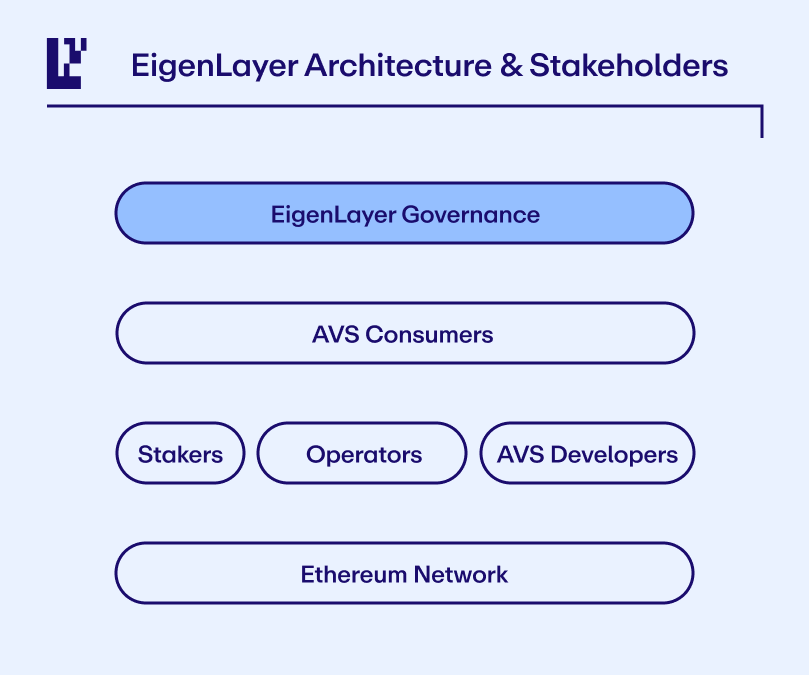
Restakers are individuals or institutions who commit assets – typically already staked tokens like ETH, LSTs, or BTC – to restaking protocols. By opting into additional slashing conditions, they become eligible to earn rewards from AVSs that leverage their capital for security.
For example, an Ethereum validator who stakes ETH to secure the Ethereum network may choose to restake that ETH in EigenLayer. In doing so, they agree to additional performance guarantees defined by an AVS, such as uptime, data availability, or correct oracle responses. In exchange, they receive additional token rewards or fees from the AVS.
EigenLayer allows these restakers to delegate their tokens to one or more Operators who actively serve specific AVSs. The restaker retains exposure to rewards and slashing tied to the Operator’s performance across those AVSs.
The key appeal of restaking is capital efficiency – restakers earn multiple streams of rewards without needing to unstake or redeploy capital. However, this comes with added risk, as poor performance by the AVS or its operator can trigger slashing of the restaked asset.
Restakers must therefore evaluate each AVS carefully before opting in. This includes reviewing the AVS’s slashing contract, the dispute resolution process, and the history or reputation of its operator. Without clear visibility into these parameters, the promise of higher yield may hide asymmetric risk.
Operators: Technical Stewards of the AVS Logic
Operators run the off-chain or on-chain infrastructure required by Actively Validated Services. These may include full nodes, relayers, data availability servers, or specialized execution environments depending on the AVS design.
In EigenLayer, operators register to serve specific AVSs. Their performance is continuously monitored, and failure to meet expectations – such as node downtime, incorrect computation, or equivocation – can lead to restaker slashing. Operators themselves do not always stake their own capital, but their service quality directly affects those who have delegated to them.
Karak and Symbiotic introduce additional layers of complexity, allowing operators to serve multiple AVSs across different asset types. This increases operational flexibility but also correlates risk. If one operator fails while serving multiple AVSs, slashing events may impact multiple restakers or vaults simultaneously.
For example, an operator serving EigenDA (a data availability layer), AltLayer (a rollup sequencer AVS), and Witness Chain (a decentralized watchtower service) must maintain distinct uptime and response standards across all three. Each of these AVSs has unique slashing conditions encoded within the EigenLayer registry. Operators must track and meet those performance expectations in parallel.
Operators must therefore manage performance monitoring, failover systems, and real-time alerts to avoid triggering disputes. Many are now building or integrating operator dashboards and insurance protocols to help minimize risk and recover from penalties.
AVS Builders: Security Designers and Reward Distributors
AVS builders are the developers or protocols that rely on restaked assets for security. These may include oracle networks, rollup sequencers, bridges, or coprocessors. Instead of creating their own validator network, AVSs define slashing rules and delegate enforcement to a restaking protocol’s smart contracts and governance systems.
AVS teams design the incentive structure, including:
- The type of work required (e.g., uptime, consensus, data relaying),
- The payout mechanism (fixed fees, token rewards, service fees),
- The slashing logic and dispute resolution model.
They must balance between setting strict slashing rules (to maintain security) and attracting enough restakers and operators (to ensure participation). If conditions are too harsh, restakers may avoid them. If too lenient, the AVS becomes vulnerable to manipulation or downtime.
Real-world AVSs on EigenLayer illustrate this balance. EigenDA, for instance, demands high bandwidth and constant data availability; AltLayer requires secure, responsive rollup sequencing; and Witness Chain uses operators to verify timestamp and fraud proofs in cross-chain settings. Each AVS publishes its own staking requirements, expected performance, and slashing logic, visible to both restakers and operators.
In 2025, many AVS builders are beginning to publish transparency dashboards, open-source slashing contracts, and third-party audits of their dispute logic to build trust with restakers. The long-term success of an AVS depends as much on governance and communication as it does on protocol design.
Understanding Slashing: Definitions and Mechanics
Slashing is the primary enforcement mechanism in restaking systems. It refers to the partial or total loss of restaked assets due to a violation of AVS-defined rules. Slashing ensures that participants have “skin in the game” and behave honestly under economic pressure.
There are several types of slashing across platforms:
- Downtime slashing occurs when an operator fails to meet uptime thresholds.
- Equivocation slashing penalizes submitting conflicting or contradictory messages in consensus processes.
- Malicious execution slashing is triggered when operators run logic that provably violates AVS rules.
EigenLayer uses a challenge-based slashing system, where restaker misconduct must be proven during a two-phase dispute window. This gives operators and AVS teams time to present evidence or dispute claims before any penalty is finalized. Babylon, by contrast, enforces slashing through Bitcoin time-lock invalidation, which makes capital temporarily inaccessible or fully lost depending on the severity of the infraction.
Disputes are often handled on-chain through bonded arbitration—participants stake tokens to challenge misconduct and earn rewards if their claim is validated. However, this process introduces a delay in enforcement, requiring proper design to avoid manipulation or abuse.
Risk Mitigation and Best Practices
As restaking platforms grow in scale and complexity, participants must adopt proactive strategies to manage risk:
- Diversification is critical. Restakers should avoid putting all assets behind a single AVS or operator, especially in early-stage protocols where slashing logic is less battle-tested.
- Operator selection should be based on transparency, uptime history, and participation in community governance.
- Insurance protocols are emerging, offering partial compensation for slashing events in exchange for premiums. These include native mechanisms (like EigenLayer’s proposed opt-in insurance pools) or third-party DeFi insurance providers.
- Real-time monitoring tools help operators and AVSs detect anomalies before they escalate into slashable offenses. These are increasingly offered as SDKs and dashboards by the platforms themselves.
- Regulatory awareness is becoming essential. In 2025, new staking guidance under the EU’s MiCA framework and proposed U.S. SEC rules classify restaking programs involving rewards and slashing as potentially financial in nature. Participants – especially institutions – must monitor how these frameworks evolve.