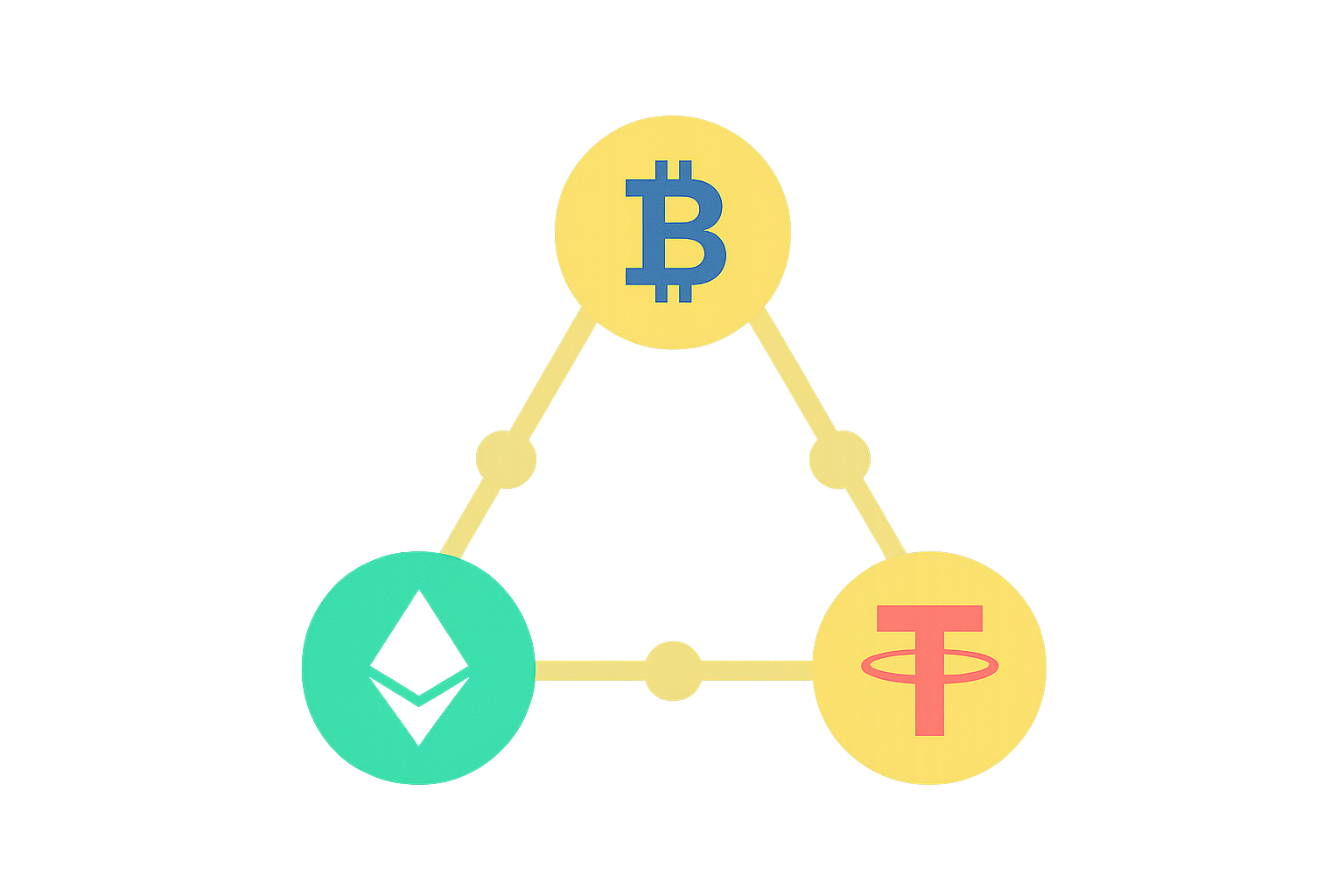
Explore triangular arbitrage in cryptocurrency: profitable strategies, advanced techniques, and a complete guide tailored for traders. Find out how to leverage price differences among three assets on Gate to maximize your returns using this sophisticated trading approach.
Introduction
Arbitrage is a trading method that transforms market inefficiencies into financial gains. Cryptocurrency traders use a range of arbitrage strategies, including simple arbitrage, cross-border arbitrage, peer-to-peer (P2P) arbitrage, and triangular arbitrage. All of these approaches seek to profit from price differences across multiple markets.
While most arbitrage strategies involve trading between two markets, one especially noteworthy method leverages price discrepancies among three asset classes: triangular arbitrage. This sophisticated strategy capitalizes on price gaps across three assets by executing a sequence of trades to profit from price imbalances.
What Is Triangular Arbitrage in Crypto?
Triangular arbitrage exploits price differences among three different assets—typically cryptocurrencies—within a single market. The core idea is straightforward: a trader swaps one crypto asset for a second, the second for a third, and the third back to the original. This cycle repeats as long as price differences exist and profitable opportunities are available.
Execution, however, is far from simple. Triangular arbitrage requires traders to spot price gaps, simultaneously trade multiple asset pairs, and manage risk effectively. Given the cryptocurrency market's volatility and rapid price movements, traders must act with exceptional speed and precision to seize opportunities before they vanish.
Suppose an experienced trader notices a price discrepancy among three assets—Bitcoin (BTC), Ether (ETH), and Tether (USDT). How can they identify a profitable arbitrage window?
The trader exchanges $50,000 USDT for BTC, then trades the BTC for ETH, and finally swaps the ETH back to USDT. If the ending USDT balance is significantly different from the initial $50,000, a triangular arbitrage opportunity exists. The difference represents the potential profit generated by this trade sequence.
Crypto traders often need to execute high-frequency trades to accumulate meaningful profits from price gaps. Each arbitrage cycle may yield only a small gain, but repeated cycles can add up over time.
Depending on the market structure, traders may use different approaches to arbitrage. For example, they might place a buy-buy-sell or a buy-sell-sell order, tailored to the prevailing price configuration and available opportunities.
Here’s an example of a buy-buy-sell strategy involving USDT, BTC, and ETH:
In this buy-buy-sell scenario, the trader would net a profit of 2,000 USDT. To maximize gains, the trader must rapidly repeat the process: buy BTC with 52,000 USDT, then purchase ETH with BTC, and so on—capitalizing on each opportunity as it arises.
In a buy-sell-sell strategy, the trader would purchase BTC at a lower price using USDT, sell the BTC for ETH at a higher price, and then sell the ETH for USDT at an even higher price. This reverse approach targets different price dynamics for profit.
Triangular arbitrage is complex and time-intensive, making manual execution challenging. That's why many arbitrageurs deploy trading bots to automate the process. These bots scan for price discrepancies and execute triangular arbitrage trades automatically, reducing the risk of missed opportunities—even when traders aren't actively watching the market.
Benefits of Triangular Arbitrage in Crypto
Financial Opportunities
Triangular arbitrage gives traders a way to generate returns from price gaps—not just from market direction—beyond what’s possible with single-market strategies. Those who can consistently identify and execute these trades gain access to an additional source of revenue, diversifying their trading portfolios.
Reduced Risk
In theory, arbitrageurs can spread risk across several assets, lowering exposure to any single currency. Diversifying risk helps cushion the impact of price swings, especially in volatile markets. This approach lets traders minimize directional exposure to individual asset movements.
However, triangular arbitrage still carries other risks, discussed in the next section. As a result, traders must use robust risk management strategies to assess and mitigate potential threats.
Improved Market Liquidity
Because triangular arbitrage involves three trading pairs, it boosts trading volume across those crypto markets—helping to increase overall liquidity. Liquidity, which measures how easily a crypto asset can be bought or sold without moving its price, is a key indicator of market health. Highly liquid markets tend to be less volatile, making trades more profitable by reducing risks like slippage.
Greater Market Efficiency
Like other arbitrage forms, triangular arbitrage targets and corrects market price imbalances. This helps stabilize market prices, improve efficiency, and reduce trading risks. By closing price gaps, triangular arbitrage promotes price convergence across trading pairs.
Drawbacks of Triangular Arbitrage
Despite its advantages, triangular arbitrage comes with limitations and challenges traders must consider.
Slippage Risk
Triangular arbitrage is especially vulnerable to slippage, as it relies on high-frequency trades in fast-moving markets. Slippage is the difference between a target price and the actual executed price, which occurs when markets move quickly.
Because triangular arbitrage requires multiple trades and precise timing, price gaps may close before the trader completes the final leg of the trade. This can erode profits—or even lead to losses on the entire sequence.
Timing
Triangular arbitrage can be profitable under ideal conditions, but traders face uncontrollable factors that affect timing. Exchange inefficiencies can delay trade execution, while volatility can shift prices before trades are completed. Such delays can turn profitable setups into losses.
Liquidity Risk
If a market lacks liquidity or active traders, you may not be able to execute all trades needed for triangular arbitrage. Failure to buy or sell assets at the desired prices can result in losses. Low liquidity may also widen price spreads, making the strategy harder to execute and less profitable.
What’s Next for Triangular Arbitrage?
Advancements in technology and the rise of new financial markets could reshape how triangular arbitrage is applied. The strategy may evolve to become more sophisticated, with improved execution speed and accuracy. Greater technological infrastructure and faster data transmission stand to reduce trade delays and increase profitable opportunities.
However, as more traders adopt triangular arbitrage, competition will intensify—potentially making profits harder to capture. As markets become more efficient, arbitrage margins may shrink. Regulatory changes and shifts in currency markets can also impact profitability.
As markets evolve, traders must adapt quickly to remain profitable when pursuing triangular arbitrage. Technological innovation and expertise with automation tools will be critical success factors.
Conclusion
Triangular arbitrage is a sophisticated trading strategy used by experienced traders who must weigh various tactics and risks. While the approach offers financial upside and potential for risk reduction, it isn’t suitable for novices lacking deep risk management experience.
Anyone interested in triangular arbitrage should first develop a thorough understanding of crypto markets, master price analysis, and build strong risk management skills. Automated trading bots can improve execution efficiency, but ongoing monitoring and the ability to adapt to market conditions are essential for sustained profitability.
FAQ
What Is Triangular Arbitrage and What’s Its Core Principle?
Triangular arbitrage is a strategy that exploits price differences among three currencies to generate risk-free profits. The core principle is to buy low and sell high to balance exchange rates between trading pairs.
Triangular arbitrage leverages price differences among three assets: buy asset 1, exchange it for asset 2, then asset 3, and finally convert it back to asset 1. This cycle generates profits from exchange rate differences between trading pairs—without risk.
What Are the Risks and Limitations of Triangular Arbitrage?
Triangular arbitrage faces several major risks: price slippage, insufficient liquidity, and high transaction costs. Limitations include rapid market volatility and operational complexity, which demand accurate analysis and fast execution.
How Does Triangular Arbitrage Differ from Other Arbitrage Strategies (Like Statistical or Inter-Market Arbitrage)?
Triangular arbitrage exploits price gaps among three assets on a single market in one transaction. Statistical arbitrage relies on quantitative analysis and historical correlations, while inter-market arbitrage compares prices for the same asset across different markets. The main differences are the number of assets involved and the time horizon.
How Much Profit Can Triangular Arbitrage Generate in Live Trading? What Capital Is Required?
Triangular arbitrage profits depend on price gaps and market liquidity. With capital ranging from $10,000 to $100,000, returns may reach 0.5%–5% per transaction. Large trading volumes can significantly amplify these gains.
Transaction fees and slippage directly reduce profits in triangular arbitrage. Fees erode gains across all three trades, while slippage creates a gap between expected and actual prices. You must calculate all costs to confirm the arbitrage opportunity remains profitable after expenses.
Exchanges with high liquidity and low fees are best suited for triangular arbitrage. Focus on major platforms offering a wide range of trading pairs, fast execution, and competitive fees to maximize profits.
* The information is not intended to be and does not constitute financial advice or any other recommendation of any sort offered or endorsed by Gate.