Bottlenecks of Traditional Payment Systems
To understand the significance of on-chain payments, we must first recognize the limitations of traditional systems. While traditional payment networks were built with security and compliance at their core, their underlying technology and structure can no longer keep pace with the needs of a globalized, digital economy.
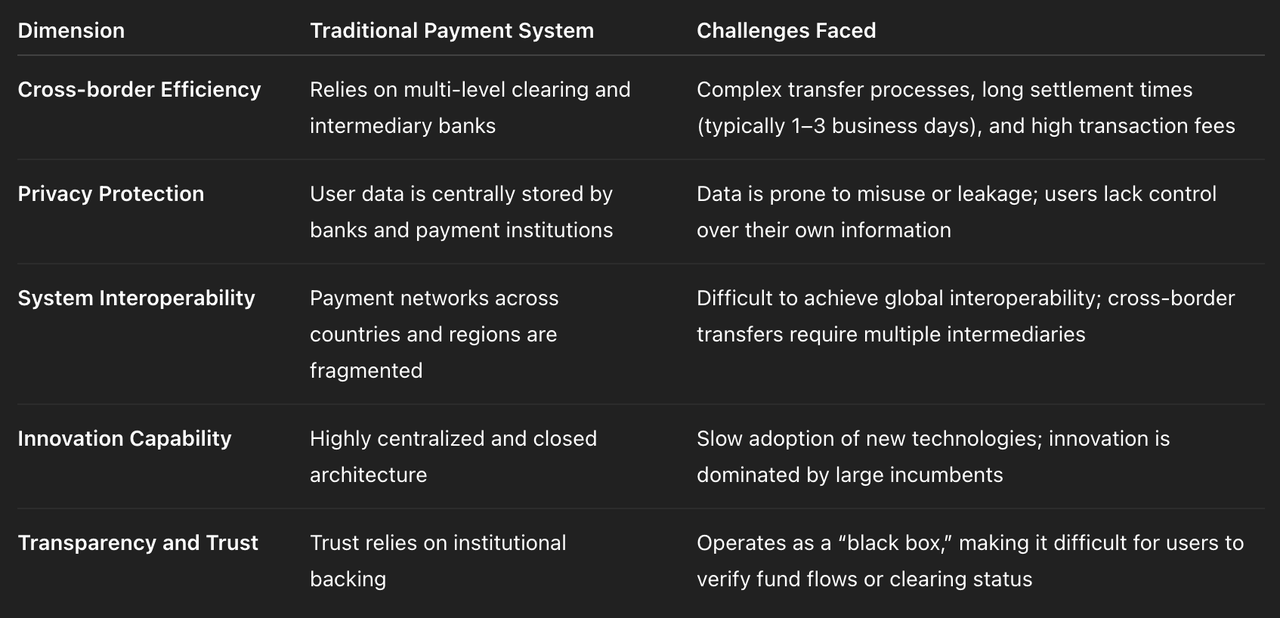
This structure makes traditional payment systems strong in security but severely lacking in efficiency and openness. These pain points become increasingly evident in emerging economic activities such as cross-border e-commerce, remote employment, and DeFi.
Value Reconstruction of On-Chain Payments
The advent of blockchain has brought structural innovation to payment systems. It does not simply replace banks or payment gateways but reshapes the way funds flow with a completely new logic of trust and clearing.
The core breakthroughs brought by on-chain payments include:
Disintermediation (Peer-to-Peer)
- Transactions can be completed directly between parties without banks or payment companies as intermediaries.
- The path of fund flow is greatly shortened, reducing fees and time delays.
Smart Contract Automated Settlement
- Payment instructions and fund allocation can be executed automatically through contracts, eliminating human errors and delays.
- Suitable for complex scenarios such as subscription services, revenue sharing, and DAO payments.
On-Chain Transparency and Traceability
- Every transaction is recorded on the blockchain, publicly accessible and verifiable.
- Enhances trust while providing a data foundation for regulatory compliance.
Globalization and Inclusiveness
* Anyone with a wallet can use it without needing a bank account.
- Transforms financial services from “permissioned” to “barrier-free,” promoting global inclusive payments.
Low Cost and High Efficiency
* Technologies such as Layer2, Rollup, and cross-chain protocols significantly reduce transaction costs and confirmation times.
- Enables micropayments and real-time settlement, bringing new momentum to the digital economy.
Through these innovations, blockchain transforms payments from an exclusive function of centralized finance into an open mechanism participated in by a global network.
Key Insights
The significance of on-chain payments lies not in opposing traditional finance but in complementing it. It redefines the source of trust, no longer relying on a single institution but maintained jointly by code, consensus, and transparent mechanisms.
We can summarize the key points as follows:
- On-chain payments are an extension and supplement to traditional systems, not a replacement. They bring users unreachable by centralized systems into the global financial network.
- The goal is to make funds flow like information. No longer restricted by time, geography, or institutions, truly achieving the freedom to transact anytime, anywhere, and with anyone.
- Trust is no longer based on institutions but on technology. From trusting banks to trusting algorithms, this is a profound shift in the paradigm of financial trust.
The Future of Payments Is On-Chain
While traditional payments still grapple with delays and costs in cross-border remittances, on-chain payments have already achieved second-level settlement and borderless circulation. This is not only an improvement in efficiency but also a reshaping of the trust structure in the financial system. Blockchain gives us the first opportunity to build an open, transparent, and universally accessible payment network, and this revolution is accelerating.
Disclaimer
* Crypto investment involves significant risks. Please proceed with caution. The course is not intended as investment advice.
* The course is created by the author who has joined Gate Learn. Any opinion shared by the author does not represent Gate Learn.