Author: Frank, PANews
Stablecoins are becoming a new strategic track for major global economies, with the United States, the European Union, and Hong Kong competing to introduce regulatory frameworks in an attempt to seize the initiative. However, the issuance of any stablecoin is inseparable from a key underlying infrastructure—public blockchain.
In this context, the industry viewpoint that “China currently lacks a globally influential public chain and should be led by central state-owned enterprises” has sparked heated discussions. This viewpoint is not without basis, but it also tends to overlook a fact: since blockchain was elevated to the level of national strategy in 2016, a blockchain infrastructure network led by a “national team” and aimed at serving the real economy has already taken shape.
From the global connector BSN, the industrial base “Spark Chain Network”, to the technological cornerstone “Chang’an Chain”, and then to the public chain “exception” Tree Graph Chain (Conflux), they collectively form a unique blockchain landscape in China. As the demand for stablecoins becomes increasingly urgent, which of these networks is most likely to break through the encirclement and become the trusted foundation for China’s stablecoin vision, aimed at the global market?
To accurately understand China’s strategic intentions, it is necessary to redefine the term “public chain” (公有链) in the Chinese context. Equating it directly with permissionless chains leads to serious conceptual deviations. In China, the “public chain” promoted at the national level is essentially more akin to a “public infrastructure” or “trust infrastructure” that is guided by the state, allows multiple parties to participate, but is ultimately controllable.
Among these, several that currently have a higher influence in the industry are the Blockchain Service Network (BSN), Xinhua Chain Network, “Chang’an Chain”, and the recently discussed public chain Conflux. PANews conducts a review and analysis of these blockchain networks to see who is more likely to become the foundation for China’s stablecoin.
Blockchain Service Network (BSN): Multi-framework adaptation, focusing on the no-token concept
In 2018, the BSN was jointly initiated by the National Information Center, China Mobile, China UnionPay, and Beijing Hongzao Technology, among others, as a blockchain public infrastructure. It currently consists of the BSN dedicated network and the BSN public network, where the BSN dedicated network mainly serves enterprises, primarily through the “BSN Distributed Cloud Management Platform,” which supports deployment in various physical IDC data centers, public clouds, and private clouds to establish a blockchain-based distributed cloud system environment.
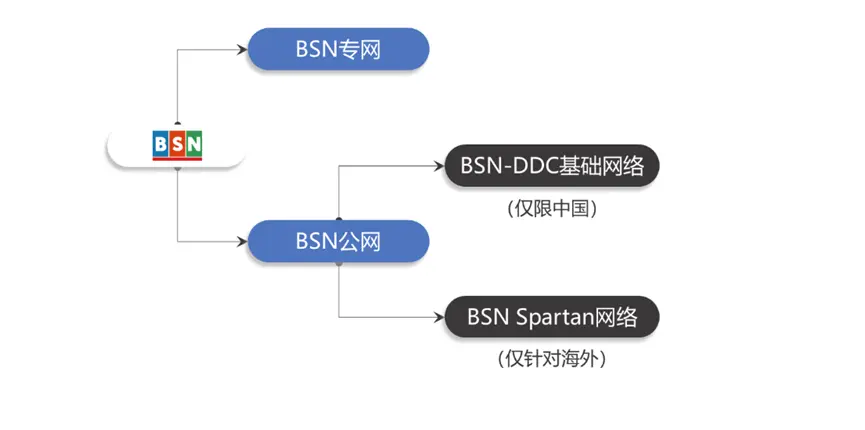
The BSN public network is more inclined towards the concepts of public chains and consortium chains that we are familiar with. In the BSN public network system, it is divided into the BSN-DDC basic network (an open consortium chain aimed at China) and the BSN Spartan network (a public distributed cloud service network composed of non-token public chains), aimed at overseas markets.
Currently, within the DDC network system, there are multiple open alliance chains such as Yan’an Chain, Wenchang Chain, Tai’an Chain, Wuhan Chain, and China Mobile Chain. These networks utilize frameworks such as Ethereum, EOS, FISCO BCOS, and Corda, with main application scenarios including NFTs (digital collectibles), distributed domains, distributed identities (DID), and trusted data storage. The DDC network system is an alliance chain system and does not have a token design; regular on-chain service fees need to be recharged using fiat currency and are aimed at the domestic market.
The consensus mechanism of the BSN Spartan network is more aligned with public chains like Ethereum, but the difference is that it is a non-token public chain. Currently, BSN Spartan consists of three sub-chains, based on Ethereum, Cosmos, and PolygonEdge. As of August 4, the daily transaction volumes for these three chains were 1,068, 844, and 938 respectively.
Overall, the core innovation of BSN lies in multi-framework adaptation, with the ability to unify the adaptation and management of dozens of mainstream blockchain underlying frameworks globally (including consortium chains and public chains). Through a standardized adaptation mechanism, developers can choose different underlying chains “plug and play” without worrying about the complex deployment and operation details, akin to a universal “operating system” for the blockchain world. However, the lack of an open Token mechanism may become a constraint in light of the increasing demand for stablecoins. He Yifan, the Executive Director of the BSN Development Alliance and CEO of Hongzao Technology, has repeatedly expressed his strong aversion to virtual currencies, believing that virtual currencies are a massive Ponzi scheme.
“Spark Chain Network”: Supported by the Ministry of Industry and Information Technology, focusing on the industrial sector
According to the official introduction, “Xinghuo Chain Network” is a national-level blockchain new integrated infrastructure system built under the leadership and special support of the Ministry of Industry and Information Technology, led by the China Academy of Information and Communications Technology, in collaboration with several large enterprises and institutions such as Beihang University, Beijing University of Posts and Telecommunications, and China Unicom.
From an architectural perspective, “Xinghuo·Chain Network” is divided into two layers. The first layer consists of the main chain formed by super nodes, which is used to manage identities, public data, or other legal assets and regulations provided by the state in the future. The second layer is a sub-chain linked by backbone nodes, connecting various applications in industry or regional contexts.
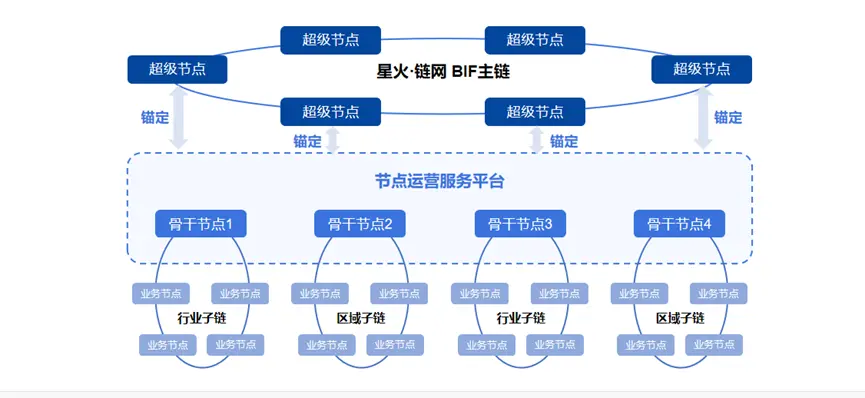
It is worth noting that “Xinghuo·Chain Network” is a permissioned public blockchain network, and according to the current information, it also does not have a token design. Similarly, “Xinghuo·Chain Network” is divided into the domestic main network and the international version known as the ASTRON network. Currently, the established super nodes of “Xinghuo·Chain Network” include Xiamen and Liuzhou; backbone nodes include Jiaozhou, Hengqin, and Suzhou; international nodes include Malaysia and Macau. The node access threshold of “Xinghuo·Chain Network” is relatively high and requires local governments to promote its construction.
The application scenarios of “Starfire·Chain Network” are highly focused on the industrial sector, including: full lifecycle traceability of high-end manufacturing products, collaborative management of complex supply chains, digital identity authentication and predictive maintenance of industrial equipment, as well as trustworthy sharing and trading of industrial data.
Chang’an Chain (ChainMaker): Multiple writings of policy planning, participation of state-owned enterprises and internet giants.
“Chang’an Chain” is led by the Chang’an Chain Ecological Alliance, which is initiated by the Beijing Microchip Blockchain and Edge Computing Research Institute (referred to as “Microchip Institute”) under the guidance and support of the Beijing Municipal Government.
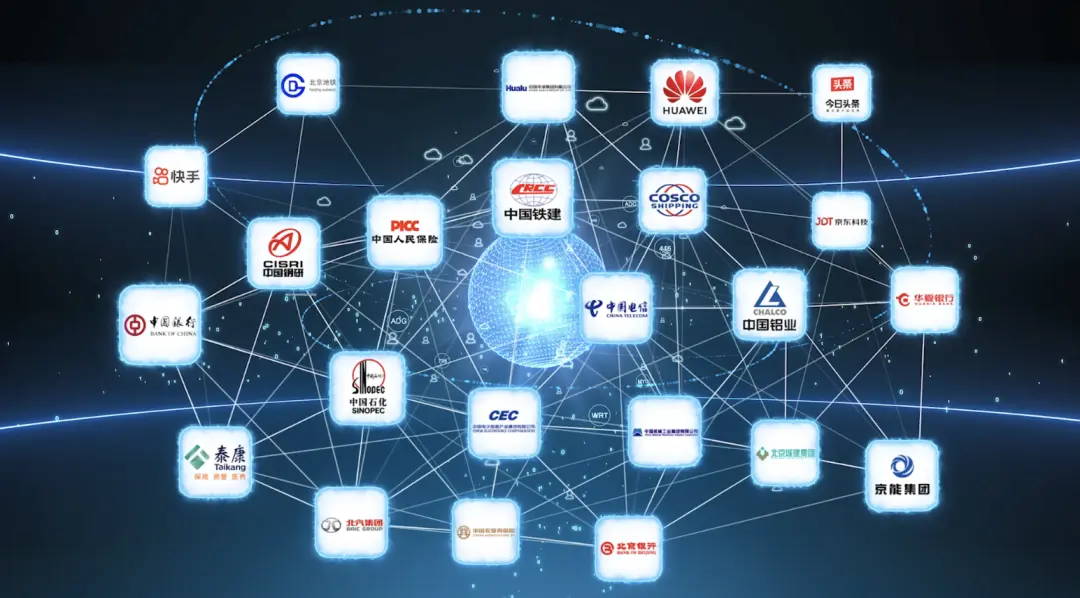
The Chang’an Chain Ecological Alliance covers key central state-owned enterprises in critical sectors such as the State Grid, China Construction Bank, Industrial and Commercial Bank of China, China Unicom, COFCO Group, as well as internet giants like Tencent and Baidu. Currently, the number of alliance members has exceeded 50.
In November 2021, “Chang’an Chain” was included in the “Beijing International Science and Technology Innovation Construction Plan during the 14th Five-Year Plan”. In January 2022, “Chang’an Chain” was included in the Beijing Municipal Government Work Report. In the “Beijing Blockchain Innovation Application Development Action Plan (2025-2027)”, “Chang’an Chain” is mentioned once again.
In addition to its strong background, the technological advantages of the “Chang’an Chain” are also quite obvious. The official claim states that its transaction throughput capacity (TPS) can reach levels of 100,000, which can meet the high concurrency demands of large-scale financial and government scenarios.
Tree Graph Chain (Conflux): Developed by Tsinghua “Yao Class” team, the only public chain in mainland China that issues tokens.
Unlike the blockchain networks mentioned above that have obvious features of alliance chains, the Conflux chain is currently the only public chain in mainland China that meets regulatory requirements. Conflux was founded in 2018 by Long Fan, a PhD from MIT and a graduate of the “Yao Class”, with Academician Andrew Yao serving as the chief scientist and participating in the theoretical design of the core algorithms. In January 2020, the Conflux team officially established the Shanghai Conflux Blockchain Research Institute in Shanghai. In October of the same year, the Conflux mainnet was officially launched.
As a complete public chain, the Conflux chain also has a governance token CFX. Although mainland China has strict regulatory policies on cryptocurrencies, Conflux has successfully issued and operated its token CFX, making it a unique “exception.”
As a global cryptocurrency asset, CFX has been listed and traded on several mainstream cryptocurrency exchanges, such as Binance, OKX, and Gate. Its market price and market capitalization are influenced by various factors, including technological advancements, ecosystem development, and macro market conditions. For example, recent positive news regarding the Conflux 3.0 upgrade and support for the offshore Chinese Yuan stablecoin plan has significantly boosted its token price in a short period.

In addition, the endorsement situation of the Shutu chain should not be underestimated. The Shutu chain has been reported multiple times by mainstream official media such as the People’s Daily and has deep cooperation with several central enterprises including China Telecom and China Mobile. Furthermore, the Shutu chain is collaborating with the fintech company AnchorX to explore the issuance of a stablecoin pegged to offshore RMB (AxCNH) to support the cross-border payment needs of countries along the “Belt and Road”.
Who is more likely to become the technological foundation of stablecoins?
In addition to the aforementioned blockchain networks with strong endorsements, there are several alliance chains in China, such as the State Grid Chain (国家电网), Unicom Chain (中国联通), China Mobile Chain (中国移动), ICBC Chain (工商银行), Ant Chain (蚂蚁集团), Zhixin Chain (腾讯), and Zhongxiang Chain Network. Most of these alliance chains are also initiated by state-owned enterprises or technology giants, each possessing unique advantages and influence within their respective fields.
But back to the original topic, does China have a public chain that has influence internationally? As of now, the answer should be lacking. The main reason is that most of China’s blockchain networks are consortium chains, which have significant differences in consensus mechanisms and economic models compared to overseas public chains like Ethereum and Solana.
Among the existing public chain infrastructures, the most likely to grow into an internationally recognized domestic public chain is “Shutuchain”. From a technical perspective, “Shutuchain” possesses characteristics of an internationally accepted public chain and has originality and performance advantages in technology. Its official background and clear exploration plan for offshore RMB stablecoins place it in a leading position in the stablecoin sector.
Among other blockchain networks, “Chang’an Chain” has also become the underlying architecture for stablecoin issuance. In 2021, its research and development institution, Microchip Institute, signed a strategic cooperation agreement with the Central Bank’s Digital Research Institute to jointly promote enterprise-level applications of the digital RMB based on the “Chang’an Chain”. In addition, the technical characteristics of the “Chang’an Chain” can also support Token design, meeting the technical requirements for stablecoin issuance. Its strong ecosystem of state-owned enterprises gives it a natural advantage in promoting the application of stablecoins in inter-institutional or specific scenarios.
Of course, in addition to this, as many listed companies in Europe and the United States begin to treat cryptocurrencies as part of their treasury and participate in the governance of public chains, China’s public chain journey may perhaps have a third option, which is to participate in the governance of international mainstream public chains. After all, in a decentralized world, the distinction of national borders is often just a differentiation of computing power percentages.


