Author | Jiawei @IOSG
Three years ago, we wrote an article about Appchain, triggered by dYdX’s announcement to migrate its decentralized derivatives protocol from StarkEx L2 to the Cosmos chain, launching its v4 version as an independent blockchain based on the Cosmos SDK and Tendermint consensus.
In 2022, Appchain might have been a relatively niche technology option. As we move into 2025, with the emergence of more Appchains, particularly Unichain and HyperEVM, the competitive landscape of the market is quietly changing, creating a trend centered around Appchains. This article will start from this point to discuss our Appchain Thesis.
Uniswap and Hyperliquid’s choice
▲ Source: Unichain
The idea of Unichain emerged early, as Nascent founder Dan Elitzer published “The Inevitability of Unichain” in 2022, pointing out the size, brand, liquidity structure of Uniswap, and the demand for performance and value capture, indicating the inevitability of its launch of Unichain. Since then, there has been ongoing discussion about Unichain.
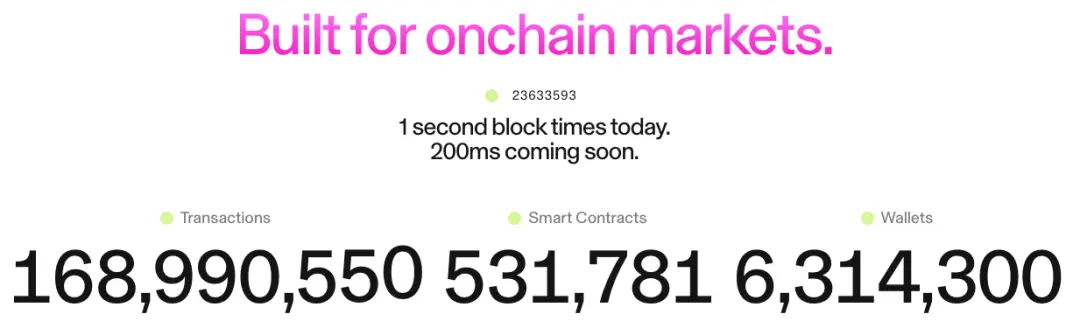
Unichain was officially launched in February today, with over 100 applications and infrastructure providers building on Unichain. The current TVL is approximately 1 billion USD, ranking among the top five of many L2s. In the future, Flashblocks with a block time of 200ms and the Unichain validation network will also be launched.
▲ Source: DeFiLlama
As a perp, Hyperliquid has clearly had the need for Appchain and deep customization since day 1. Beyond its core product, Hyperliquid has also launched HyperEVM, which, like HyperCore, is protected by the HyperBFT consensus mechanism.
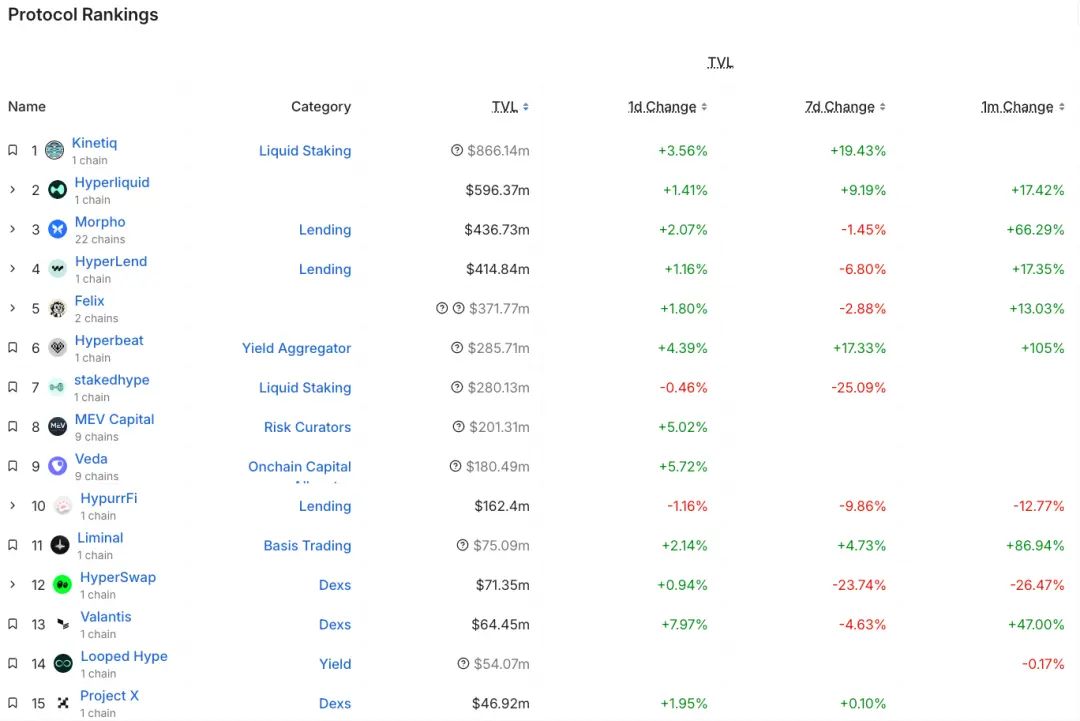
In other words, beyond its powerful perp products, Hyperliquid is also exploring the possibilities of building an ecosystem. Currently, the HyperEVM ecosystem has over $2 billion in TVL, and ecosystem projects are starting to emerge.
From the development of Unichain and HyperEVM, we can intuitively see two points:
- The competitive landscape of L1/L2 is beginning to differentiate. The combined TVL of Unichain and HyperEVM ecosystems exceeds 3 billion dollars. These assets should have been previously settled on general-purpose L1/L2 platforms like Ethereum and Arbitrum. The independence of top applications has directly led to the loss of core value sources such as TVL, trading volume, transaction fees, and MEV for these platforms.
In the past, L1/L2 had a symbiotic relationship with applications like Uniswap and Hyperliquid, where applications brought activity and users to the platform, and the platform provided security and infrastructure for the applications. Now, Unichain and HyperEVM have become platform layers themselves, forming direct competition with other L1/L2s. They are not only competing for users and liquidity but also starting to compete for developers by inviting other projects to build on their chains, which significantly alters the competitive landscape.
- The expansion paths of Unichain and HyperEVM are vastly different from the current L1/L2. The latter often involves building infrastructure first and then using incentives to attract developers. In contrast, the model of Unichain and HyperEVM is “product-first”—they start with a core product that has been market-validated, possesses a large user base, and has brand recognition, and then build the ecosystem and network effects around that product.
The efficiency and sustainability of this path are higher. They do not need to “purchase” the ecosystem through high developer incentives, but rather “attract” the ecosystem through the network effects and technological advantages of core products. Developers choose to build on HyperEVM because there are high-frequency trading users and real demand scenarios, not because of nebulous incentive promises. Clearly, this is a more organic and sustainable growth model.
What has changed in the past three years?
▲ Source: zeeve
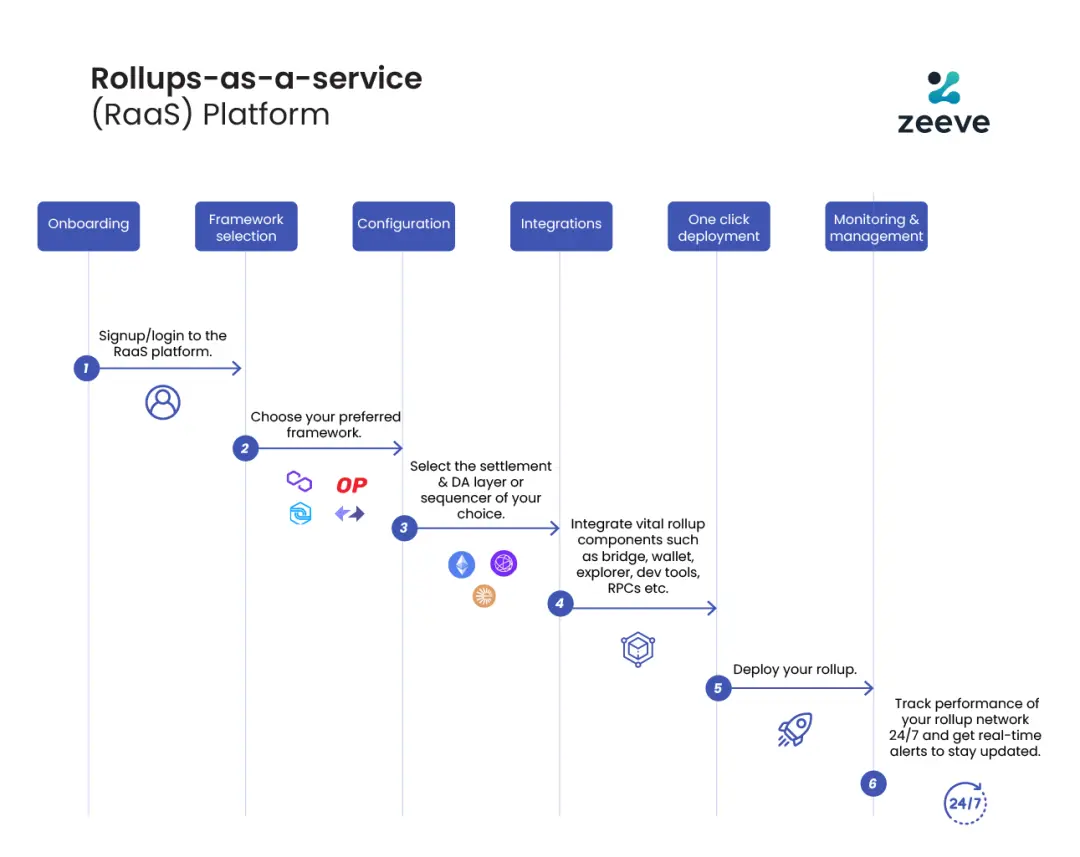
First is the maturity of the technology stack and the improvement of third-party service providers. Three years ago, building an Appchain required teams to master full-stack blockchain technology. However, with the development and maturity of RaaS services such as OP Stack, Arbitrum Orbit, and AltLayer, developers can modularly combine various components on demand, just like choosing cloud services, which significantly reduces the engineering complexity and upfront capital investment of building an Appchain. The operational model has shifted from building infrastructure in-house to purchasing services, providing flexibility and feasibility for application layer innovation.
Secondly, there is the brand and user mindset. We all know that attention is a scarce resource. Users tend to be loyal to the brand of the application rather than the underlying technical infrastructure: users use Uniswap because of its product experience, not because it operates on Ethereum. As multi-chain wallets become widely adopted and UX further improves, users are nearly oblivious when using different chains—their touchpoints are often primarily the wallet and the application. When applications build their own chains, users’ assets, identities, and usage habits are all consolidated within the application ecosystem, creating a powerful network effect.
▲ Source: Token Terminal
The most important thing is that the pursuit of economic sovereignty is gradually emerging. In traditional L1/L2 architectures, we can see that the flow of value shows a clear “top-down” trend:
- The application layer creates value (trading of Uniswap, lending of Aave)
- Users pay fees to use the application (application fees + gas fee), part of which goes to the protocol, and part to LP or other participants.
- 100% of the gas fees go to L1 validators or L2 sequencers.
- MEV is divided among searchers, builders, and validators in different proportions.
- The final L1 tokens capture other value beyond app fees through staking.
In this chain, the application layer that creates the most value captures the least.
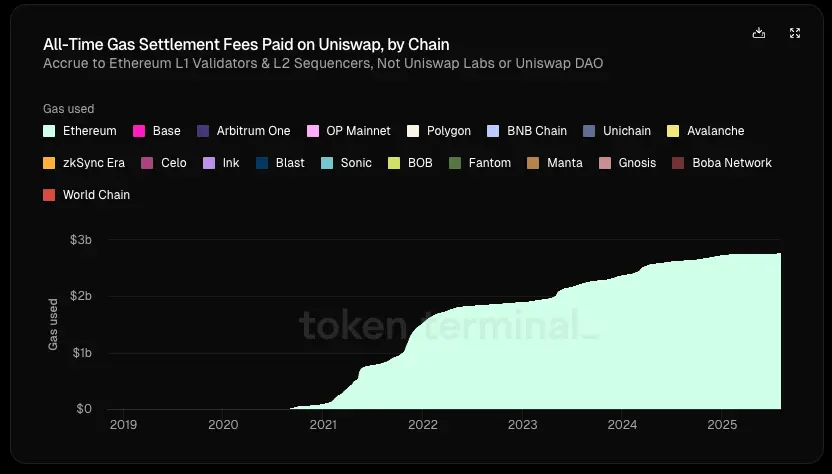
According to Token Terminal statistics, in the total value creation of 6.4 billion USD on Uniswap (including LP earnings, gas fees, etc.), the allocation received by protocols/developers, equity investors, and token holders is less than 1%. Since its launch, Uniswap has generated 2.7 billion USD in gas revenue for Ethereum, which is about 20% of the settlement fees charged by Ethereum.
What would happen if the application has its own chain?
They can capture gas fees for themselves, using their own tokens as gas tokens; and internalize MEV by controlling the sorters to minimize malicious MEV, returning benign MEV to users; or customize fee models to achieve more complex fee structures, etc.
In this way, seeking the internalization of value has become an ideal choice for applications. When the bargaining power of applications is sufficiently large, they will naturally demand more economic benefits. Therefore, high-quality applications have a weak dependence on the underlying chain, while the underlying chain has a strong dependence on high-quality applications.
Summary
▲ Source: Dune@reallario
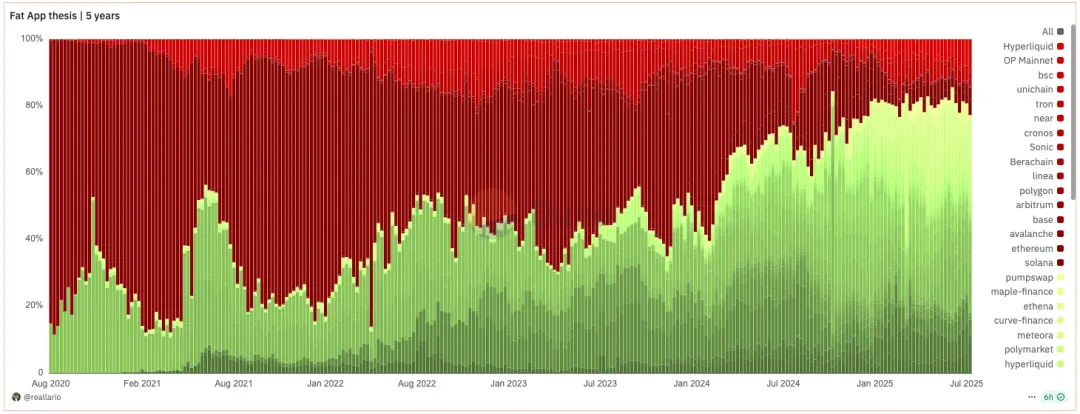
- The above image roughly compares the revenue of protocols (in red) and applications (in green) from 2020 to the present. We can clearly see that the value captured by applications is gradually increasing, reaching about 80% this year. This may somewhat overturn Joel Monegro’s famous theory of “fat protocols and thin applications.”
We are witnessing a paradigm shift from the theory of “fat protocols” to the theory of “fat applications.” Looking back at the pricing logic of projects in the cryptocurrency space, it has primarily been centered around “technical breakthroughs” and the push of underlying infrastructure. In the future, it will gradually shift to pricing methods anchored by brand, traffic, and value capture ability. If applications can easily build their own chains based on modular services, the traditional L1 “rent-seeking” model will be challenged. Just as the rise of SaaS has reduced the bargaining power of traditional software giants, the maturity of modular infrastructure is also weakening the monopoly position of L1.
The market value of leading applications in the future will undoubtedly surpass most L1s. The valuation logic of L1 will shift from the previous “capturing total ecological value” to a stable, secure decentralized “infrastructure service provider.” Its valuation logic will be more akin to public goods that generate stable cash flow, rather than “monopolistic” giants that can capture most ecological value. The valuation bubble will be compressed to some extent. L1 also needs to rethink its positioning.
- Regarding Appchain, our view is: due to its brand, user mindset, and highly customized on-chain capabilities, Appchain can better solidify long-term user value. In the era of “fat applications,” these applications can not only capture the direct value they create but also build a blockchain around the application itself, further externalizing it and capturing the value of the infrastructure – they are both products and platforms; serving end users as well as other developers. In addition to economic sovereignty, top applications will also seek other sovereignties: the right to decide on protocol upgrades, transaction ordering, resistance to censorship, and ownership of user data, etc.
- Of course, this article primarily discusses in the context of top applications such as Uniswap and Hyperliquid that have already launched Appchains. The development of Appchains is still in its early stages (Uniswap’s TVL on Ethereum still accounts for 71.4%). Protocols like Aave, which involve wrapped assets and collateral and heavily rely on composability within a single chain, are also not very suitable for Appchains. In contrast, perpetual contracts that only require oracles for external demand are more suitable for Appchains. Furthermore, Appchains are not the best choice for mid-tier applications and need to be analyzed on a case-by-case basis. This will not be elaborated further here.


