Author: Wilbur Fernandes
Compiled by: Shaw Golden Finance
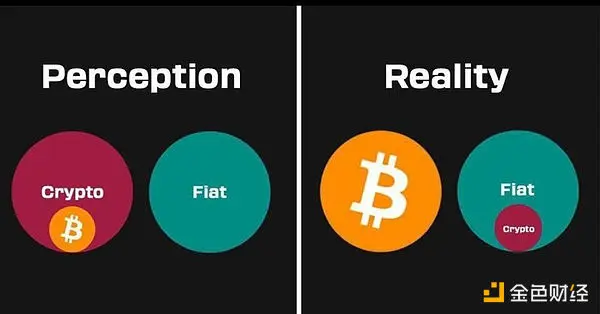
Look at the picture above. What it shows has completely changed my perspective on money, investing, and the future. For a long time, I thought Bitcoin was just another “cryptocurrency”—like the thousands of currencies you see on apps like Coinbase or Binance. Oh my, I was so wrong.
When you first get into it, no one will tell you this: Bitcoin and “cryptocurrency” are not the same thing. In fact, they are completely opposite. It took me too long to figure this out, and I really wish someone had explained it to me earlier. So let me explain it in simple terms.
The biggest lie in the current financial world
When most people hear the term “cryptocurrency,” they often group it all together. Bitcoin, Ethereum, Dogecoin, Shiba Inu Coin—they all seem to be just different variants of the same kind of digital currency, right? And that’s exactly what the cryptocurrency industry wants you to think.
But the fact is: Bitcoin is trying to replace our existing, flawed monetary system. Everything else? They are just companies trying to profit from our existing flawed system.
Let’s think about it this way. Suppose our current financial system is a leaking boat. Most cryptocurrency projects are like selling you better buckets to scoop water, more advanced pumps, or more expensive boat decorations. And Bitcoin? Bitcoin is building you a whole new boat that won’t leak.
Why are almost all things referred to as “cryptocurrencies” just wolves in sheep’s clothing?
Let me tell you something that shocked me when I first learned about it. Almost all mainstream cryptocurrencies, except for Bitcoin, operate exactly like ordinary companies. They have CEOs, marketing teams, headquarters, and boards to decide the direction of your investments.
Take Ethereum as an example. It is operated by the Ethereum Foundation, and its founder Vitalik Buterin regularly publishes the development direction of Ethereum. When they switched from one system to another (from “Proof of Work” to “Proof of Stake”), it was not because of a user vote, but because the Ethereum leadership believed it was in the best interest of the business.
Cardano is also the same - led by founder Charles Hoskinson. Solana is operated by the Solana Foundation. They are not decentralized networks, but rather technology companies that issue tokens instead of stock certificates.
This is why so many people lose money in cryptocurrency “scams.” When you buy these tokens, you are essentially buying shares in a company, but that company has no legal obligation to do anything for you. The founders can make decisions that benefit themselves, change the direction of the business, or simply abandon the project altogether.
Do you remember when Facebook changed its name to Meta? Imagine if Mark Zuckerberg decided to completely pivot to other businesses, your Facebook stocks would become worthless. This situation is actually quite common in cryptocurrency projects.
The true meaning of “decentralization” (most cryptocurrencies are not like this) ###
Here is another question that has confused me for a long time. Every cryptocurrency project claims to be “decentralized,” but what does that actually mean?
Most cryptocurrency companies believe that decentralization means storing copies of the database on partners’ computers rather than just on their own. It’s like a group of friends keeping copies of the club rules at each other’s houses and calling it “decentralized” because no one has the only copy.
But this is not true decentralization; it is just a company with a good backup system.
True decentralization means that anyone in the world can participate without needing permission from anyone. With Bitcoin, you can download the software immediately and start participating in the network, and no one can stop you. You don’t need approval from a foundation, you don’t need to meet wealth requirements, and you don’t need permission from anyone.
Is it like most other cryptocurrencies? Good luck. To verify transactions on Ethereum, you need ETH worth about $50,000 to $100,000. This directly excludes 99% of the global population. The people who are able to participate are mostly institutions and the wealthy — and these are the people who are the current controllers of our financial system.
Bitcoin: The True Meaningful Rebel
Bitcoin is unique. It is fundamentally different. When someone created Bitcoin in the name of Satoshi Nakamoto, they were not trying to start a company or get rich. They were trying to solve a problem that has existed for thousands of years: how to create a currency that is not controlled or manipulated by governments and banks?
The following are the special features of Bitcoin:
Fixed supply: The number of Bitcoins will always be 21 million. No company can decide to print more Bitcoins to maintain operations. No government can issue more Bitcoins to pay bills. No CEO can dilute your Bitcoins by issuing more. This is mathematically impossible.
Anyone can participate: You can secure the Bitcoin network with hardware that is cheaper than a smartphone. You can send Bitcoin to anyone in the world without the permission of any bank or government. You can store Bitcoin without trusting any company.
Decentralized: Bitcoin has no CEO, no corporate headquarters, and no board of directors. Its founder disappeared over a decade ago, and Bitcoin has since operated on its own. Any changes to Bitcoin require the consensus of global users—this process is so challenging that Bitcoin has maintained considerable stability for over 14 years.
In fact, it is very secure: Bitcoin uses a mechanism called “proof of work,” which means the security of the network is ensured by computers solving mathematical problems that require actual power consumption. This is not just clever programming, but also a manifestation of physics. To attack Bitcoin, you would need to consume more power than the gains you would get from the attack.
Why does Bitcoin consume so much energy (and why this is actually beneficial)
You may have heard that Bitcoin “wastes” a lot of energy. I used to think so too, until someone explained to me what this energy actually does.
Bitcoin does not accelerate payment processing speed by consuming energy. Instead, Bitcoin uses energy to create absolute truth in the digital world. Every 10 minutes, computers around the globe compete to write the next page in Bitcoin’s historical ledger. The winner must prove that they have completed a significant amount of computational work, and once victorious, that page of history becomes permanent and immutable.
This is a revolution. For the first time in human history, we have a way to create digital records that cannot be changed, deleted, or manipulated by any authority. When you receive Bitcoin, you can be 100% sure that these coins exist and that this transaction can never be reversed.
In contrast, among other cryptocurrencies, a small group of wealthy validators could potentially collude to alter transaction records. Or compare it to your bank account, where banks can freeze your funds, reverse transactions, or even completely close your account.
The energy consumption of Bitcoin is not waste, but rather the cost of creating the safest and most trustworthy monetary system in human history.
Scalability Issues: Why Steady and Steady Wins the Race
Another criticism you will hear about Bitcoin is that it is “slow.” Bitcoin processes about 7 transactions per second, while newer cryptocurrencies claim to handle thousands of transactions per second.
But the problem is that the foundational layer of Bitcoin is designed like the foundation of a house. The foundation needs to be solid, not fast. Each Bitcoin transaction is a final settlement, much like transferring gold bars between bank vaults. It should be secure and permanent, not quick and convenient.
For daily transactions, Bitcoin has solutions like the Lightning Network, which enables instant Bitcoin payments. It’s like having a solid foundation (the Bitcoin main network) with fast and convenient rooms built on top (the Lightning Network).
Other cryptocurrencies attempt to make their infrastructure faster, but this always comes with trade-offs. Solana can process thousands of transactions per second, but its network has crashed multiple times—while Bitcoin has never experienced such a situation. Would you prefer to choose a rock-solid infrastructure that requires you to build extra layers for convenience, or a faster infrastructure that could potentially collapse completely?
Why does the government treat Bitcoin differently?
There is an interesting phenomenon here that helps me understand the differences between Bitcoin and cryptocurrencies. Take a look at how governments around the world regulate them.
Most crypto projects are regulated like companies because they are, in fact, companies. The U.S. Securities and Exchange Commission (SEC) can take action against the Ethereum Foundation, subpoena executives from Cardano, or shut down the Solana development team. These projects have offices, employees, and decision-makers who can be held accountable.
Bitcoin? There is fundamentally no Bitcoin company to regulate. There is no CEO to arrest. There is no headquarters to shut down. Bitcoin simply exists as software running on computers around the world, just like email or the internet itself.
This is why even regulatory agencies that are skeptical of Bitcoin acknowledge its uniqueness. They refer to it as “digital gold” or a “commodity,” rather than a security issued by a company. Some countries have even designated Bitcoin as legal tender, which is a stance they would never take with tokens from cryptocurrency companies.
The real problem that Bitcoin solves (and its significance)
The more I learn about Bitcoin, the more I realize that it is not trying to become a better payment application or a faster transfer method. Bitcoin is trying to solve the problems of currency itself.
Think about it—when we take a step back and examine the current monetary system, we find it quite strange. Governments can print money without limits, which causes your savings to depreciate over time. Banks can freeze your accounts, reverse your transactions, or prevent you from transferring money to certain people or places. Financial institutions can exclude entire groups from the banking system.
For most of human history, the currency used by people was not controlled by authorities—such as gold, silver, or other rare items. However, these physical currencies have limitations. They are difficult to transport, hard to divide, and easy to steal.
Bitcoin combines the excellent characteristics of traditional currencies (scarcity and independence from authority) with the advantages of digital technology (instant global transfers and perfect divisibility). It’s like having digital gold that can be sent instantly to anyone in the world.
Network Effects: Why Bitcoin Continues to Win
As I delved deeper into this field, I discovered one thing. Despite the creation of thousands of alternative cryptocurrencies every year, Bitcoin has continued to grow. It has the most users, the strongest security, the widest acceptance, and the most real-world applications.
From a historical perspective, this makes sense. People have always tended to choose the best form of currency available at the time. Gold dominated for thousands of years not because governments forced people to use it, but because it was indeed superior to other currencies.
In the digital world, Bitcoin follows the same pattern. Although new cryptocurrency projects claim to be faster, cheaper, or more advanced, people still choose Bitcoin for long-term savings and real currency purposes.
When large institutions, governments, and enterprises enter the cryptocurrency space, the ultimate focus is on Bitcoin. They may trade other tokens for speculation, but when it comes to storing significant wealth in digital form, they will choose Bitcoin.
Make the right choice for your future ###
Understanding all of this has completely changed my perspective. I no longer see cryptocurrency as a means to get rich overnight or a way to trade the latest hot tokens. I have begun to understand that Bitcoin may be the most significant monetary innovation in hundreds of years.
The cryptocurrency industry spends billions of dollars on marketing, partnerships, and hype, trying to convince people that their tokens represent the future. However, the future of currency does not lie in complexity, flashy features, or the latest technological innovations, but rather in returning to sound monetary principles that have proven effective over thousands of years and improving them with modern technology.
Every penny you spend chasing the latest cryptocurrency trends is a penny that could have been used to acquire what might be the best form of currency in the world. Every hour you spend researching which altcoin to buy is an hour that could have been used to understand the currency revolution that is happening.
I say this not to preach or persuade you, but just to share my thoughts, because I wish someone could have explained these concepts to me when I first entered the industry. Understanding the difference between Bitcoin and cryptocurrencies completely changed my financial strategy and gave me more confidence in my decisions.
The image at the top of this article represents a choice that we all must make. We can accept the idea that everything digital and monetized is essentially the same, or we can take the time to understand what is actually happening in the fields of currency and technology.
No matter what decision you make, be sure that it is based on a fully informed situation rather than following the crowd or being swayed by marketing promotions. Your financial future may depend on it.


