Written by: Thejaswini M A
Compiled by: Saoirse, Foresight News
Original Title: From Delivery Arbitrage to a Billion-Dollar Exchange: The Crypto Adventure of Arthur Hayes
Arthur Hayes’s suitcase was filled with stuffed animals while traveling.
This 40-year-old cryptocurrency billionaire has collected over 100 stuffed toys, each with a unique name, and he brings these toys to celebrate important moments in life. In his Miami apartment — where he was under house arrest for six months — visitors can see a row of dolls arranged like in a children’s bedroom: a yellow-green starfish, a fox, an armadillo, a giraffe, an elephant, an octopus, a snake, and a personified little bok choy.
It may seem a bit strange for someone who has created the financial tool that currently dominates cryptocurrency trading. But Hayes has never played by the rules.
In 2013, Bitcoin traders faced a problem that was both absurd and mathematically intriguing.
Every month, their futures contracts expire, forcing them to repeatedly roll over their positions, much like playing an expensive financial version of ‘Sisyphus Simulator’.
Rollover contracts, pay transaction fees, and the cycle continues, ultimately all funds gradually flow into the exchange’s pocket through transaction costs.
Arthur Hayes, a derivatives trader who has worked for many years at Deutsche Bank and Citigroup, has spent his life researching how to profit from the characteristic of “markets being barely held together by mathematical tape.” As he examined the predicament before him, an idea that would later prove to be invaluable began to take shape in his mind:
What would happen if we set aside the limitation of time?

This is not a philosophical speculation — Hayes is not entangled in existential propositions such as the nature of time.
He was pondering at that time: what would it be like if he could design a futures contract that never expires, completely ending the cycle of monthly fees that is gradually driving global Bitcoin traders towards bankruptcy?
This answer made him a cryptocurrency giant, creating the financial tools that now support most cryptocurrency trading, but ultimately he faced federal criminal charges for creating the tool without prior permission from the relevant authorities.
This is a story about traditional financial logic breaking into the “wild market” - a market built by a group of programmers who view regulation as “suggestions”. What kind of sparks will fly when rigorous financial logic collides with the casual world of code?
Hayes grew up in Detroit in the 1980s. His parents both worked at General Motors, and they understood that education was the only reliable way to escape the boom and bust cycles of the auto industry. To allow him to attend Nichols School, they moved to Buffalo. It was a preparatory school where wealthy children learned Latin, while children from poorer families learned to network with the wealthy.
He graduated with second place in his class and also joined the school’s netball team during that time. After studying at the University of Hong Kong and the Wharton School, he obtained a degree in Economics and Finance in 2008. If you enjoy witnessing the collapse of the global financial system in real time, then this time point couldn’t be more suitable.
Hayes did not stay in New York to participate in the profound reflection on whether Wall Street had become terminally ill after the financial crisis, but instead moved to Hong Kong. It turned out that this move was extremely prescient— in Hong Kong, you can trade complex derivatives without many people sharply questioning the systemic risks involved.
Learning the “Language” of Derivatives
As a broke intern, Hayes turned food delivery into a business, charging a markup on every colleague’s order and making hundreds of dollars a week. During the Wharton School’s recruitment season, he took recruiters to a nightclub in Philadelphia, leaving a deep impression on them. His work attire became legendary: on one “Casual Friday,” he wore a tight pink polo shirt, acid-washed jeans, and bright yellow sneakers, prompting the department head to exclaim, “Who the hell is that guy?” This incident led the company to cancel “Casual Fridays.”
In 2008, Deutsche Bank’s Hong Kong branch hired Hayes as an equity derivatives trader. It was here that he plunged into the complex mathematical world of derivatives – the value of these financial instruments derives precisely from the underlying assets behind them.
He specializes in Delta-one trading and ETFs, which are comparable to “pipeline engineering” in the financial field; although not glamorous, they are essential. As long as one understands the connection logic of the pipelines, profits can be made from it.
(Note: Delta-one trading is a financial product that tracks the price movements of underlying assets through transactions that have a 1:1 relationship with the price of the underlying asset, such as ETFs, futures, etc.)
After spending three years honing the skill of arbitraging a price difference that lasted only about 17 seconds, he switched to Citigroup in 2011. However, by 2013, with tighter banking regulations, the good times came to an abrupt end. Hayes was fired, but this coincided with Bitcoin’s urgent need for knowledgeable “financial plumbers,” leading him to unexpectedly encounter this market.
The Bitcoin exchanges of 2013 were all built by people who understood blockchain protocol coding — these people could write code but had never heard of what a “margin requirement” was. In Hayes’s view, this market operates year-round without pause, lacking a circuit breaker, no central regulation, and there’s hardly any complex risk management to speak of. This is either the future of finance or a clever design that quickly depletes people’s money — and in his opinion, both possibilities can coexist.
Although the infrastructure is rudimentary, the underlying mechanisms fascinate him. This is clearly a market that urgently needs the financial engineering skills he learned from traditional finance.
Build BitMEX
He teamed up with Ben Delo and Samuel Reed - the former is a mathematician capable of building trading engines, while the latter truly understands the operational logic of cryptocurrency. In January 2014, the three began to create BitMEX, claiming to build the “top-notch peer-to-peer trading platform,” competing with those exchanges that are mostly poorly functional and barely usable.
The skills of the three founders form a perfect complement: Hayes understands market structure and derivatives, Delo can build complex trading engines, and Reed is well-versed in cryptocurrency technology.
BitMEX launched real-time trading on November 24, 2014, focusing on Bitcoin derivatives. This timing was the result of months of careful development and stress testing. At the time of launch, the founding team was actually spread around the world — Hayes and Delo in Hong Kong, while Reed participated remotely from Croatia during his honeymoon.
Early products include leveraged Bitcoin contracts and Quanto futures, allowing traders to express their views on Bitcoin prices without actually holding the underlying asset. These complex tools require a deep understanding of margin, clearing mechanisms, and cross-currency hedging — which is precisely where the Hayes team’s strengths lie.
(Note: Quanto futures are derivative contracts where the underlying asset is priced in one currency but settled in another currency at a pre-agreed exchange rate, thereby eliminating the risk of exchange rate fluctuations at the time of settlement.)
But their ambitions go far beyond this.
On May 13, 2016, BitMEX launched an unprecedented innovation: the XBTUSD perpetual contract. This is a futures-like instrument that never expires, anchoring the contract price to the spot price of Bitcoin through a funding payment mechanism between long and short positions. The contract offers leverage of up to 100 times and is settled in Bitcoin.
Traditional futures expire monthly, forcing traders into an absurd cycle of “rollover - pay.” Hayes draws on the funding mechanism of the forex market, injecting new logic into Bitcoin futures: contracts do not expire but instead self-correct through mutual funding between longs and shorts: when the contract price is above the spot price, longs pay shorts; when it is below the spot price, shorts pay longs.
This design eliminates the expiration date, reduces transaction costs, and is practical enough for all cryptocurrency exchanges to immediately emulate. Today, perpetual contracts account for a significant portion of global cryptocurrency trading volume. Hayes essentially “solved” the time issue, at least in the realm of derivative contracts.

@Intelligencer
Explosive Growth and Regulatory Scrutiny
The XBTUSD contract on BitMEX has quickly become the deepest liquidity Bitcoin derivatives market in the world. Its mature risk management, professional-grade tools, and high leverage have attracted both traditional financial traders and native cryptocurrency players.
By 2018, BitMEX’s daily nominal trading volume had exceeded $1 billion. The exchange moved into the 45th floor of the Cheung Kong Center in Hong Kong - one of the most expensive office buildings in the city. In August of the same year, when BitMEX servers went down due to scheduled maintenance, the price of Bitcoin surged by 4%, adding $10 billion in market value to the entire cryptocurrency market.
BitMEX nominally prohibits U.S. customers from participating, but critics say these restrictions are merely a facade. Its influence on Bitcoin pricing has attracted the attention of scholars, regulators, and politicians newly entering the cryptocurrency market.
In July 2019, economist Nouriel Roubini published a report accusing BitMEX of “systematic illegality,” allowing excessive risk-taking and potentially profiting from customer liquidations. These allegations triggered regulatory investigations and congressional hearings on the structure of the cryptocurrency market.
By the end of 2019, the daily trading volume of Bitcoin derivatives had reached 5-10 billion USD, more than ten times the spot trading volume. BitMEX held a significant share in this, making Hayes and his partners key figures in the global cryptocurrency market.
On October 1, 2020, the federal indictment finally came down: the CFTC filed a civil complaint, and the DOJ announced criminal charges, stating that BitMEX operated as an unregistered futures broker while servicing U.S. customers and ignored anti-money laundering requirements. Prosecutors pointed out that Hayes and his partners deliberately circumvented compliance while raking in hundreds of millions in profits.
Hayes resigned as CEO that day. Reed was arrested in Massachusetts, while Hayes and Delo were listed as “wanted” — a term used by the Department of Justice, meaning “we know where you are, we just haven’t gotten around to arresting you.”
This legal lawsuit lasted for more than two years, during which Hayes unexpectedly discovered that he had a talent for writing market and monetary policy analyses. His column “Crypto Trader Digest” became essential reading for anyone trying to understand the relationship between macroeconomics, Federal Reserve policies, and cryptocurrency prices. The analytical framework he constructed explained why central bank decisions would ultimately drive people to turn to Bitcoin.
In August 2021, BitMEX agreed to pay 100 million dollars to settle civil charges. On February 24, 2022, Hayes pleaded guilty to the charge of “willfully failing to establish anti-money laundering procedures.” On May 20 of the same year, he was sentenced to 6 months of home confinement, 2 years of probation, and a 10 million dollar fine.
During the litigation period, Hayes gradually became one of the most insightful commentators in the cryptocurrency field. His analysis of the Federal Reserve’s policies and Bitcoin price dynamics has reshaped traders’ and institutions’ understanding of cryptocurrencies as macro assets. The concept of “NakaDollar” he proposed is highly forward-thinking: creating synthetic dollars through a combination of Bitcoin longs and perpetual contract shorts, obtaining dollar exposure without traditional banks.
Hayes also candidly emphasized the value of Bitcoin as a hedge against currency devaluation: “In the field of fund transfers, we are transitioning from a simulated society to a digital society, which will bring about significant disruption. I see opportunities to create companies using Bitcoin and cryptocurrencies, which can benefit from this chaotic transformation.”
On March 27, 2025, U.S. President Trump pardoned Hayes and the co-founder of BitMEX, bringing this legal chapter to a close. At this point, Hayes had already started a new venture outside of BitMEX, serving as the Chief Investment Officer of the family office fund Maelstrom, with investment areas covering venture capital, liquidity trading strategies, and cryptocurrency infrastructure.
The fund supports Bitcoin development by providing developers with grants ranging from $50,000 to $150,000. As stated on the Maelstrom official website: “Bitcoin is the cornerstone asset of the cryptocurrency space, and unlike other projects, it has never financed technological development through token issuance.” This highlights Hayes’ emphasis on sustainable funding support for open-source development.
Recent Market Trends
Hayes’ current investment strategy reflects his macro perspective. In August 2025, he made headlines for purchasing over $15 million in cryptocurrencies within five days, focusing on Ethereum and DeFi tokens rather than Bitcoin. This included 1,750 Ethereum (worth $7.43 million) and a significant amount of HYPE, ENA, and LDO tokens. This allocation stems from his judgment that certain altcoins will benefit from the current market environment, namely institutional favor towards Ethereum, rising stablecoin adoption rates, and various protocols generating revenue by filling market gaps.
Hayes is also one of the most outspoken supporters of Ethena (ENA). This synthetic dollar protocol is based on the derivatives concept he pioneered at BitMEX. In August 2025, he purchased 3.1 million ENA tokens (worth $2.48 million), becoming one of the largest individual holders of the project. In his view, Ethena is an evolution of the “Satoshi dollar” concept: using derivatives to create assets pegged to the dollar, without relying on the traditional banking system. This investment is his bet on the new generation of projects: they are redefining the operation of synthetic assets with perpetual swaps and funding mechanisms.
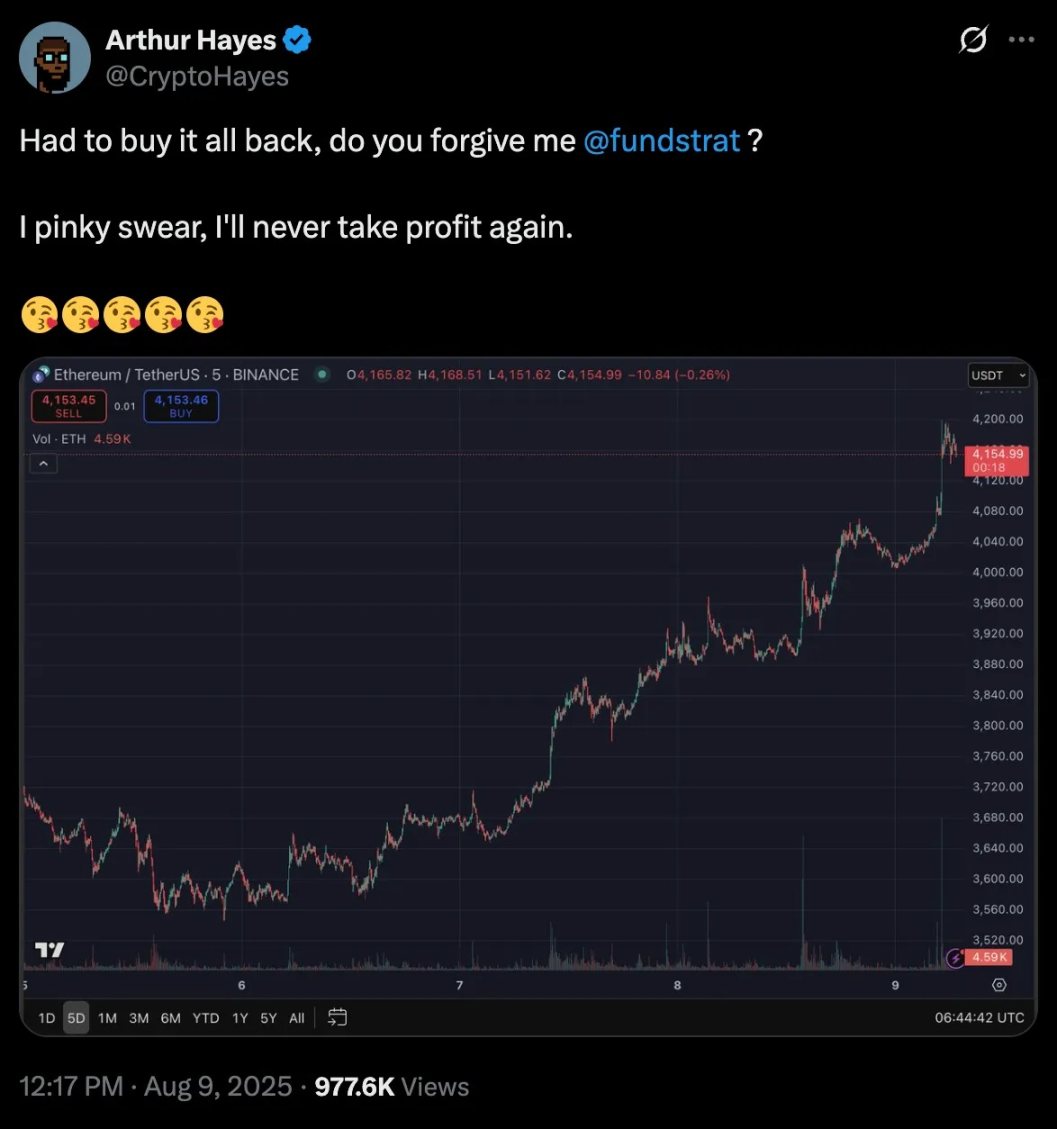
Earlier this month, he sold $8.32 million worth of Ethereum at a price of nearly $3,500 due to concerns about the macroeconomy. But when Ethereum rebounded to over $4,150, he bought back all his positions and admitted on social media: “I had to buy it all back. I swear, I will never take profits again.”
@CryptoHayes
Hayes’ current macroeconomic argument centers around his belief that the Federal Reserve will inevitably begin printing money. He points out that structural issues such as pressure in the real estate market, changes in demographic structure, and capital outflow will force policymakers to inject approximately $9 trillion into the financial system. “Without printing money, the system will collapse.” He particularly emphasizes the debt burdens of institutions like Fannie Mae and Freddie Mac.
If this scenario comes true, Hayes predicts that Bitcoin could reach $250,000 by the end of the year, as investors seek alternatives to the depreciation of fiat currencies. Based on the judgment that the current monetary system is unsustainable and that Bitcoin is the most viable alternative for value storage, he believes that Bitcoin is expected to reach $1 million in the long term by 2028.
Perpetual contracts fundamentally change cryptocurrency trading by eliminating many of the frictions present in early derivatives markets. By 2025, even mainstream platforms like Robinhood and Coinbase will be launching their own perpetual products, while new exchanges like Hyperliquid have built a complete business around Hayes’ original innovations.
The regulatory framework arising from the BitMEX case has also shaped industry standards: comprehensive anti-money laundering plans, customer verification, and regulatory registration have become essential requirements for any exchange serving the global market.
At 40 years old, Hayes occupies a unique position in the crypto ecosystem. He has experienced traditional finance before the birth of Bitcoin, has the ability to build the infrastructure that defines crypto trading methods, and has undergone both explosive success and severe legal consequences.
His story proves that in the crypto space, sustainable success requires an understanding of the balance between technology and regulation, innovation and compliance. The success of perpetual contracts is not only due to their technical ingenuity but also because they address the real problems faced by traders. At least this is the case until the regulatory framework catches up with the pace of innovation.
“Back when we built all of this, there was no need to seek anyone’s permission. In which industry can you find three ordinary people managing to create an exchange with a daily trading volume of tens of billions of dollars?” Hayes reminisces about the experience of creating BitMEX, feeling a sense of amazement.
This sentence captures the opportunities and responsibilities of building financial infrastructure in a rapidly evolving regulatory environment.
Today, Hayes is still analyzing the market and making heavy bets based on macro judgments. His influence has long surpassed individual trades or investments. Through articles, investments, and continuous participation in the crypto market, he remains one of the most insightful voices in this industry, which often prioritizes speculation over analysis.


