Original: Odaily Odaily Daily
Author: Ethan
In the blink of an eye, it has been three months since the USD1 airdrop was distributed. Looking back at those 47 airdrops, they seem more like a foreshadowing, quietly opening the curtain on the “family wealth script”. Last week, WLFI's TGE made a stunning debut, with the token price once halving, allowing the Trump family to harvest a large amount of traffic and funds.
But for ordinary users, beyond just watching the excitement, what is more practical is how to increase the value of their wallets. If the 47 USD1 coins remain in the wallet, they may not even cover the miner fees; however, if they are placed in a CeFi or DeFi investment pool, they may have already hatched a few “golden eggs.”
So the question arises: what are your 47 USD1 doing right now? Are they quietly “lying flat” or are they working hard? Odaily has summarized the investment strategies of USD1 in CeFi, DeFi, and points play for readers.
A Comprehensive View of USD1 Investment Opportunities from the “47” Airdrop
After continuous observation and community research, USD1 has been fully deployed on mainstream public chains such as Ethereum, Solana, Tron, and BNB Chain, and has developed diversified yield scenarios in both CeFi and DeFi, with an annualized range covering 1.7%–45%, suitable for users with different risk preferences. The following breakdown is provided from several dimensions:
CeFi: The Best Principal Protection Channel for “Lazy People”

Note: Binance Simple Earn APR is variable; HTX activity limit (20% APY for amounts below 500 USD 1, newcomers can reach up to 100%).
On centralized platforms, Binance Simple Earn is the “lazy person's standard.” Starting from 0.1 USD1, it offers an annualized return of about 13.5%, with no lock-up period and daily interest calculation, combined with irregular Yield Arena events, equivalent to “automatically leveling up by defeating monsters.”
HTX has launched a “high-interest card”, with an annualized rate of up to 20% in the stablecoin section. However, this is a subsidized behavior, suitable for short-term profit-taking, and should not be relied upon long-term.
In addition, WLFI is promoting a cross-platform USD1 points system, covering exchanges such as KuCoin, HTX, Bybit, LBank, etc. Holding, trading, or staking USD1 will accumulate points, which can be redeemed for airdrops, NFTs, or other benefits in the future.
Solana ecosystem: The source of DeFi vitality
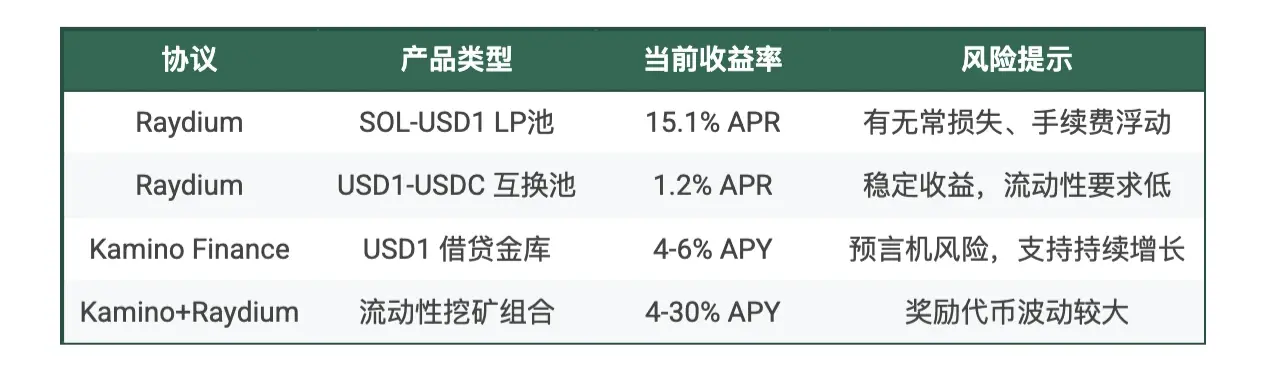
Solana is the richest ecosystem for USD1 DeFi yields. Raydium USD1-USDC pool: annualized 1.2%, almost no price fluctuation, similar to “on-chain Yu'ebao”; Raydium SOL-USD1 LP: annualized 15.1%, but must bear impermanent loss; Kamino lending vault: 4-6% annualized, no lock-up required, suitable for conservative holding, and can accumulate points; Raydium + Kamino combination pool: yield range of 4%-30%, highly dependent on reward token prices, with significant fluctuations.
Ethereum: A breeding ground for high-risk, high-reward strategies
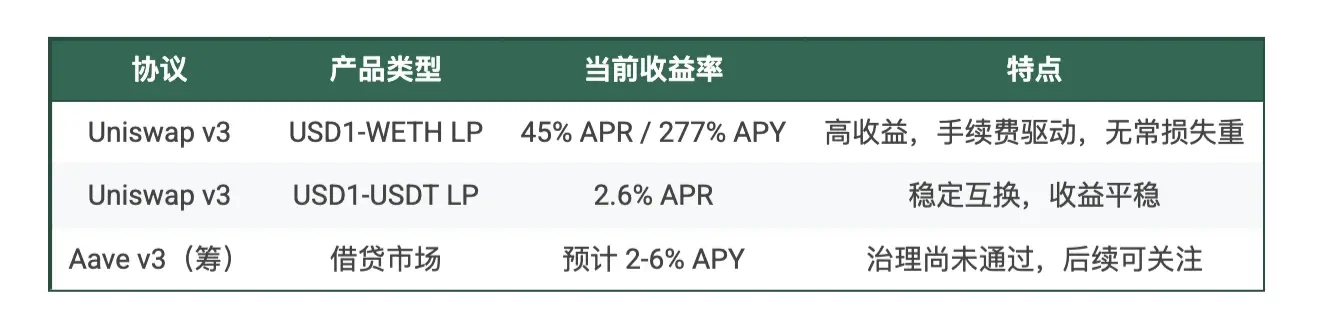
Ethereum has always been a paradise for DeFi players, but risks and rewards coexist.
- Uniswap v3 USD1-WETH LP: 45% APR / 277% compound APY, impressive returns, but subject to impermanent loss. High fees during bullish markets, and when ETH skyrockets, it may only leave stablecoins.
- Uniswap v3 USD1-USDT LP: 2.6% APR, stablecoin pair, almost no price risk, more of a “retirement type”.
- Aave v3 Lending Market (In Preparation): Expected annualized return of 2%–6%, overall risk is relatively controllable, more like a “serious financial product”, suitable for conservative investors.
Tron: Hidden Interest Rate Jump Risk
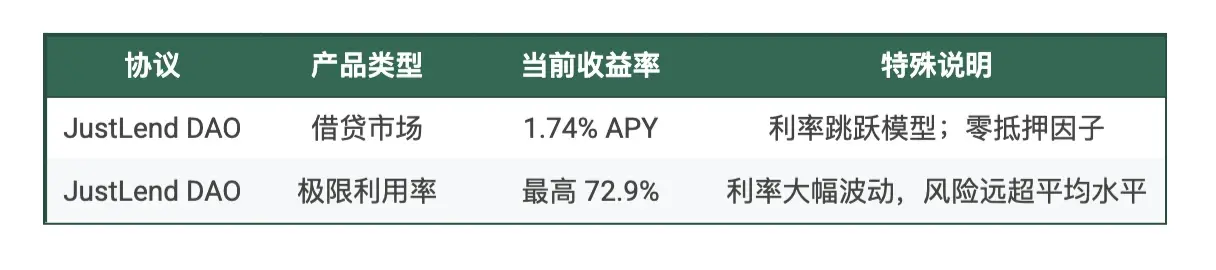
Tron's JustLend DAO offers a more “extreme” way to play. Regular Lending: Approximately 1.74% annualized return, low risk, but limited yield, similar to on-chain savings; Extreme Utilization Rate: When the pool is fully borrowed, the annualized return can soar to 72.9%. However, this state is very unstable, and interest rates can drop sharply at any time. In the morning it might be 70%, but by the afternoon it could be in single digits, so it's important to be aware of the risks.
The high yield of Tron relies entirely on the “interest rate jump model”, with volatility far greater than that of Solana and Ethereum. Conservative players may find it too stimulating, but short-term speculators who monitor the market diligently may find their “moment of thrill.”
Disclaimer: The information on this page may come from third parties and does not represent the views or opinions of Gate. The content displayed on this page is for reference only and does not constitute any financial, investment, or legal advice. Gate does not guarantee the accuracy or completeness of the information and shall not be liable for any losses arising from the use of this information. Virtual asset investments carry high risks and are subject to significant price volatility. You may lose all of your invested principal. Please fully understand the relevant risks and make prudent decisions based on your own financial situation and risk tolerance. For details, please refer to
Disclaimer.


