Author: Felix, PANews
“From $0.1 to $1000, we've come a long way, but this is just the beginning.” Binance founder CZ wrote on social media. As CZ subtly changed his X account bio from “ex-@binance” back to “@binance”, the community erupted, with some shouting “CZ is back” and others excited about BNB's impressive performance.
Last Thursday (September 18), BNB strongly broke through $1000, setting a new historical high; it continued to rise over the weekend, reaching a peak of $1076.3, with its market capitalization temporarily surpassing $150 billion, overtaking traditional industry giants like Accenture and BYD, and climbing to the 143rd position in the global asset rankings. Behind this is not only the explosion of market sentiment but also a value reshaping propelled by the easing of regulatory pressures, the entry of traditional institutions, the expansion of the ecosystem, and its own deflationary mechanism.
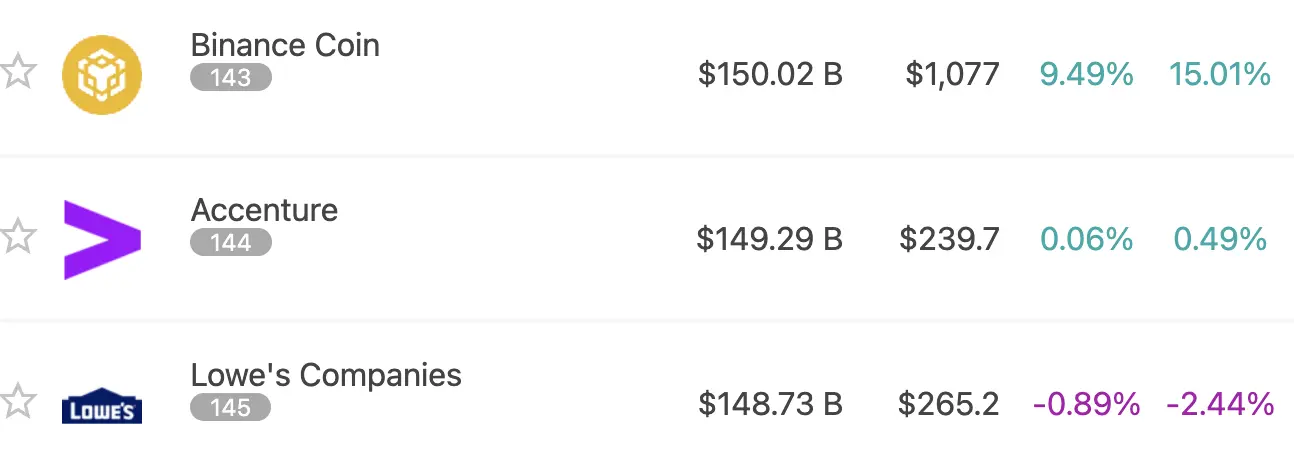
Image source: 8marketcap
The fact that BNB was able to “ride ahead of the pack” in this cycle is not due to a single factor, but rather the result of multiple favorable factors resonating together.
The regulatory environment has significantly improved, could CZ possibly “return” to Binance?
After taking office, President Trump of the United States implemented a more favorable cryptocurrency policy, creating a positive regulatory atmosphere that provided a better external environment for the development of Binance and many cryptocurrencies like BNB. Looking globally, Binance has now obtained regulatory licenses in 21 countries or regions and is actively cooperating with regulatory agencies around the world.
Under this macro “tailwind”, the United States has further relaxed regulatory requirements on Binance, alleviating the long-standing uncertainties hanging over the market. According to Bloomberg, insiders revealed that Binance is negotiating a potential agreement with the U.S. Department of Justice, which could lead to an early end to the compliance monitoring period that began in 2023. This development greatly enhances the market's confidence in Binance's future growth.
This news broke not long ago, and Binance founder CZ has updated his social media profile to associate it again with the official Binance, changing his X account personal description from “ex-@binance” to “@binance”. This move has sparked speculation in the market about his potential return to Binance under a new identity. Although there has been no official statement, this action is interpreted by the market as a positive signal, boosting investor sentiment and becoming one of the catalysts for BNB's rise.
In this regard, CZ tweeted this morning, “The new U.S. government that supports cryptocurrencies could be the biggest driving force for BNB to break through $1000. Its stance not only affects the United States but also impacts most countries around the world. Now, most countries have adopted a pro-cryptocurrency stance. This is a huge boost for the industry.”
It is worth noting that the support behind this round of BNB's rise is not only the repair of market sentiment but also a series of solid fundamental factors that provide more lasting confidence for its price performance.
Expand the financial landscape, gain endorsement from traditional institutions.
On September 10, Binance and Franklin Templeton announced a strategic partnership to jointly develop products related to digital assets, aiming to promote the deep integration of traditional finance and blockchain technology.
According to the statement, the core of this cooperation is to combine Franklin Templeton's expertise in compliant security tokenization with Binance's global trading network and user base.
As the world's largest cryptocurrency exchange serving over 280 million users, Binance boasts an unparalleled trading infrastructure and a global network of investors. Meanwhile, Franklin Templeton, a traditional financial giant managing over $16 trillion in assets, has actively positioned itself in the blockchain space in recent years, showcasing diversification by tokenizing traditional financial products, providing regulated digital asset investment tools (such as ETFs), and exploring the application of blockchain in financial infrastructure.
The cooperation between Binance and Franklin Templeton is viewed by the outside world as not just a complement to each other's products, but also an acceleration of the integration between new finance and traditional finance. One side provides speed and market reach, while the other brings compliance and institutional endorsement. Both parties are committed to enhancing the efficiency, transparency, and accessibility of capital markets, as well as offering competitive returns and settlement efficiency to meet the ever-changing needs of investors.
It is worth mentioning that Binance's recent series of actions also reveals expansion signals. Not long ago, it announced a new partnership with South African payment service provider Zapper. Starting from September 9, more than 31,000 merchants in South Africa will begin accepting Binance Pay, expanding Binance Pay's global merchant network to over 63,000. Whether partnering with Wall Street institutions or establishing payment solutions in the African market, Binance is embedding its business more into broader mainstream financial and consumer scenarios.
DAT leads the BNB accumulation trend, supported by strong companies.
Since the beginning of this year, the crypto treasury strategy represented by listed companies has become an important driving force for the rise of cryptocurrencies. Driven by this strategy, tokens such as BTC, ETH, and SOL have gradually been included in the balance sheets of many companies, including BNB. Multiple listed companies, investment institutions, and even sovereign nations have incorporated BNB into their strategic reserves, forming another force driving up the price of BNB.
At the level of sovereign economies, the newly established special administrative region of Gelephu Mindfulness City (GMC) in the Kingdom of Bhutan has included BNB in its strategic reserves. In January of this year, this special economic zone announced that BTC, ETH, and BNB would be included in its official list of strategic reserve assets. The reason given is that BNB has a high market value, good liquidity, and the underlying BNB Chain is a mature and secure network that has been tested over time. Although this is an action taken by a special economic zone and not by the Kingdom of Bhutan as a whole, it has greatly boosted market confidence in BNB. Additionally, there are reports that Binance founder CZ has proposed to the Kyrgyz government to consider BNB in its planned national-level cryptocurrency reserves, but there has been no public progress on this matter.
In contrast, public companies are the main force in purchasing BNB. Currently, several publicly traded companies in the U.S. have announced that they will use BNB as a strategic reserve asset, and some companies even consider it as a core business direction. For example:
- BNB Network Company (BNC, formerly CEA Industries): Currently the “number one fan” of BNB, supported by YZi Labs, it has completed a $500 million private placement financing, aiming to become the world's largest BNB reserve publicly listed company. The company has also directly renamed itself to BNB Network Company, with the stock code changed to “BNC”. As of September 10, the total amount of BNB held by BNC has reached 418,888 coins.
- Web3 infrastructure company Nano Labs (NA): The company plans to invest $1 billion in purchasing BNB over the next three years, with a goal of holding 5%-10% of the total circulating supply of BNB. According to the company's financial report for the first half of the year, it currently holds 128,000 BNB.
- Biopharmaceutical company Windtree Therapeutics (WINT): The company had announced that it signed a common stock purchase agreement of up to $500 million to establish an equity line of credit (“ELOC”) and strengthen its BNB cryptocurrency funding strategy. The company also signed an additional stock purchase agreement worth $20 million with Build and Build Corp. 99% of the funds raised from ELOC and Build and Build Corp will be used to acquire BNB.
- Biopharmaceutical company Liminatus Pharma (LIMN): The company plans to establish a wholly-owned subsidiary named “American BNB Strategy” with the aim of raising $500 million through this entity for long-term strategic investment in BNB.
- Huaxing Capital: The company has signed a strategic cooperation memorandum with YZi Labs, investing approximately 100 million USD for the special allocation of BNB assets, and promoting the listing of BNB on licensed virtual asset exchanges in Hong Kong, becoming the first Hong Kong-listed company to include BNB in its digital asset allocation.
In addition, some investment institutions have also launched funds or investment tools focusing on BNB:
- B Strategy: A digital asset investment company plans to raise $1 billion to establish a BNB reserve company listed in the United States. The plan has received strategic support from YZi Labs, which not only holds BNB but will also invest in and support the development of the BNB ecosystem.
- Hash Global BNB Yield Fund: Hash Global has launched a compliant BNB Yield Fund, which plans to expand its managed scale to $3 billion within three years.
Regarding the BNB treasury company (DAT), CZ stated in a video conversation that he has contacted about 50 potential teams, but cannot provide support to all BNB DAT companies, and will only support a few strong companies.
In addition to BNB DAT, the BNB ETF has also provided potential support for the rise of BNB to some extent. Currently, two institutions have submitted applications for the BNB ETF to the U.S. SEC, namely VanEck and a joint application from REX Shares and Osprey Funds. These applications aim to provide investors with a channel to invest in BNB through traditional stock exchanges and may include staking yield features.
If approved, the BNB ETF will provide traditional investors with a regulated and familiar investment channel, likely bringing new capital inflows to BNB and enhancing its market recognition and liquidity.
Technical Upgrade and Deflation Mechanism
The value support of BNB comes not only from the increased holdings by external institutions and companies but also from the technological advancements and optimization of its own ecosystem's economic model.
As the native token of BNB Chain, BNB's innovation and high performance are closely linked to the excellent performance of BNB Chain. BNB Chain completed the Maxwell hard fork upgrade on June 30, significantly enhancing network performance by increasing block speed and validator collaboration capabilities. After the upgrade, the block time on the BNB Chain network was reduced to 0.75 seconds, and the final transaction confirmation time was accelerated to 1.875 seconds, greatly improving user experience. The Gas fees on the BNB Chain were also reduced by 10 times, making it one of the blockchains with the lowest fees.
In addition, unlike the common sandwich attacks and front-running seen on EVM chains such as Ethereum, as well as the large-scale arbitrage and spam attacks faced by blockchains like Solana, BNB Chain excels in resisting MEV (Miner Extractable Value) attacks. Developers, nodes, block builders, wallets, DEXs, and other participants on BNB Chain have invested significant effort to reduce MEV attacks.
In terms of products, WLF issued the first native stablecoin USD1 on the BNB Chain, further enhancing the liquidity of on-chain stablecoins; multiple RWA issuers have deployed on the BNB Chain, which not only enriches the assets of the BNB Chain but also increases the BNB Chain's visibility in traditional fields.
The deflationary mechanism of BNB continues to contribute to its price increase. Binance's ongoing token burn plan gradually reduces the circulation of BNB, benefiting long-term holders. On July 10, the BNB Foundation completed its 32nd quarterly burn, totaling 1,595,599.78 BNB. After this burn, the total supply of BNB remains at 139,289,513.94 BNB. The dual support of deflation and network upgrades provides a solid foundation for the price of BNB.
With so many positive factors, OSL HK also opened BNB trading services for professional investors on September 3, becoming the first exchange in Hong Kong to support BNB.
Conclusion
In summary, the recent price increase of BNB is not accidental. Favorable factors such as easing regulatory pressure, deepening collaborations with traditional institutions, increased institutional investment, and its own deflationary mechanism have provided multiple supports for its value. The BNB price breaking through 1000 dollars is more like a market affirmation of BNB's fundamentals and ecological potential, and perhaps it has not yet reached its true limits.
However, the cryptocurrency market is volatile, and investors need to remain cautious in the short term. In the long term, BNB is closely linked to Binance's operational status, and there is still uncertainty regarding future regulatory trends. Furthermore, whether it is BNB Chain or CEX operations, there will also be fierce competition from other public chains and exchanges (CEX and DEX) in the future.
As CZ recently stated, “This is just the beginning.” Therefore, although BNB is currently the “darling” of the crypto market, PANews advises users to view the market rationally, avoid chasing highs and falling into FOMO, and focus on long-term value and ecosystem development.
Related reading: In the wave of institutional accumulation of BNB, what opportunities do retail investors still have?


