Author: Jeff Dorman, Chief Investment Officer of Arca
Compiled by: Felix, PANews
With Bitcoin hitting new highs and cryptocurrencies sweeping Wall Street and Washington, now is a great time to explain cryptocurrency investment to those around you again. Most “industry experts,” crypto KOLs, and mainstream media do a poor job of explaining this asset class to new investors, and the constant misinformation can deter more people rather than excite them.
Most people don't even know about the world of token investment (aside from Bitcoin and meme coins). But now, with ETH, SOL, BNB, HYPE, stablecoins, and Polymarket appearing in the news every day, they are starting to pay attention. Investors are not concerned about the underlying technology, liberal ideals, or decentralization. They care about how to achieve growth and profits.
In the past decade, I have been communicating with new cryptocurrency investors, and the explanation below resonates with them the most, as it explains cryptocurrency investment in a way that investors can understand. Even those who come with preconceived negative views will understand this industry after reading the explanation below.
So, if you want to try explaining blockchain to the public again, here is the simplest (and also the fastest) explanation I have personally discovered.
**Beginner's Guide:**5 Minutes to Understand Blockchain
- The internet enables you to communicate instantly, without borders, and at no cost.
- Blockchain enables you to send assets instantly, borderless, and at no cost.
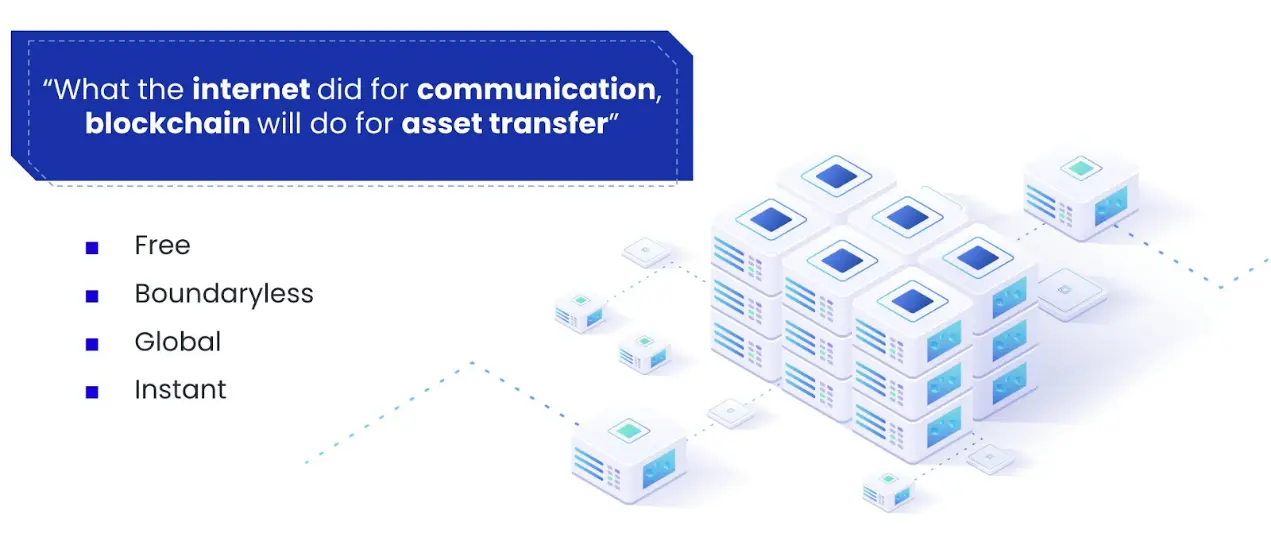
The first asset sent via blockchain is a completely fictional cryptocurrency called Bitcoin (BTC), which is sent through the newly created Bitcoin blockchain. Bitcoin is the biggest outlier / smokescreen in investment history. Its success is miraculous and unique and should not be studied or applied to anything else. While Bitcoin assets and the Bitcoin blockchain are the first pioneers, it does not mean that it is the only blockchain or asset that can be sent in a similar way. Bitcoin showcases a single use case of this technology, but it is not the only one. Similarly, SPY is the first exchange-traded fund (ETF) in the United States, but since then there have been many other products that can be wrapped in an ETF.
Other blockchains (such as smart contract platforms like Solana and Ethereum) are more flexible than the Bitcoin blockchain, allowing for the creation and transfer of other assets. In fact, you can think of smart contract platform protocols as an app store that anyone can develop applications for. Just like your app store gives you access to banking, games, maps, collectibles, and social applications on IOS or Android operating systems, your smart contract platform protocols give you access to banking (DeFi, stablecoins), games (Polymarket), collectibles (NFTs), maps (Hivemapper), and social (Pump.Fun) blockchain applications.
- Encryption Application = Company
- Smart Contract Protocol = App Store

Blockchain has its own tokens, just like Apple and Google have their own stocks, but many applications within these platforms also have their own tokens. If the token economics are designed properly, they can become a form of quasi-equity for the business. This is no different from many publicly traded companies having their own stocks for their IOS or Android applications.
The applications on your phone create value for Apple or Google, just as these crypto applications create value for the blockchain protocols they are based on. When applications are used (generating revenue), both the application companies and the stocks (or tokens) of the operating systems/blockchains appreciate in value. Of course, since any asset can be created out of thin air and transferred via blockchain, there will also be some “junk” assets (like meme coins) or assets that are loosely associated with a company but have no value drivers for the tokens themselves (like XRP). Tokens come in various forms, largely depending on who issues them and how the tokenomics are structured.
But aren't most crypto startups bound to fail? Of course, just like the “dot-com bubble” period gave rise to a variety of startups, but most failed to thrive, most native crypto blockchains and applications will also fail. However, the development of blockchain is about to bid farewell to the “.-crypto” phase (where all investable tokens are issued by some emerging cryptocurrency companies) and enter a new stage, where those century-old establishments (companies) will also adopt blockchain technology and issue tokens. Nowadays, no one would call a company an “internet company (.com)” because every company is an “internet company (.com)”. Every business operates online. Walmart, JPMorgan Chase, and Domino's Pizza are all internet companies today, even though they existed before the internet came into being; they were not born because of the internet but grew stronger with the help of the internet. The crypto space will soon be the same.
Approximately 99% of global assets (stocks, bonds, and real estate) have not yet been transferred via blockchain. However, these assets are likely to be tokenized and transferred through blockchain in the near future, thereby replacing a large number of meaningless cryptocurrencies that exist today.
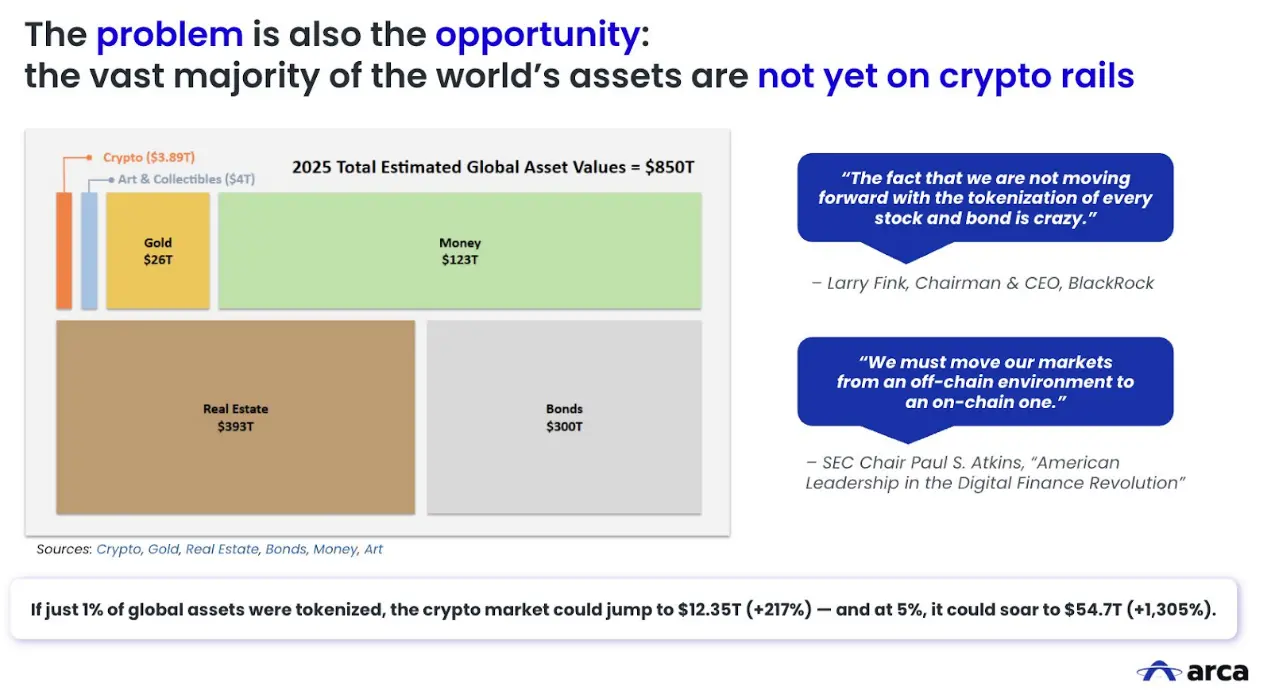
Today, a company can both tokenize existing assets (such as stocks and bonds) and issue new tokens as hybrid tokens. In the future, every company, university, municipal authority, celebrity, organization, and sports team will inevitably issue their own tokens, which can become a third asset in their capital structure.
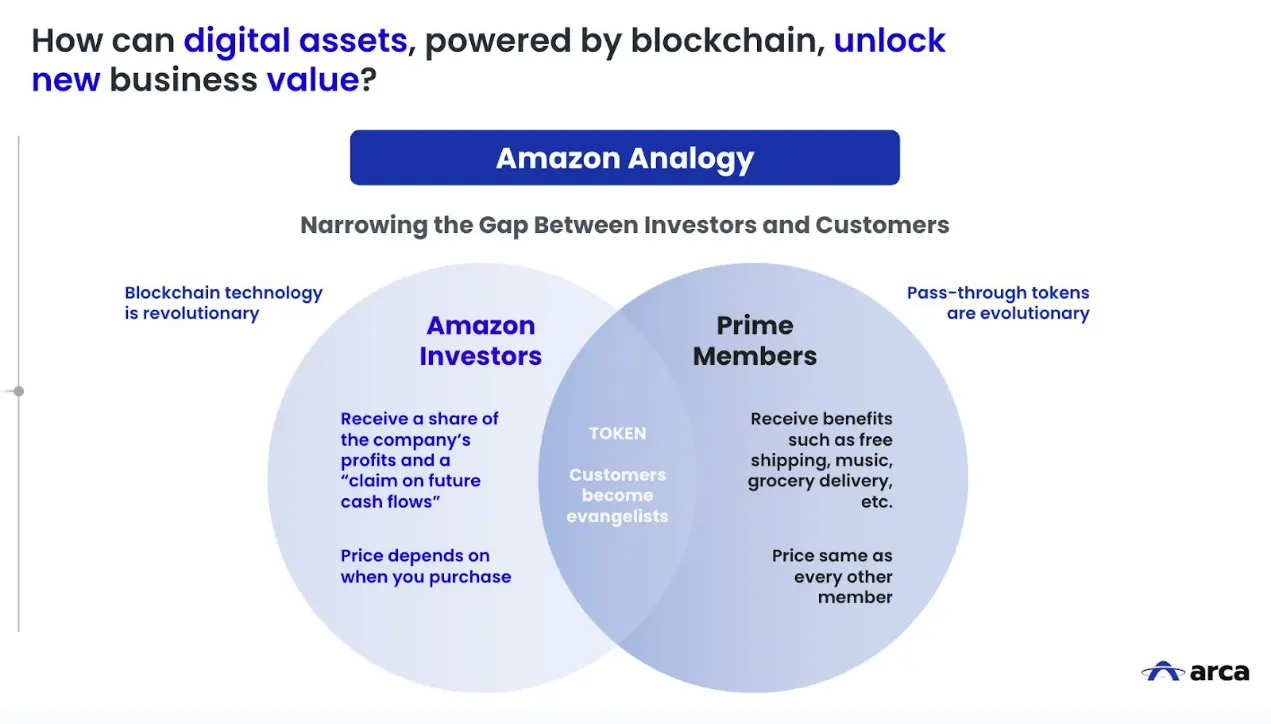
- Stock = Claim on cash flow
- Bond = Right to claim against an asset
- Token = a mixed claim of entitlement to income growth and loyalty reward cards used within the company ecosystem.

These tokens are typically the most powerful capital formation and customer engagement mechanisms created to date, as they unite all customers and stakeholders, making them promoters and loyal users. Tokens serve both as a means of benefiting from the company's success and as a medium of exchange for the company's services. This is in stark contrast to today's corporate structures, where investors and customers often stand in opposition to each other.
- McDonald's shareholders are not customers, and McDonald's customers are not shareholders.
- Uber drivers and passengers cannot benefit from Uber's success.
- Delta Air Lines SkyMiles members do not care about Delta Air Lines' profits or growth, and therefore will not help Delta Air Lines to develop; Delta Air Lines shareholders also do not care about customer experience.
- Content creators will not benefit from the success of Twitter and Instagram.
- Chefs and delivery drivers will not benefit from DoorDash's success.
Tokens can immediately change this situation. Take Binance or Hyperliquid as examples—customers of these exchanges are early token holders (through trading or airdrops). You can use HYPE and BNB tokens as collateral to trade on the exchange and profit from their growth through token buybacks. Therefore, customers effectively become quasi-equity holders, benefiting from the company's financial success, which drives increased product usage, higher revenue, and subsequently pushes up token prices. However, as customers of its products, you can also benefit from holding HYPE or BNB tokens (through discounts, collateral, and paying Gas fees on its blockchain). This is a perfect hybrid model that immediately aligns all stakeholders and transforms customers into loyal users and promoters.
In this way, one can imagine a world where your investments and payments become the same type of asset. For example, buying a real Tesla with TSLA stock, or paying for your Amazon shopping with AMZN stock.
This establishes an extremely simple investment philosophy for the next five years, eliminating most of the “nonsense” in cryptocurrency investing.
Investment Philosophy
Blockchain technology has proven to be extremely efficient in asset transfer and trading, but most of the world's popular assets (stocks, bonds, real estate) are currently unable to circulate on the blockchain (mainly due to regulatory and workflow issues). As barriers between crypto-native assets and traditional financial assets are broken down, more and more tokenized assets will be issued, transferred, and traded on-chain.
Beneficiaries will be specific smart contract platform protocol blockchains (L1) that support this growth and trading, DeFi applications built on these chains, stablecoins and stablecoin providers on these chains, as well as a select few applications that help you navigate on-chain in segments like gaming and artificial intelligence. However, it is difficult to determine which chains will prevail, as there are currently almost no assets on-chain in the world. If large asset issuers like the U.S. government, Walmart, JPMorgan, and Apple suddenly decide to issue assets on a certain L1, that L1 could become the most important blockchain overnight.
Even now, the outside world has not yet witnessed the true potential of blockchain, as the majority of global assets have not yet been integrated into blockchain systems. So far, everything that has happened in the blockchain field has largely been experimental, serving as a trial run before the arrival of true giants (stocks, bonds, real estate, and new tokens issued by companies, universities, municipal authorities, sports teams, etc.).
Therefore, although cryptocurrency traders often become obsessed with short-term trading, chasing those flashy and worthless tokens (like meme coins), the concept of long-term investment revolves around a mundane, globally accepted, and permissionless financial system that can make investing, banking, and consumption more efficient and transparent.
Related reading: Halving narrative and liquidity resonance, will Q4 2025 become the ultimate carnival of the bull market?


