Author: Benson Sun

Introduction
A few days ago, the cryptocurrency market experienced the largest liquidation wave in history. Many analysts, including myself, first noticed that the USDe stablecoin decoupled significantly on Binance.
At that time, we speculated that this was due to the circular loan liquidation caused by Binance's 12% annual yield USDe promotional campaign.
In retrospect, this theory is incorrect. Decoupling is not the cause, but rather the result. The market had already collapsed before the fluctuations occurred in USDe.
Two-Minute Fault Line
Between 21:18 and 21:20 UTC, Binance experienced an abnormal synchronization of liquidity withdrawals. The order book was nearly drained, and the market briefly fell into a complete vacuum.
When risk events strike, it is normal for market makers to widen spreads and temporarily withdraw capital. But this is not just ordinary caution; it is a complete disappearance.
It was expected that there would be a slight contraction in liquidity from the time Trump announced tariffs at 20:00 UTC to one hour later when the market crashed. However, the scale of events that occurred in those two minutes far exceeded what could be explained by “risk management.”
Background of the Crash
Is Trump's last-minute tariff announcement detrimental to cryptocurrencies?
Of course not beneficial.
However, compared to historical crises—the COVID-19 crash in March 2020, the LUNA crash, or the FTX crash—those crises were much more severe, yet none triggered such extreme liquidity withdrawals in such a short time frame.
The top two assets, BTC and ETH, have remained relatively stable due to benefiting from deep off-exchange liquidity. However, altcoins that rely entirely on on-exchange market makers have become the biggest victims of this liquidity vacuum.
Binance, long known for its deep spot liquidity, has seen unprecedented price dislocations for multiple tokens. As the largest offshore exchange in the world, its massive influence has led to similar collapses in USDT-based trading venues, while the dollar remains relatively stable against trading platforms.
For example, $XRP :
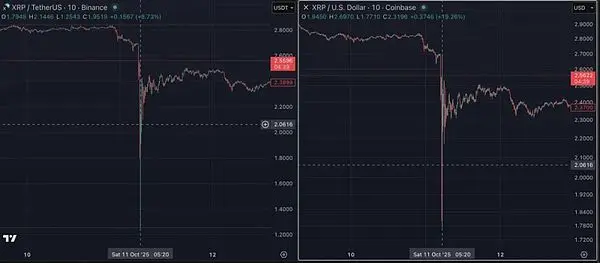
- Binance lowest price: 1.2543 USD
- Coinbase Lowest Price: 1.7710 USD
- The gap between the two is about 41.2%—a difference that is almost unimaginable under normal market conditions.
$ATOM is another more extreme example:
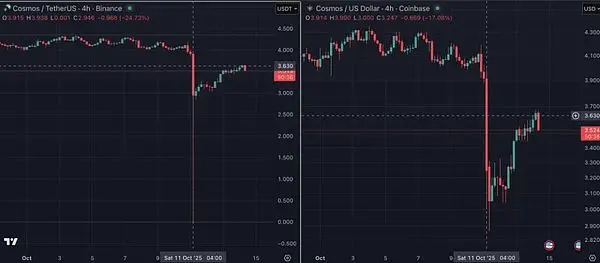
- Binance minimum price: 0.001 USD
- Coinbase lowest price: 2.872 USD
- For the token ranked 54th by market capitalization, the price difference is as high as 2,871 times.
Questions that go unanswered
Three days after the incident, the crypto community (CT) is still obsessed with the superficial narrative:
- The debate about whether the decoupling of USDe is the responsibility of the project team;
- The $280 million compensation from Binance is a topic of debate worth praising or sparking anger;
- The crazy speculation about whether the anonymous whales shorting early on Hyperliquid are related to the Trump family.
However, almost no one has asked the only truly important question - what exactly happened inside Binance's trading system between 21:18 and 21:20 UTC?
This is not a typical chain reaction of liquidations triggered by panic.
The synchronicity of Binance's liquidity crash during these two minutes exceeded any previous market crisis.
If this is just a collective withdrawal of liquidity by market makers for hedging, similar signs should also appear in other exchanges.
But the fact is not so - no other exchange has experienced such a large vacuum in the spot market.
Binance's role in the cryptocurrency space is similar to that of CME in the global commodity market—it is both a center for price discovery and a pillar for clearing in the entire ecosystem.
Binance's role in the cryptocurrency space is similar to that of the Chicago Mercantile Exchange (CME) in the global commodities market—it's both a center for price discovery and a clearing pillar for the entire ecosystem.
Imagine this: if one day, the price of crude oil or gold on the Chicago Mercantile Exchange suddenly plummets to a level far below other market quotes, triggering large-scale liquidations and margin calls across the entire market, regulators around the world would demand a comprehensive and transparent investigation.
However, similar scale events in the cryptocurrency field have been met with silence.
The world's largest exchange experienced a systemic collapse of spot prices in just two minutes, and to date, no specific post-analysis or technical explanation has been released.
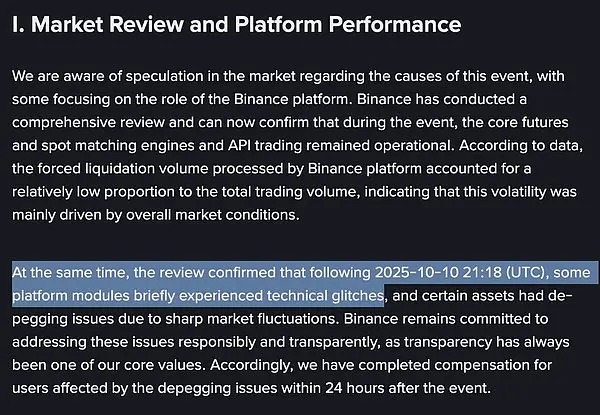
Binance's response - which vaguely mentioned “temporary issues with certain trading modules” - offered little explanation of what had occurred.
This is not an ordinary flash crash.
This is the largest liquidation wave in the history of cryptocurrency - this event shook the structural foundations of the market:
- Mass liquidation - hundreds of thousands of traders wiped out in minutes, hundreds of billions of dollars evaporated from the system.
- Losses of Market Makers - According to reports, several major liquidity providers have suffered losses of billions of dollars due to a reduced order book and widened spreads.
- The Collapse of Delta Neutral Funds - Countless short positions of Delta neutral funds were forcibly liquidated (ADL), leading to their long positions being fully exposed, triggering a chain reaction of losses across the entire market.
If such a significant event can be so lightly overlooked, how can market participants continue to trust the industry?
I personally did not suffer significant losses in this incident.
Binance has long been my primary exchange. Before the incident, I had about 15% of my portfolio stored there — but later I moved those assets elsewhere.
The issue is not the loss itself, but the lack of a sense of responsibility.
Several core metrics of CoinKarma rely on data obtained directly from the Binance market API endpoints.
For researchers, developers, and quantitative teams like us, Binance's trading data is not just market information—it is the infrastructure that supports our entire research framework and strategy validation process.
However, when an unprecedented systemic anomaly occurs, society is unable to provide even the most basic technical explanation.
There are no analysis reports, no data transparency, and no insights on why the world's largest exchange experienced a market vacuum in just two minutes.
I am not a conspiracy theorist, nor do I believe that Binance has any motives to manipulate the market for profit at the expense of its own users or to deliberately target market makers.
If that is true, Binance could never achieve its current status - let alone become the largest exchange in the world.
The reason Binance has developed to its current scale is based on making wise and decisive choices at critical moments over the long term.
For this reason, I sincerely hope that Binance can proactively provide a comprehensive post-event explanation:
The status of the internal trading system between 21:18 and 21:20 UTC time.
how its matching and risk control modules operate, and
And why is its price so different from its peers?
This is not just a matter of trading risks; it is about transparency and systemic trust.
If the world's largest exchange experiences the most severe spot price collapse in the history of cryptocurrency and chooses to downplay the fact that its prices are far lower than its peers, it will expose every participant in the cryptocurrency industry to an unavoidable systemic risk.


