Recently, the popularity of the prediction market sector has surged. At the beginning of October, the parent company of the New York Stock Exchange, ICE, announced an investment of up to $2 billion in Polymarket, with a post-investment valuation of approximately $9 billion; a few days later, the U.S. compliance prediction market Kalshi also completed a $300 million financing round, with its valuation rising to $5 billion.
With massive financing, leading platforms like Kalshi and Polymarket have seen a surge in trading volume. Kalshi expects its annualized trading volume to reach $50 billion this year, with a global market share exceeding 60%, surpassing Polymarket for the first time.
In the context of the cooling crypto narrative and tightening regulatory scrutiny, why is the prediction market being brought up again? Has its product form truly undergone a qualitative change? What new generation projects are attempting to break away from the old path of 'speculative games'?
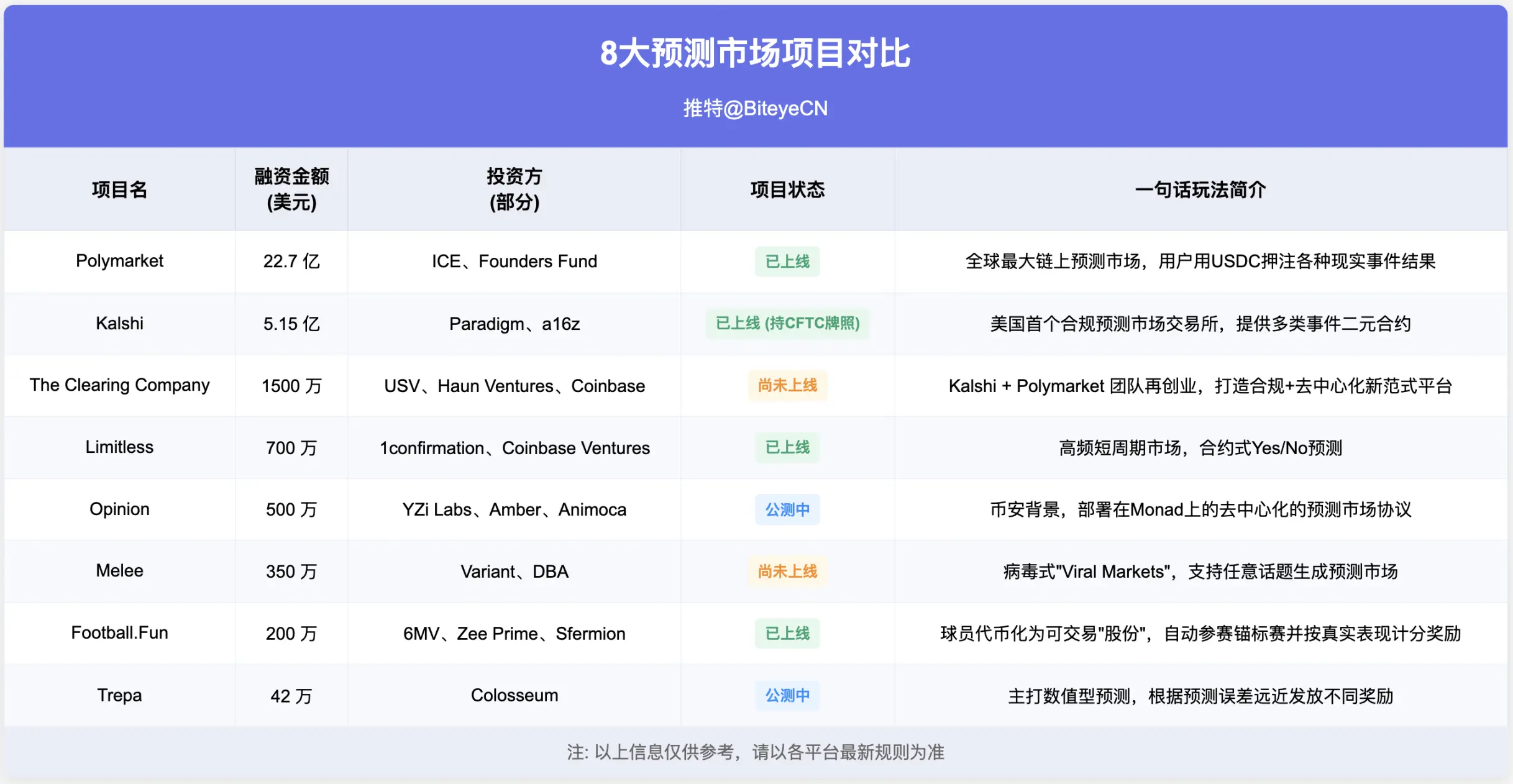
The following are 8 representative project samples, from which one can glimpse the different orientations in product design, Compliance games, and financing logic in this track.
1. Polymarket
Polymarket is currently the largest prediction market platform in the world, having received a massive $2.279 billion in funding. In October, the parent company of the New York Stock Exchange, ICE, committed to invest up to $2 billion, bringing Polymarket's pre-investment valuation to $9 billion.
Polymarket was founded by Shayne Coplan in 2020. Shayne got involved in Ethereum ICO investments during high school and is regarded as a “prodigy” in the crypto space. In response to regulatory pressures, Polymarket acquired the CFTC-licensed derivatives exchange QCEX for $112 million in 2025, thus gaining the qualification to operate legally in the U.S. Polymarket is a classic prediction market where users can bet on the outcomes of various real-world events using cryptocurrency, participating in the market by purchasing “prediction shares,” each representing a bet on a specific outcome. When the event's outcome is revealed, users holding shares of the correct outcome will receive corresponding returns. The entire trading process is conducted on-chain, settled in USDC, ensuring both the stability of funds and enhancing transparency.
2. Kalshi
Kalshi is the first licensed compliance comprehensive prediction market exchange in the United States, having raised $515 million in funding, led by Paradigm and a16z.
Kalshi was founded in 2018 by Tarek Mansour and Luana Lopes Lara at the Massachusetts Institute of Technology. The two founders chose a challenging but Compliance path, engaging in a long-term game with the Commodity Futures Trading Commission (CFTC), ultimately becoming the first prediction market platform to obtain regulatory approval from the CFTC.
Kalshi has opened the U.S. market since 2021, offering event contracts in various categories such as political elections, economic indicators, and sports events. In 2024, it won the qualification to launch U.S. presidential election contracts through litigation, filling the Compliance gap.
3. The Clearing Company
The Clearing Company is a prediction market launched by the former teams of Kalshi and Polymarket, having raised $15 million in funding. CEO Toni Gemayel has previously served as the platform growth lead for both Kalshi and Polymarket.
The platform is currently in the preparation and development stage. The team places great emphasis on simplifying the user experience, hoping that the new product will be as easy for ordinary users to use as Robinhood or Coinbase. They also emphasize designing compliant products. From the concept perspective, these products attempt to find a compromise between the two ends, not straying too far from regulatory requirements while striving to lower the user understanding threshold. However, whether they can truly establish an effective market ecosystem remains to be seen.
4. Limitless
Limitless is a high-frequency prediction market that offers short-term price prediction contracts ranging from minute-level to daily. It has raised approximately $7 million, with investments from renowned crypto funds 1confirmation and Coinbase Ventures, and was founded by CJ Hetherington and others in 2023.
Limitless will officially launch on the Base mainnet in May 2025, and will subsequently expand to layer twos such as Arbitrum. The product form is closer to a traditional exchange, allowing users to bet “Yes/No” in short-term price markets with a preset expiration time, and the results will be determined by on-chain oracles at settlement.
From the data performance perspective, Limitless has created a large number of ultra-short-term trading scenarios, where some users utilize quick and clear results for short-term arbitrage. However, this has also led to criticism within the community: some users pointed out that the platform once launched markets with predetermined outcomes or those that were almost impossible to occur, and did not charge fees, such as the BTC price market within 1.5 hours. This “fixed outcome market” has been abused by arbitrageurs to inflate trading volume. Currently, the team has responded that they have optimized the market generation rules to eliminate such situations.
5. Opinion
Opinion Labs (O.LAB) has currently raised $5 million in funding, led by YZi Labs, with other investors including Echo, Animoca Ventures, Manifold Trading, Amber Group, and others.
Currently, in terms of progress, Opinion has launched a prediction market on the Monad testnet to collect community feedback and has a collaboration background with Binance Labs.
6. Melee
Melee is a new prediction market backed by Variant Fund, claiming to create “Viral Markets” - allowing any topic to generate a prediction market and gain traction through viral dissemination. It has currently completed a $3.5 million funding round, with investors including Variant and DAO Builders Alliance (DBA). Co-founder and CEO Max previously served as the strategic head at Ava Labs and has also founded a short video influencer brand, possessing unique insights into community operations and business strategies.
As of now, Melee is still in the development and pre-heating stage, and the product has not officially launched yet. The official website currently only provides an entry point for waiting list registration, and you can join the candidates by binding your X account. According to official sources, the “viral market” concept advocated by Melee includes three major features: any topic can become a market, creators can achieve a closed-loop monetization, and incentives for early participation. It is positioned at the intersection of social and prediction markets and attempts to stimulate widespread participation through the UGC (User Generated Market) model.
7. Football.Fun
Football.Fun is centered around player predictions, tokenizing real-life professional players into tradable “shares.” Users can hold player cards and earn points and settlement rewards based on their performance in real matches. Founder Adam is a member of the WolvesDAO community and has completed a $2 million seed round financing, with investors including 6th Man Ventures, Zee Prime, Sfermion, and others.
8. Trepa
Trepa focuses on numerical prediction, allowing users to make forecasts on specific values such as macroeconomic indicators, and obtain varying degrees of returns based on the size of the error. Currently, it has completed approximately $420,000 in financing, with the lead investor Colosseum being a fund created by the former head of growth at the Solana Foundation.
The Trepa team was established in Singapore in 2024, with core members having cross-domain backgrounds. It is currently in the public testing phase, where users can choose a prediction topic (mostly macroeconomic or financial data, such as the inflation rate of a certain country, GDP growth rate of a certain quarter, etc.), and then submit their predictions by dragging a numerical slider or entering specific values. Unlike traditional binary markets that only have “correct / incorrect” outcomes, Trepa adopts a continuous reward mechanism: the closer the predicted value is to the actual result, the higher the reward, and even if there is a deviation in the guess, a partial return can still be obtained.
Compliance risks, the biggest uncertainty in the track
Looking at the eight projects mentioned above, it is clear that the prediction market has shown obvious differentiation in product design and technical implementation. However, regardless of the model, the common challenge remains how regulation defines its legal attributes.
Prediction markets inherently possess the characteristics of “speculation + gambling” and are considered a sensitive industry in most jurisdictions. In the United States, a few projects like Kalshi have obtained compliance licenses, while Polymarket is also attempting to establish a legal path through acquisitions. However, many more projects remain in regulatory gray areas.
In addition, even on-chain platforms inevitably face the following risks:
- Market manipulation: A small amount of capital may affect the price direction, undermining the validity of information.
- Oracle risk: Errors in data sources or attacks can directly lead to settlement errors.
- Contract Security: Some new platforms have not completed comprehensive audits, which poses a risk of fund theft.
- Exit Difficulty: Some markets have limited liquidity, posing a risk of fund lock-up.
Based on experience, it is generally not recommended to go ALL-IN with heavy positions in prediction markets, but rather to adopt a strategy of diversifying with small amounts and multiple bets to hedge against the uncertainty of a single market. If you are eager to participate, it is also advisable for beginners to first choose a platform that is compliant and user-friendly, Polymarket is a good starting point.
In addition, the biggest barrier for newcomers is understanding the trading mechanisms and the use of technology. In the prediction market, placing an order is not as straightforward as simply buying up or down; it requires understanding the odds or prices that represent probabilities. For example, a price of 0.20 means that the market believes there is a 20% chance that the event will occur, which requires some skill in converting traditional odds. It is recommended to spend time reading the platform's beginner's guide or online popular science articles to understand the profit and loss calculations of binary markets.
In Conclusion: Is it a Tool or a Speculative Variant?
Prediction markets are not a new phenomenon. As early as around the year 2000, many think tanks and economists viewed them as one of the tools for “information integration and social consensus formation.” However, the reality is that in the past twenty years, whether in Web2 scenarios or on-chain applications, prediction markets have never achieved large-scale breakthroughs. On one hand, compliance barriers have limited their user base, while on the other hand, their speculative nature makes it difficult to gain widespread support from public institutions.
The recent resurgence of Polymarket and Kalshi may be a pursuit of new themes in the capital cycle, or it could simply be a supplement to market gaming tools. However, it is far from being a force that “changes market structure.”
The real turning point of this track lies not in the product form, but in the institutional boundaries. Before establishing a complete risk control and access system, we still need to remain calm and observe.


