1. Market Background
Recently, market rotation has accelerated noticeably, with less popular sectors showing phased activity. Leading anonymous coins DASH and ZEC initiated the rally first, followed by storage sector representatives AR and FIL, forming a short-term structure driven by “funds low absorption + oversold rebound.”
Meanwhile, mainstream coins BTC and ETH have gradually stabilized in the bottom area, with leverage clearing completed, and market sentiment shifting from extreme panic to cautious observation.
Against this backdrop, the willingness of funds to bet on undervalued tracks has increased, with anonymous and storage sectors becoming the most resilient representatives in this rebound.
2. Correlation Between Sentiment and Price
Based on hourly data, we calculated the Pearson correlation coefficient between the sentiment indicator (Emo_Z) and the next hour’s price change rate. 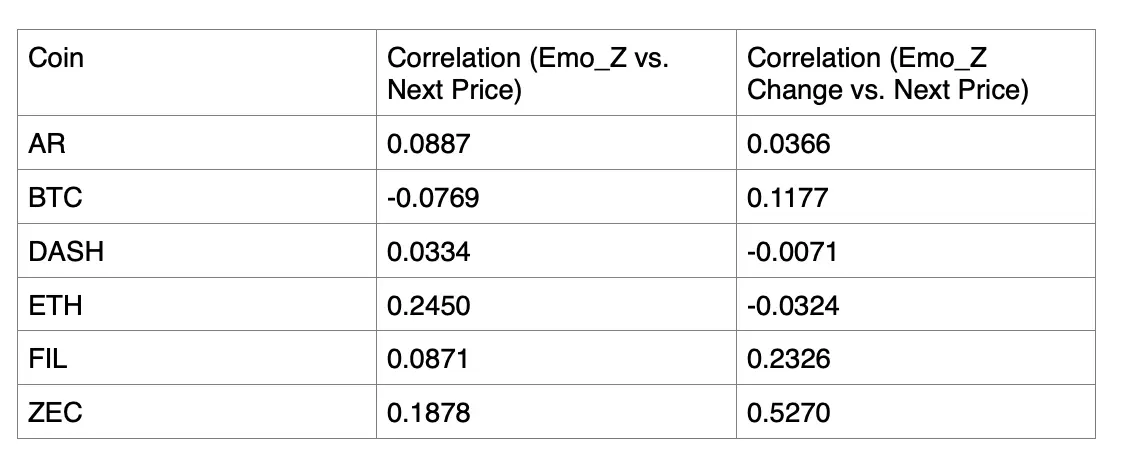
The results show that ETH and ZEC have the most prominent sentiment correlation, especially ZEC, where sentiment changes are significantly positively correlated with price changes (R=0.527), indicating that the anonymous coin sector reacts more sensitively to market sentiment fluctuations. In other words, when sentiment indicators change sharply, prices tend to respond in the short term with synchronized feedback.
3. Model Logic and Signal Interpretation
The model adopts an Correlation Adaptive Strategy Framework, which automatically switches signal directions based on the different coin types’ sentiment-price relationships:
- Trend Continuation Strategy (Momentum): When sentiment and price are positively correlated (R ≥ 0), rising sentiment is viewed as an increasing momentum signal;
- Contrarian Strategy: When sentiment and price are negatively correlated (R < 0), extreme pessimism can become a potential buy point;
- Thresholds are set at ±2, corresponding to the extreme ends of the sentiment distribution, triggering signals only when market sentiment deviates strongly.
This design allows the model to flexibly switch logic under different market environments, capturing both strong trending opportunities and reversal chances in less popular coins.
4. Backtest Performance of Signals
In the sample period in early November 2025, the model triggered 17 valid signals, correctly predicting 11, with a one-hour ahead price direction prediction accuracy of 64.71%.
Signals mainly concentrated during November 5 to November 7, during the initiation phase of anonymous and storage sectors, especially with ZEC, DASH, AR entering extreme sentiment zones multiple times.
Some typical signals are as follows:

5. Key Conclusions
- The anonymous and storage sectors led the market rotation, showing a clear oversold rebound structure;
- The sentiment indicator Emo_Z in the ±2 zone can effectively identify extreme market states, providing a quantitative reference for stage reversals;
- Funds flowed from mainstream coins to less popular ones, accompanied by rapid sentiment recovery and improved trading efficiency;
- Extreme sentiment values often lead price formation of “resonance turning points,” offering high monitoring value;
- It is recommended to closely track short-term opportunities in high-elasticity sectors like anonymous and storage when similar sentiment extremes occur in the future.
6. Charts Display
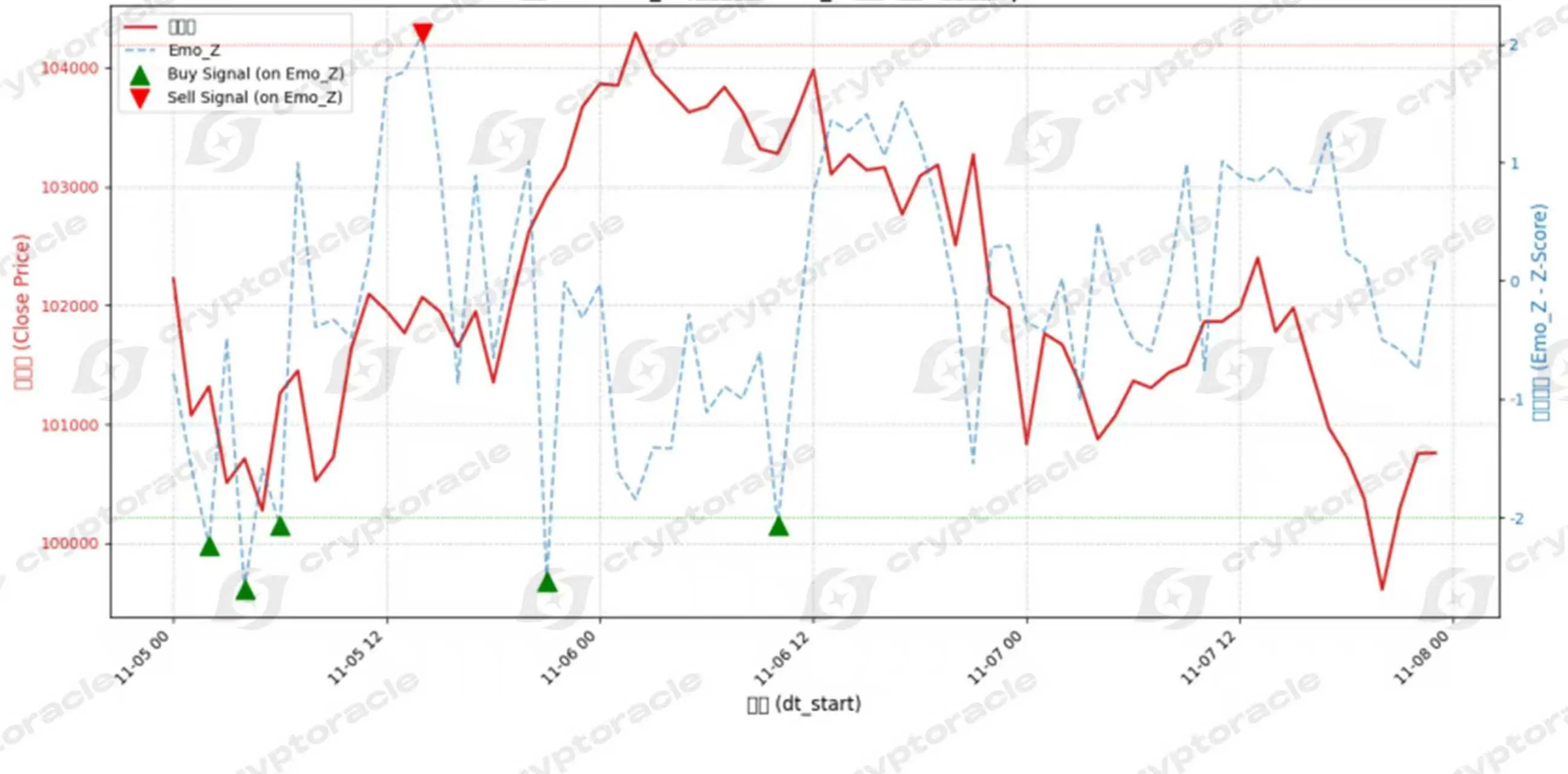
The sentiment-price dual-axis charts included in the report clearly show the distribution of signals across different stages for each coin:
BTC_Price_EmoZ_OnEmoZLine:
DASH_Price_EmoZ_OnEmoZLine:

ETH_Price_EmoZ_OnEmoZLine:
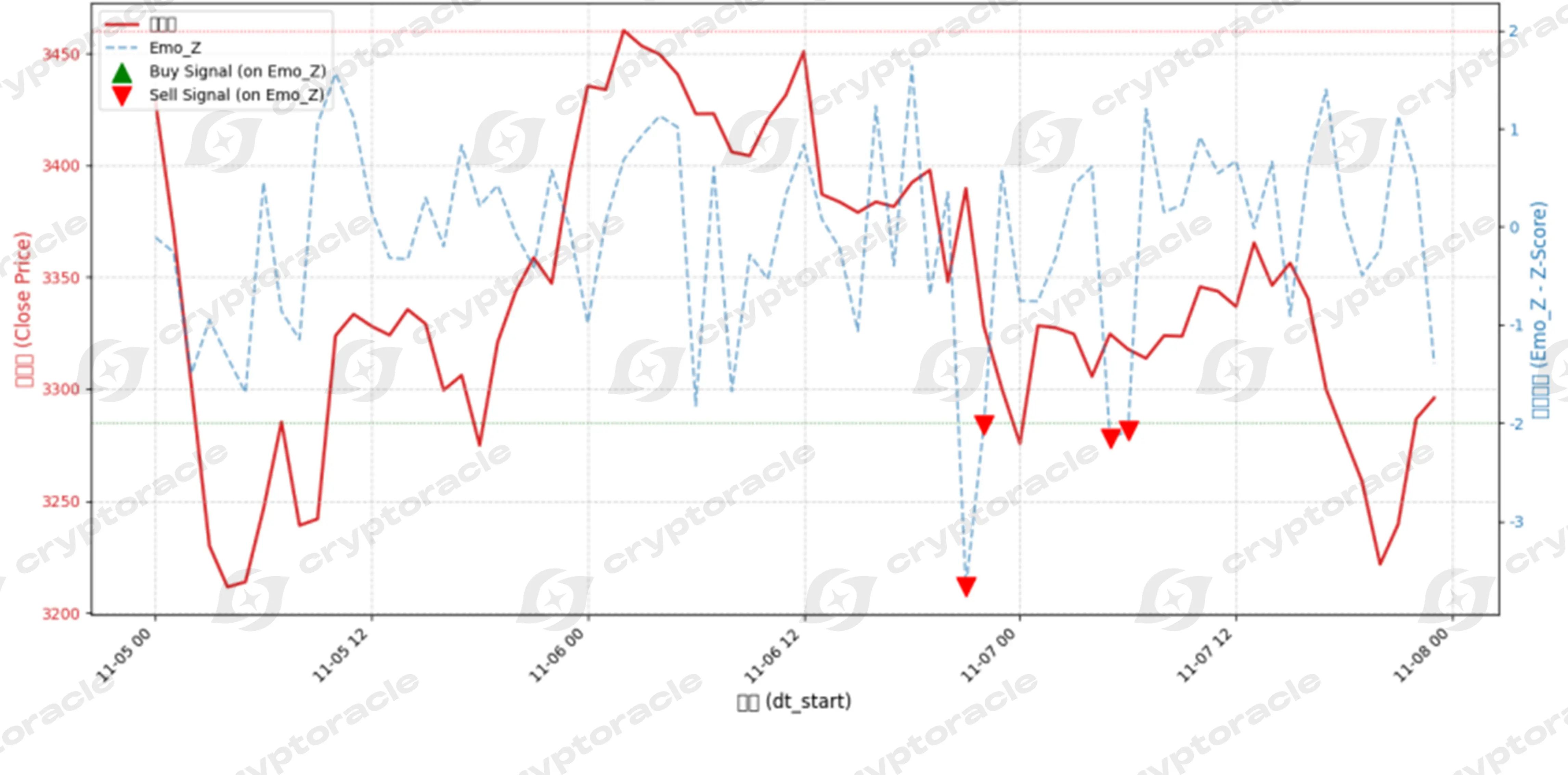
- Green Upward Triangle: Buy signals triggered during extreme low sentiment;
- Red Downward Triangle: Sell signals triggered during overheated sentiment.
It can be observed that the anonymous coins’ sentiment curves in early November showed significant turning points, with signals concentrated and having some foresight.
7. Risk Warning
- This report is based on historical data and statistical correlations, and does not constitute any investment advice.
- Cryptocurrency assets are highly volatile; sentiment indicators may lag or distort under extreme market conditions.
- Investors should consider macro liquidity, capital structure, and market expectations comprehensively and operate cautiously.
Disclaimer: The information on this page may come from third parties and does not represent the views or opinions of Gate. The content displayed on this page is for reference only and does not constitute any financial, investment, or legal advice. Gate does not guarantee the accuracy or completeness of the information and shall not be liable for any losses arising from the use of this information. Virtual asset investments carry high risks and are subject to significant price volatility. You may lose all of your invested principal. Please fully understand the relevant risks and make prudent decisions based on your own financial situation and risk tolerance. For details, please refer to
Disclaimer.
Related Articles
Short-selling firm Culper releases bearish report on Ethereum: Fusaka upgrade disrupts ETH token economics
Aggressive short-selling firm Culper Research has released a report bearish on Ethereum (ETH), believing that the Fusaka upgrade in 2025 will cause structural damage to ETH's token economy. The report points out that a significant decrease in Gas fees has led to increased address pollution attacks and reduced validator rewards, and emphasizes that Ethereum is facing competitive pressure from Solana and L2 solutions. Culper believes that ETH's value capture ability is declining and has started shorting ETH.
ChainNewsAbmedia54m ago
Geopolitical Turmoil! Dalio Declares "Gold is the Only True God," but Its Safe-Haven Performance Trails Bitcoin
As geopolitical tensions in the Middle East escalate, Bridgewater founder Ray Dalio questions Bitcoin and reaffirms gold as the preferred safe haven. Nevertheless, gold prices fell accordingly, while Bitcoin only experienced a slight correction, indicating that the correlation between the two is weakening. Dalio doubts Bitcoin's transparency and future risks, but he still maintains a small allocation of Bitcoin for diversification.
区块客1h ago
Zcash (ZEC) at the important crossroads: What could happen in the next few weeks?
Zcash (ZEC) shows signs of stabilization after declining from over 700 USD, with price nearing critical support around 200 USD. Recent recovery indicates buyer strength, but momentum indicators suggest caution. A breakout above 250 USD could initiate further recovery.
TapChiBitcoin1h ago
ETH 15-minute sharp decline of 1.53%: Large investors' short-term profit-taking and ETF capital outflows resonate, triggering a significant drop
From 13:45 to 14:00 on March 6, 2026 (UTC), ETH experienced a significant fluctuation, with a short-term decline of 1.53%. The price fluctuated sharply between 2019.21 and 2051.26 USDT, with an amplitude of 1.56%. High-frequency sell orders surged, market attention spiked, trading volume increased, and the divergence between bulls and bears intensified. Market sentiment became more cautious.
The main driving force behind this fluctuation was large investors and whale accounts reducing their positions after a short-term rebound, leading to a rapid release of large sell orders and triggering short-term selling pressure in the market. On the ETF front, holdings
GateNews1h ago
BTC short-term decline of 1.23%: whale fund outflows and leveraged long liquidations trigger concentrated selling
On 2026-03-06 from 13:45 to 14:00 (UTC), the price of Bitcoin (BTC) experienced a -1.23% return over 15 minutes, with a price range of 69,219.0 to 70,086.3 USDT, and an amplitude of 1.24%. Trading activity significantly increased in a short period, with the market focusing on intense volatility and a resurgence of risk sentiment.
The main drivers of this anomaly are continuous outflows of on-chain whale funds and large-scale leveraged long liquidations in the derivatives market. According to on-chain data, whale withdrawals reached as high as 16,972 BTC in a single day, Whales O
GateNews1h ago
Samson Mow Objects to Michael Saylor's Bitcoin Insufficiency Post - U.Today
The debate over Bitcoin's supply scarcity is highlighted by Michael Saylor's claim that there isn't enough Bitcoin for everyone, which Samson Mow counters with calculations showing each person could receive around 259,259 satoshis if distributed globally. Mow's argument underscores the reality that large entities hold significant portions of Bitcoin, emphasizing its scarcity and potential value.
UToday2h ago


