The world’s largest stablecoin issuer, Tether, has hired a senior metals trader from HSBC to oversee the expansion of its gold reserves and precious metals trading operations. Tether currently holds one of the largest private gold reserves in the financial sector, with a value exceeding $12 billion as of September 2025. This strategic hiring reflects Tether’s approach to diversify into physical assets amid turbulent macroeconomic conditions.
HSBC Executive Brings Institutional-Level Expertise

(Source: Bloomberg)
The newly hired individual brings decades of experience in precious metals trading, risk management, and reserve allocation, indicating Tether’s ambitious goal to become a major player in the global precious metals market. Vincent Domien, HSBC’s Global Head of Metals Trading, manages the metals trading division at one of the world’s largest banks, with deep market insights and extensive industry connections. Matthew O’Neill has rich experience in precious metals procurement across Europe, the Middle East, and Africa, familiar with complex cross-border sourcing and logistics networks.
Tether plans to leverage this expertise to improve liquidity, enhance storage efficiency, and potentially launch new gold-backed financial instruments. By utilizing HSBC’s institutional trading capabilities, Tether aims to optimize its reserve management, which generates record revenues from stablecoin issuance, and expand its influence into traditional commodity markets. This strategy of recruiting top talent from traditional financial giants demonstrates that Tether is not content with merely developing within the cryptocurrency space but aims to establish genuine competitiveness in the physical asset markets.
It is estimated that Tether has been purchasing over 1 ton of gold weekly since September this year. Such a pace of acquisition is rare among private institutions, typically only maintained by central banks or sovereign wealth funds. Weekly purchases of 1 ton imply that Tether will buy over 50 tons of gold annually—comparable to the annual gold reserve increases of some small to medium-sized countries. This buying power positions Tether as a significant demand source in the global gold market, and its procurement strategy could have a tangible impact on market prices.
In recent years, Tether’s gold reserves have grown rapidly, making it one of the largest holders of physical gold outside of banks and governments. The company’s gold reserves, part of total assets exceeding $18 billion, amount to about $1.2 billion as of September. This proportion indicates that gold’s strategic role in Tether’s asset allocation is rising, shifting from traditional dollar cash and short-term government bonds toward a diversified portfolio of physical assets.
Historic Gold Price Surge Drives Demand for Safe-Haven Assets
This move coincides with a historic rise in gold prices. This week, gold rebounded above $4,100 per ounce after a dip, reaching a new high in October of over $4,381. Geopolitical uncertainties and their economic impacts, along with a U.S. government shutdown, have accelerated demand for on-chain safe-haven assets such as gold, metals, and government bonds.
The ongoing increase in gold prices has created substantial unrealized gains for Tether’s gold reserves. Assuming an average cost basis of $3,000 per ounce for Tether’s $1.2 billion worth of gold reserves, the current price of $4,100 per ounce implies approximately 36% unrealized gains, equating to over $400 million in paper profits. These gains not only strengthen Tether’s financial position but also provide capital to further expand its gold reserves.
Investors’ persistent demand for tangible value storage has become a core reason for Tether to increase its gold holdings. Under the pressures of inflation, geopolitical conflicts, and monetary policy uncertainties, traditional fiat and short-term debt reserves face erosion of purchasing power. Gold, a proven store of value for thousands of years, is regaining favor in this environment. Incorporating gold into its reserves allows Tether to diversify risk and safeguard and grow its assets amid long-term inflation expectations.
Impact of Gold Price Rise on Tether’s Multiple Fronts
Reserve Appreciation: $12 billion in gold reserves gains unrealized value as gold prices rise, strengthening financial strength
Competitive Edge: Holding physical gold enhances Tether’s stability compared to purely fiat-backed stablecoins
Product Innovation: Gold-backed stablecoins like Tether Gold (XAUT) benefit from rising gold prices, attracting more users
Tether Gold Stablecoin and Reserve Dual-Strategy
Tether has incorporated gold into its reserve backing for its dollar-pegged stablecoin (USDT) and issued a gold-backed stablecoin called “Tether Gold (XAUT).” XAUT’s market cap is approximately $2 billion, fully backed by about 1,300 gold bars. Each XAUT token represents one troy ounce of LBMA-certified gold stored securely in Switzerland.
Tether Gold offers a unique value proposition: investors can own real gold without the complexities of physical storage, insurance, and transportation. Each XAUT holder can redeem tokens for physical gold, ensuring the token’s price remains closely linked to spot gold prices. Compared to traditional gold ETFs, XAUT offers 24/7 trading, instant settlement, and cross-border transfer advantages.
Tether’s gold strategy operates on a dual-track approach. The first involves using gold as part of USDT’s reserve assets to enhance overall inflation resistance and diversification. The second involves directly offering gold-backed digital assets like XAUT to the market, creating new revenue streams. This dual strategy allows Tether to benefit from gold price appreciation through reserve value growth and generate ongoing cash flow via issuance and management fees of XAUT.
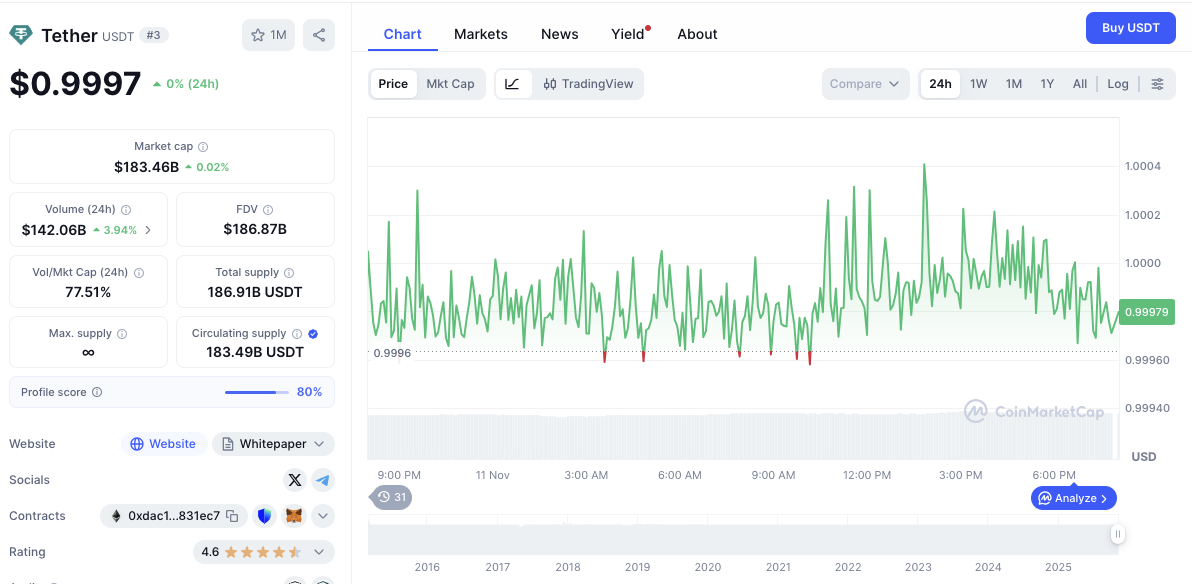
As of November 11, Tether (USDT) has a market cap exceeding $183 billion. According to CoinMarketCap, CEO Paolo Ardoino confirmed that stablecoin supply increased by $17 billion in Q3, with the company holding $6.5 billion in excess reserves. This robust growth demonstrates that even amid crypto market volatility, demand for USDT as a trading medium and hedge remains strong.
The $6.5 billion excess reserves provide ample buffer for Tether to handle potential large-scale redemptions or market shocks. These reserves also fund its increased gold procurement. Compared to the reserve ratio needed to fully back circulating USDT 1:1, excess reserves offer greater flexibility, allowing Tether to allocate a significant portion toward long-term appreciating assets like gold.
Strategic Considerations Behind Physical Asset Diversification
This strategic hiring reflects Tether’s plan to diversify its asset-liability structure, especially in the context of macroeconomic turbulence and sustained demand for tangible value storage. Tether currently holds one of the largest private gold reserves in the financial sector, giving it influence in the precious metals market.
Traditional stablecoins mainly rely on reserves composed of USD cash, short-term government bonds, and commercial paper. While liquid, this structure faces risks of purchasing power erosion in inflationary environments. Adding gold changes this single-currency reserve structure, providing a natural hedge against inflation and currency depreciation. When the dollar depreciates due to quantitative easing, gold prices tend to rise, preserving the real value of reserves.
Poaching top metals traders from HSBC indicates that Tether not only aims to hold gold but also actively manages and trades these assets. A professional trading team can employ strategies such as futures hedging, spot arbitrage, and inventory optimization to maintain reserve safety while enhancing asset returns. This shift from passive holding to active management marks Tether’s evolution from a simple stablecoin issuer to a comprehensive digital and physical asset management company.
In the coming months, with the official addition of Vincent Domien and Matthew O’Neill, Tether’s gold operations may expand further. New gold-backed financial products could include yield-generating gold tokens, gold lending platforms, or hybrid products linked to other physical assets. These innovations will further blur the lines between traditional finance and cryptocurrencies, offering investors more diversified asset allocation options.
Related Articles
Tether CEO Paolo Ardoino Highlights USDT’s Broad Global User Base
Tether CEO Paolo Ardoino highlighted USDT's strength in having a low sender concentration, with the largest sender accounting for under 5% of volume, which contrasts with other stablecoins at 23%. USDT serves over 550 million users, promoting financial access in emerging markets.
CryptoFrontNews5h ago
USDT Manipulation Case Upgraded! Tether and Bitfinex Collective Lawsuit Approved by New York Court
The U.S. court partially approved the class-action lawsuit against Tether and Bitfinex, narrowing the scope of plaintiffs to include investors who purchased crypto commodity futures between 2017 and 2019. The core allegations of the case involve the manipulation of the market through USDT that was not fully backed by reserves, resulting in investor losses. This class-action lawsuit is still ongoing and will strengthen the plaintiffs' bargaining position.
MarketWhisper19h ago
Tether CEO Frames USDT As a “Digital Dollar for the People” After New Concentration Data
Paolo Ardoino, the CEO of Tether, went on X today with a short, proud message: USDT, he wrote, “is unique.” He backed that claim with a single, sharp statistic: over the past year, the biggest sender of USDT accounted for less than 5% of all USD send volume, while for other stablecoins, one
BlockChainReporter20h ago
Tether USDT Powers 550M Users Across Emerging Markets, Says CEO
Tether's USDT leads the stablecoin market with over 550 million users and widespread transaction distribution. Strategic partnerships and increased liquidity drive global adoption, but regulatory challenges in South Korea hinder local access.
CryptoFrontNews03-08 23:41
USDC tops Tether as stablecoin transfers hit all-time high $1.8T
Stablecoins are delivering a liquidity surge unseen in recent cycles, with February marking a record on-chain transfer activity and signaling a shift in how capital moves through crypto markets. Allium’s data shows total stablecoin transfers climbed to $1.8 trillion in February, underscoring a
CryptoBreaking03-08 12:00
Tether CEO: USDT has served over 550 million users in emerging markets worldwide, with the largest individual sender accounting for less than 5%
Tether CEO Paolo Ardoino announced that, among the total USDT sent over the past 12 months, the largest individual sender accounts for 4.97%, significantly lower than the 23.34% seen in other stablecoins. He pointed out that USDT primarily serves populations overlooked by traditional finance, with over 550 million users in emerging markets worldwide currently relying on USDT.
GateNews03-08 09:35


